
20 murder cases filed over police deaths during July-August uprising
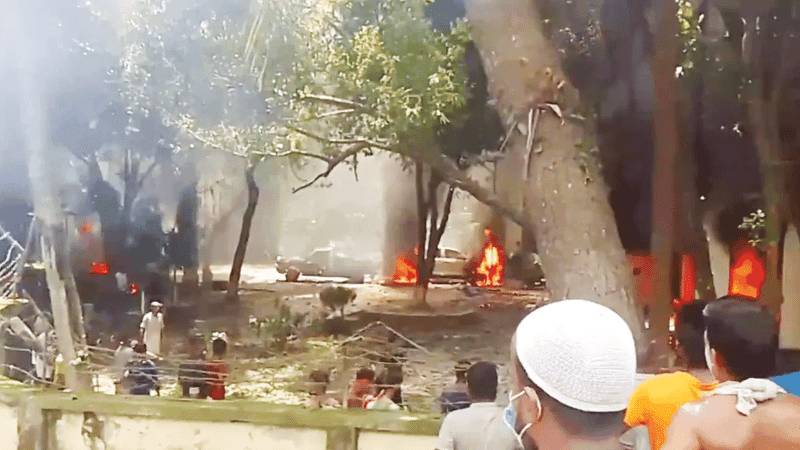

Twenty murder cases filed over the deaths of 44 police personnel during the violence that accompanied the Anti-Discrimination Student Movement in July and August 2024 have effectively remained dormant for more than a year.
Although the victims' families filed the cases at police stations across the country last year, the police did not publicly disclose the matter.
Officials concerned say the cases were recorded to ease discontent within the force, formally document the deaths of the officers, and preserve an official record to counter future misinformation.
According to Police Headquarters, 44 police personnel were killed in various incidents between 20 July and 14 August 2024. Among the victims were three Inspectors, eleven Sub-Inspectors (SIs), seven Assistant Sub-Inspectors (ASIs), and twenty-three personnel holding the ranks of ATSI, Naik, and Constable.
Several police officials said the incidents were brought under criminal investigation following demands by police personnel who had gathered at Rajarbagh. They also alleged that fugitive leaders and activists of the Awami League had circulated misleading information regarding the number of police personnel killed. As a result, the cases were filed to preserve accurate records and to meet possible future legal requirements.
In October 2024, Police Headquarters published, for the first time, a complete list of the 44 police personnel who had been killed. At the time, the Chief Adviser's Office stated that inaccurate and misleading information regarding police deaths during the July–August mass uprising was being circulated through various platforms. It therefore released a government-verified list and invited anyone claiming additional casualties outside the list to provide supporting evidence.
Subsequently, on 15 January, the Advisory Council approved the July Mass Uprising Protection and Accountability Ordinance. Under the ordinance, individuals who participated in the July–August political resistance aimed at overthrowing the authoritarian government and restoring democracy are granted legal protection for actions committed during the uprising. Consequently, many criminal cases related to that period have either been withdrawn or face legal restrictions on the filing of new cases. However, murders committed out of personal greed, revenge, or other narrow personal interests remain outside the scope of this legal immunity.
The deadliest day was 5 August, when attacks, arson, and violence targeting police stations and police installations across the country resulted in the deaths of 24 police personnel—the highest single-day death toll in the history of the Bangladesh Police.
The previous day, 4 August, an attack on Enayetpur Police Station in Sirajganj claimed the lives of 15 police personnel, including the Officer-in-Charge (OC), several Sub-Inspectors, one Assistant Sub-Inspector, and a number of Constables.
According to law enforcement officials, this was the first time in the history of independent Bangladesh that such a large number of police personnel had been killed in an attack on a single police station.
According to information published by Police Headquarters, the deceased officers served with the Dhaka Metropolitan Police (DMP), Enayetpur Police Station in Sirajganj, Sonaimuri Police Station in Noakhali, Titas Police Station in Cumilla, Kachua Police Station in Chandpur, Baniachang Police Station in Habiganj, Kasba Police Station in Brahmanbaria, the Special Branch (SB), the Police Bureau of Investigation (PBI), the Highway Police, the Tourist Police, the Khulna and Gazipur Metropolitan Police, and the Dhaka District Police. The published list also includes each member's place of posting, district, date of death, and location of the incident, providing an official account of the losses suffered by the police force during that period.
According to the Police Headquarters list, the 44 police personnel who lost their lives were: Inspectors Rashedul Islam, Md. Abdur Razzak, and Masud Parvez Bhuiyan; Sub-Inspectors Sujan Chandra Dey, Khagendra Chandra Sarkar, Rezaul Karim, Mamunur Rashid Sarkar, Bashir Uddin, Rais Uddin Khan, Tahsenuzzaman, Pranabesh Kumar Biswas, Md. Nazmul Hossain, Anisur Rahman Molla, and Santosh Chowdhury; Assistant Sub-Inspectors Sanjoy Kumar Das, Firoz Hossain, Sohel Rana, Raju Ahmed, Obaidur Rahman, Rafiqul Islam, and Md. Muktadir; ATSI Ali Hossain Chowdhury; Naik Gias Uddin; and Constables Abdul Majid, Rezaul Karim, Mahfuzur Rahman, Shahidul Alam, Abu Hasnat Rony, Mir Montaz Ali, Suman Kumar Gharami, Abdul Malek, Moinuddin Liton, Mohammad Ibrahim, Md. Abdus Salek, Md. Hafizul Islam, Md. Robiul Alam Shah, Md. Humayun Kabir, Md. Ariful Azam, Md. Riazul Islam, Md. Shahin Uddin, Md. Hanif Ali, Ershad Ali, Sujan Mia, and Khalilur Rahman.
Police officials say the list is significant not only because it identifies the deceased personnel but also because it will serve as an authoritative record for future investigations, compensation claims, the provision of benefits to the victims' families, and as an official state document recording the losses suffered by the Bangladesh Police during the July–August violence.
Leave A Comment