
38-years of legal battle for land that goes under water 27 years ago
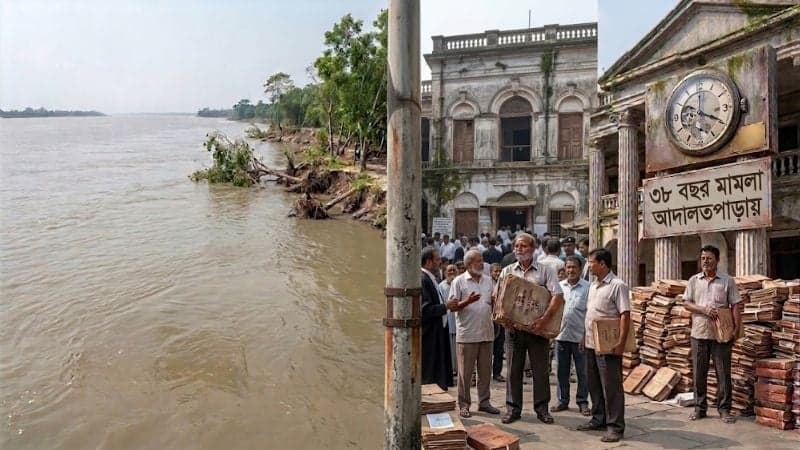

Once, there was a piece of land there. There was the smell of earth, dreams of crops, boundary ridges, and claims of possession and ownership. There were plans for the future, too. Each decimal of land was worth approximately Tk 2,000. The total value of the eight decimals was Tk 16,000.
Today, that land is gone. There is no trace of it on the surface, no boundary, and no visible evidence of possession. In 1999, the eight-decimal plot in Ratanpur mouza, Vidyanandapur Union, Mehendiganj upazila of Barishal, was swallowed by the Lata River, a branch of the Meghna, as river erosion took its toll.
But while the land disappeared, the claim to its ownership did not. Nor did the lawsuit over that claim come to an end. Nearly 27 years after the land vanished beneath the river, the legal battle over its ownership is still continuing. And 38 years have passed since the case was first filed.
The two cousins whose dispute gave rise to the case are no longer alive. Plaintiff Sattar Howlader died in 2002. His cousin and the defendant in the case, Jamin Uddin Howlader, died in 2008. Yet their deaths did not bring the case to an end. Instead, their children are now carrying on the litigation.
The dispute concerns eight decimals of land under Dag No. 22 of Khatian No. 36 in Ratanpur mouza. The J.L. (Jurisdiction List) number of the land is 27. In 1988, Sattar Howlader filed a case in a Barishal court over the eight decimals, claiming that the land belonged to him. His cousin Jamin Uddin Howlader, who was in possession of the property, was named as the defendant.
At the time, each decimal of land was worth around Tk 2,000. The eight decimals were therefore worth Tk 16,000. Although the amount may seem insignificant today, the land was then an important family asset—linked to inheritance, the future and financial security.
No one imagined that a lawsuit over land worth Tk 16,000 would one day become a 38-year-old legal saga. No one imagined that the age of the case would eventually exceed the physical existence of the land itself. And no one imagined that the very land for which they had gone to court would one day disappear into a river.
That is exactly what happened in 1999. The eight decimals in Ratanpur mouza were swallowed by the Lata River as erosion carried the land away. Where the land once stood, there is now river water. There are no boundaries and no visible signs of possession. Yet in the court records, the land is still alive—with its ownership disputed and the claims and litigation continuing.
Even after the land disappeared, the two original parties were still alive. But time did not spare them either. Plaintiff Sattar Howlader died in 2002. Six years later, in 2008, defendant Jamin Uddin Howlader also died. Their children subsequently took over the case.
Ali Akbar Howlader, the eldest son of Sattar Howlader, is now 60. Kabir Howlader, the second son of Jamin Uddin Howlader, is 55. When the case began, they were children and teenagers. Today, they are the heirs to the lawsuit their fathers started. Several decades of their lives have passed, and age has left its marks on their bodies. But the case bears no such mark. It continues much as it did before.
The case is currently pending before a civil bench of the High Court. It has been before the High Court for nearly a decade.
Speaking to Views Bangladesh about the prolonged litigation, High Court lawyer Barrister Biplab Hossain said, “The case is very old and has been pending in the High Court for around 10 years. I have tried to explain to both sides—how much longer will you continue a case over such a small piece of land? On top of that, the land is now beneath the river. But neither side is willing to back down. I am hopeful that a verdict may come this year.”
Barrister Biplab Hossain said the two sides have even told him that, if necessary, the case could continue for many more years even after they themselves die—until a char emerges from the river and the land resurfaces.
For Ali Akbar Howlader, the heir to the plaintiff's claim, this is not merely a matter of eight decimals of land. To him, it is about his father's property and his family's rights.
Ali Akbar said that approximately Tk 500,000 has been spent on the case over the past 38 years. Yet he is unwilling to abandon it. In his words, no matter how much money is spent, neither he nor the generations after him will give up the land. The case will continue until they get what they believe is rightfully theirs.
The position of Kabir Howlader, heir to the defendant's claim, is the same. He maintains that the land belonged to his father. His family has also spent several lakh taka pursuing the case. They, too, want to continue fighting until the end.
In other words, the land is gone, but the claim remains. The boundaries are gone, but the dispute over ownership remains. The two original claimants are gone, but their children continue the battle. Their next generation, too, has indicated that they are prepared to carry on the fight if necessary.
The case over these eight decimals in Ratanpur may be an extraordinary example of the delays surrounding land litigation in Bangladesh, but prolonged land disputes are nothing new. Disputes over ownership, possession, khatians, mutation, deeds, inheritance or boundaries can continue for years once they reach the courts.
As of 31 March 2026, a total of 4,639,476 cases were pending in courts across the country. Of these, 1,813,263 were civil cases. The number of pending civil cases in subordinate courts alone stood at 1,690,443. At the end of the 2024–25 financial year, 281,659 land-related cases were pending in courts across the country, according to Land Minister Mizanur Rahman Minu.
Explaining why land cases take so long, Barrister Badruddoza Badal told Views Bangladesh, “There are complexities involving land ownership, possession, khatians, mutation and deeds. Multiple parties may make claims over the same piece of land. After a ruling by a lower court, there are opportunities for appeal, revision and proceedings before higher courts, which can prolong litigation. The absence of witnesses, verification of documents, investigations and adjournments of hearings also add to the delay. When this is combined with the enormous caseload of the courts, cases can take a long time to resolve. In many instances, the parties continue litigating for years instead of reaching a settlement or pursuing alternative dispute resolution.”
Retired High Court judge Abu Tariq also considers land documents and ownership histories to be major causes of prolonged land litigation. He told Views Bangladesh, “Cases arise from multiple deeds relating to the same land, inconsistencies in khatians, inheritance disputes and problems concerning possession. When multiple parties become involved in a case, the process of hearing and taking evidence becomes longer. The sheer number of cases in the courts is also a major factor. Parties often exercise their rights to appeal or seek revision. Even when there is an opportunity for settlement, many do not take it. As a result, a land case can pass from one generation to another.”
The story of the eight decimals in Ratanpur appears to be an extreme example of precisely that reality.
The case began in 1988 over land worth Tk 16,000. In 1999, the river took the land away. The plaintiff died in 2002 and the defendant in 2008. Their children took over the case. And in 2026, the case is 38 years old.
Over those 38 years, people's lives, technology, communications and the economy have changed. Even the course of the river has changed. The only thing that has not changed is the question of ownership of those eight decimals recorded in the court documents.
So the question is not simply: Who owns the land?
The bigger question is: Why should it take longer than a person's lifetime to determine ownership of a piece of land? Why are people still fighting in court over land that disappeared beneath the river 27 years ago?
A river can carry away soil, erase boundaries and make a piece of land disappear from the visible world. But it cannot wash away a claim of ownership embedded in the human mind.
Perhaps one day the case will finally be decided. The court will determine whom the land belonged to. One side will find relief; the other will be disappointed. But 38 years will never return.
The two cousins who began the lawsuit did not live to see its verdict. The land at the centre of their dispute is now beneath the river.
The river has taken the land with its current. Time has taken the two original claimants. But the case continues in the hands of their heirs, in the court records and in the unwavering claims of the two families.
For now, there is only one reality: The land has been under the river for 27 years, while the lawsuit over it has been running through the courts for 38 years.
Leave A Comment