
A land of sea, hills and forests: What's holding our tourism back?
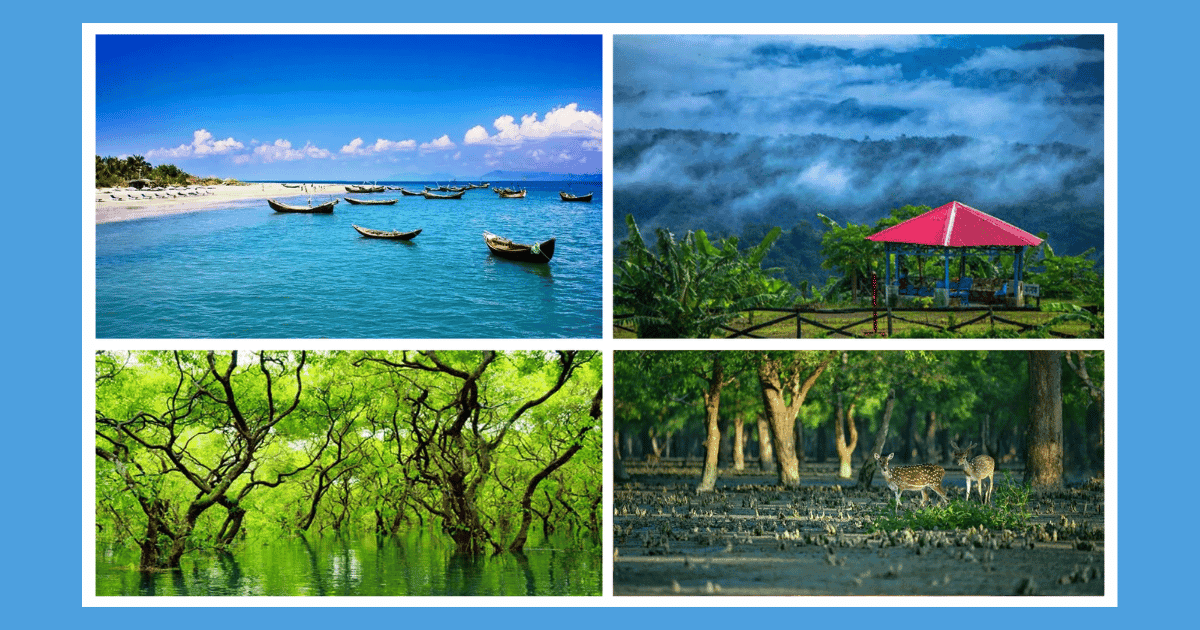

Bangladesh is like an unfinished poem written by nature's hand. Somewhere the blue waters of the Bay of Bengal, somewhere hills touching their heads to the clouds. Somewhere tiger footprints in the deep forests of the Sundarbans, somewhere the blue of the sky in the waters of the haor. Green carpets of tea, sails of boats on the bosom of rivers, ancient architecture, folk culture and diversity of taste—altogether, it is as if many Bangladeshes reside within one country.
Yet the story of that Bangladesh is still not heard loudly enough on the map of international tourism. Statistics also bear witness to that silence. According to Bangladesh Tourism Board data, 585,145 foreign visitors came to the country in 2025. In 2025, the number was 633,094, and in 2023 it was 655,451. In one year, foreign visitors decreased by 7.6 percent. Among them, visitors from India decreased by 26.1 percent. However, not all of this number are leisure tourists; foreign visitors of various categories, including businesspeople, are also among them.
Of course, the story of Bangladesh's tourism is not written only by foreigners. On Eid holidays, winter mornings or long vacations, crowds of people head to Cox's Bazar's sea beach, Saint Martin's blue waters, Sajek's clouds, Bandarban's hills, Sylhet's tea gardens or the Sundarbans. Domestic tourism is already a major economic activity. But the biggest question lies in the place of turning that tide into a planned, sustainable and internationally standard tourism industry.
September 27 is World Tourism Day. This year's theme is 'Digital Agenda and Artificial Intelligence to Redesign Tourism'. While the world is rushing towards artificial intelligence, digital booking, virtual tours and smart tourism, Bangladesh has still not been able to fully open the door to its nature.
Why is it lagging despite being a country of so much beauty?
First, the delay in planning. The tourism master plan seems to be walking on paper for years. After the plan that began in 2019 got stuck in various administrative complexities, efforts are now underway again to finalise it. A total of 1,498 tourism resources were identified in the plan. A target was also set to attract 55.7 lakh foreign tourists annually by 2041.
In other words, Bangladesh's crisis is not the lack of destinations; the crisis is the lack of an integrated system to turn destinations into planned tourism products.
Second, publicity to introduce Bangladesh to the world is weak. Long-term marketing is needed to create a country's identity in the international tourism market. Yet in the 2024-25 fiscal year, the Bangladesh Tourism Board's allocation for international branding and publicity was only Tk 7.5 crore. The board also had only 43 permanent staff, along with nine outsourced workers.
The tiger of the Sundarbans, the sunset of Cox's Bazar, the clouds of the hills or the tea gardens of Sylhet—these scenes, familiar to the country's people, are therefore still largely unknown in the eyes of world tourists.
Third, infrastructure has not kept pace with beauty. A place does not become a tourist destination just by being beautiful. One has to be able to go there easily, stay safely, eat comfortably and travel without worry. Cleanliness, quality accommodation, skilled guides, reliable communication and emergency medical care are needed.
The lack of these integrated facilities is still acute in many potential destinations in Bangladesh. As a result, even though nature beckons, the tourist's path is often stopped by the wall of management.
Fourth, not just the number of tourists, quality also matters. The tourism industry does not become prosperous just because foreign visitors arrive. The economic benefits of tourism also depend on how long they stayed, where they stayed, what they ate, what they bought, and whether they used local transport and guides.
Therefore, the goal should be not just 'more tourists'; rather, creating a tourism system where a tourist spends money on local hotels, restaurants, transport, handicrafts and services after coming to the country. Only then will the wave of tourism reach the homes of local people as well.
Fifth, nature itself must not be endangered by the pressure of tourism. Nature is Bangladesh's biggest tourism asset; yet nature is also the biggest risk of unplanned tourism.
Saint Martin is its warning bell. A 2025 study found that the island's developed area increased by 2.52 percent between 2018 and 2024. The same study revealed that the degradation of coral reefs reached nearly 25 percent between 2015 and 2022. Researchers have linked unplanned tourism and development to the island's environmental risks.
In other words, if the sea, hills, forests and corals are lost in the effort to increase tourists, then one day there will be no destination left for tourists.
Yet the window of possibility has not closed. The government is now talking about advancing an integrated master plan around 1,498 tourist attractions. There are also plans to give importance to eco-tourism, adventure, religious, cultural and heritage-based tourism.
Bangladesh therefore has two paths before it—making nature merely an object of display, or building a new tourism economy while saving nature.
Digital technology can make that path easier. If destination, travel, hotel, guide, tickets, security and local experience all come within the palm of the hand on one platform, then unknown Bangladesh can also become easily accessible. Ultimately, Bangladesh's tourism crisis is not of beauty; it is of the system to properly present beauty, preserve it and connect it with the economy. There is sea, but there are thorns on the path. There are hills, but there is a lack of infrastructure. There are forests, but there are questions of conservation. There is history, but there is little arrangement for telling the story on the world stage.
So on World Tourism Day, the question is not just how much beauty Bangladesh has. The question is—nature has left the door open; can we build the path to reach that door?
Leave A Comment