

Female Leadership in Islam
A Response to Jamaat Ameer Shafiqur Rahman’s Views on Women’s Political Role
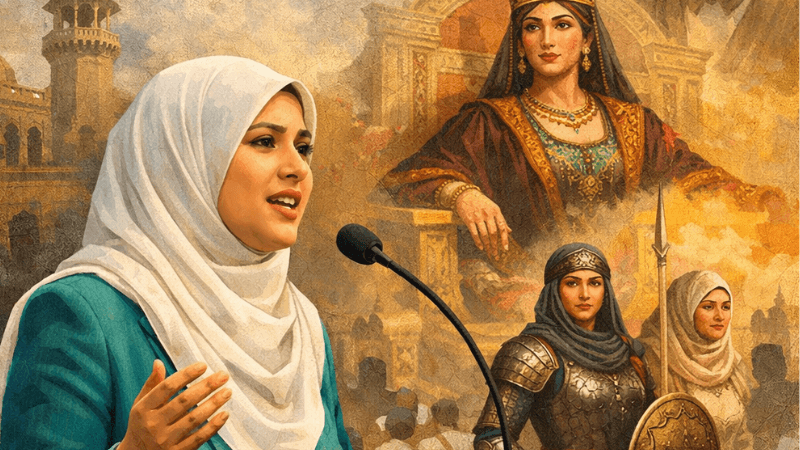

The Ameer of Bangladesh Jamaat-e Islami, Mr. Shafiqur Rahman, has categorically declared that no woman can ever occupy the party’s highest leadership position. In an extended interview with Al Jazeera, he justified this stance by appealing to what he termed “God-given biological differences” (interview with Al Jazeera, 29 January 2026). Yet such a claim, delivered with finality, raises serious theological, hermeneutical, and ethical concerns within the Islamic tradition. Before addressing Mr. Rahman’s assertion directly, it is necessary to return to the Qur’anic hermeneutics that underlie debates on women’s political leadership in Islam.
Islamic interpretive tradition has never claimed singular or absolute authority in understanding divine revelation. Early Muslim scholars frequently acknowledged the provisional nature of their opinion, often concluding with the caveat that while their reasoning reflected their best understanding, ultimate knowledge rests with God alone (El Fadl 2001, 10). Mr. Rahman’s pronouncement departs sharply from this tradition of epistemic humility. He neither cites Qur’anic evidence prohibiting women’s political leadership nor acknowledges alternative interpretive possibilities, instead presenting his view as conclusive and divinely sanctioned.
The Qur’an itself offers no support for such categorical exclusions. It affirms that God directly created Adam and breathed His/Her spirit into him (15:29), but it does not state that Adam’s wife—popularly known among most Muslims as Hawwa—was created from Adam’s rib. Rather, the Qur’an repeatedly emphasizes that humanity was created from a single nafs (self or soul), from which its mate was created, and from the two spread countless men and women (4:1; see also 6:98; 7:189; 39:6). This ontological unity undermines any claim of inherent gender hierarchy.
Likewise, the Qur’an does not portray Hawwa as the instigator of Adam’s disobedience. Instead, both Adam and his spouse are depicted as victims of Satan’s deception (7:20–22; 20:120–121). Notably, Satan is said to have whispered directly to Adam (20:120), and responsibility for the transgression is shared equally. Nowhere does the Qur’an assert the moral, intellectual, or ontological superiority of one sex over the other, despite the chronological sequence of creation.
However, early Qur’anic exegesis often incorporated Judeo-Christian narratives that reshaped Muslim understandings of gender relations. Figures such as Adam and Hawwa, Joseph/Yusuf and Zulaikha, and Solomon/Sulaiman and Bilqis were frequently interpreted through lenses borrowed from biblical lore. Al-Tabari (d. 923), for example, drawing on reports attributed to Ibn ‘Abbas, Ibn Mas‘ud, and others, narrates that Hawwa was created from Adam’s rib—a claim absent from the Qur’an and reflective of biblical influence (Ayoub 1984, 82). Further reports, attributed to Jewish converts such as Wahb ibn Munabbih, portray Hawwa as the primary agent of the fall, suggesting that she first succumbed to Satan and then persuaded Adam to follow (Ayoub 1984, 83–84, also see Genesis 3:12-13). These narratives also associate menstruation and childbirth pain with divine punishment (see Genesis 3:16), despite the Qur’an’s silence on such claims.
The social and political implications of these exegetical interpolations have been profound. They cast women as morally deceptive, intellectually deficient, and ontologically derivative, thereby legitimizing unequal gender relations. By attributing the primal fall to Hawwa, women were rendered perpetual bearers of guilt and divine curse. As Barbara Stowasser observes, these interpretations became doctrinal tools for asserting women’s inferior moral and rational capacities (1994, 34).
A similar pattern emerges in the interpretation of the story of Zulaikha. Medieval commentators frequently portrayed her as the embodiment of unrestrained female desire, reducing femininity itself to seduction and guile. Although the Qur’an narrates a reciprocal dynamic between Yusuf and Zulaikha (12:23–35). Later exegesis generalized her actions to all women, fostering mistrust of the female sex (Bouhdiba 1985, 26). Scholars such as Al-Baydawi extended this characterization, contributing to what some have described as the literary roots of Muslim misogyny (Barlas 2002, 218).
In contrast, the Qur’anic portrayal of Bilqis, the Queen of Sheba, presents a striking affirmation of female political agency. Chapter 27 depicts her as intelligent, deliberative, and sovereign. Extra-Qur’anic traditions further describe her as an effective ruler who successfully governed her kingdom. Yet medieval exegetes devoted remarkably little attention to her leadership. Scholars such as Ibn Kathir focused more on the historical plausibility of related legends than on Bilqis herself. As Stowasser argues, Bilqis’s competence and autonomy conflicted with prevailing male elite perceptions of female authority, rendering her an uncomfortable anomaly within classical discourse (1994, 65).
Some early scholars also associated supposedly superior attributes such as reason (‘aql) and spirit (ruḥ) with men, while linking passion, desire, or the carnal soul (nafs) with women. However, some Sufis related women to the concept of nafs in a positive sense (see Schimmel 1979, p. 124). Several scholars argue that the Qur’an scarcely articulates any spirit–soul (ruḥ–nafs) dualism, nor does it endorse a distinction between mind and body. Rather, such dualistic frameworks have been traced to Neoplatonic origins. As Fazlur Rahman (1980) argues, the term nafs, often translated as “soul,” more accurately denotes the person or self. In the Qur’anic usage, nafs most often refers to tendencies of human personality and mental states. These mental states, however, should not be understood as the mind conceived as a separate substance. Despite this, within certain discourses women were portrayed as passionate beings driven by carnal desire, appetite, and animal instinct, while men were represented as higher, superior, and intellectual beings.
Fatna A. Sabbah contends that such discourses were intended to subjugate women. “Reason and desire are connected in a power relationship, and any strengthening of one implies the weakening of the other,” she asserts (1984, p. 112). Although Sabbah does not develop a systematic theoretical framework and does not sufficiently consider the sociopolitical and historical contexts of the medieval texts she examines, some of her observations remain valuable. She cites medieval jurists and Qur’anic commentators who argued that, without the triumph of reason over desire, men cannot fully cultivate their rational capacities. One such jurist and Qur’an commentator is Abu al-Faraj ʿAbd al-Raḥman ibn al-Jawzi (d. 1200). In his work Dhamm al-hawa (Condemnation of Desire), Ibn al-Jawzi describes the tension between reason and desire, assigning reason to men and desire to women. Similarly, the jurist and Qur’an commentator Ibn Qayyim al-Jawziyya (d. 1350), in Rawḍat al-muḥibbin wa-nuzhat al-mushtaqin (The Meadow of Lovers and the Diversion of the Infatuated), depicts desire as polluting and distracting. He observes that Satan aligns himself with women when seeking to lead individuals into despair. Women, construed as embodiments of desire, are thus portrayed as distractions to men’s rational endeavors. This view, widely held in medieval discourse, served to justify the control and subjugation of women (Sabbah 1984, p. 113), which does not match with the following verse of the Qur’an (33:35): “For Muslim men and women – for believing men and women, for devout men and women, for true men and women, for men and women who are patient and constant, for men and women who humble themselves, for men and women who give in charity, for men and women who fast (and deny themselves), for men and women who guard their chastity, and for men and women who engage much in Allah’s praise – for them has Allah prepared forgiveness and great reward” (trans. Abdullah Yusuf Ali).
Regarding women’s leadership, it has been argued that women are unfit for leadership positions on the grounds that Islamic leaders are assumed to lead communal prayers, and that women cannot lead men in prayer (Mernissi 1993, p. 32). Fatima Mernissi notes that this argument rests on two assumptions: first, that political or social leaders are obligated to lead prayer; and second, that women are categorically prohibited from leading men in prayer (1993, p. 32). Beyond the concept of ʿawra, women’s religious and political leadership has also been tied to the notion of walaya—authority and sovereignty—which classical fuqaha and ʿulama largely denied to women (Calderini 2009, pp. 9–10). Amina Wadud challenged traditional interpretations of women’s leadership in congregational prayer and, in 2005, led a mixed-gender congregational prayer on March 18. Mernissi and others further argue that the Qur’an does not prohibit women from holding leadership positions; rather, it includes affirmations of female leadership, most notably in the example of the Queen of Sheba.
Historical evidence from both the Prophet Muhammad’s (upon whom be peace) era and the period following it further demonstrates that women participated in leadership roles, including leading battles and holding public office (Engineer 1992; Mernissi 1993; Wadud 1999; Hashmi 2000; El Fadl 2001). Consequently, many scholars maintain that there is no explicit Qur’anic prohibition against women’s leadership. The frequently cited hadith used to prohibit women’s leadership (Sahih al-Bukhari, vol. 5, book 59, no. 709) is the following: “Narrated Abu Bakra: During the days of the Battle of al-Jamal, Allah benefited me with a word I had heard from the Messenger of Allah when I was about to join the Companions of al-Jamal and fight alongside them. When the Messenger of Allah was informed that the Persians had appointed the daughter of Khosrau as their ruler, he said, ‘A people who entrust their affairs to a woman will never prosper.’”
Mernissi questions the authenticity of this Prophetic statement, even though it is recorded in one of the most authoritative canonical compilations, Sahiiḥ al-Bukhari. She raises serious doubts about the moral character of the hadith’s narrator. According to the methodological standards developed by hadith collectors such as Imam al-Bukhari, the narrator in question would not qualify as trustworthy, as he was known to have given false testimony against a fellow Muslim—an offense for which the caliph ʿUmar reportedly sought to have him flogged (1991 [1987], p. 60). By the criteria established in hadith criticism, Mernissi argues that this report should therefore be classified as majʿul (fabricated), given the questionable integrity of its narrator and the weakness of its chain of transmission (see also Brown 2009, p. 249).
Despite these concerns, both Imam al-Bukhari and Imam Muslim included this report in their respective sahih collections, and jurists from all major madhahib have relied on it as a key textual authority in arguments against women’s leadership in the public sphere. Another Prophetic tradition frequently cited in this context (Saḥiḥ al-Bukhari, vol. 1, book 6, no. 301) asserts that women are deficient in both intellect and religion. This claim is typically linked to women’s exemption from ritual prayer and fasting during menstruation and postpartum bleeding—periods that jurists have argued diminish women’s capacity for judgment.
Drawing on these hadiths alongside Qur’anic verses 2:228 and 4:34, most jurists have maintained that God favors one sex over the other and grants men a degree of authority over women. On this basis, they argue that it is unlawful for women to hold public office, since such positions could place women in authority over men (see an-Naʿim 1990, pp. 87–88; 2008, p. 109; Mernissi 1991, pp. 152–53).
However, historical evidence undermines claims of such prohibition. During and after the Prophet Muhammad’s lifetime, women participated in public decision-making, led military engagements, and held positions of authority (Engineer 1992; Wadud 1999; El Fadl 2001). No Qur’anic verse explicitly forbids women from holding public office.
The Qur’an affirms only a vertical relationship between God and human beings. The relationship among human beings—women and men—is horizontal, more precisely one of mutual reciprocity, as Amina Wadud argues. The only hadith cited to prohibit women from holding political office is of questionable authenticity. The so-called authority, Mr. Shafiqur Rahman—who is not a member of the Muslim scholarly community but a medical professional and therefore lacks the requisite qualifications—cannot legitimately claim doctrinal finality on this issue. What he has articulated is merely his personal, or his party’s, understanding of Islam regarding female leadership, which does not represent the legal, theological, or philosophical traditions of Islam. Nor should one forget Jamaat’s historical treatment of women in 1971, shaped by its own perceptions of women.
Sarwar Alam, George Mason University, USA (salam25@gmu.edu)
Leave A Comment
You need login first to leave a comment