
Afghan women can't file abuse complaints without husband’s permission
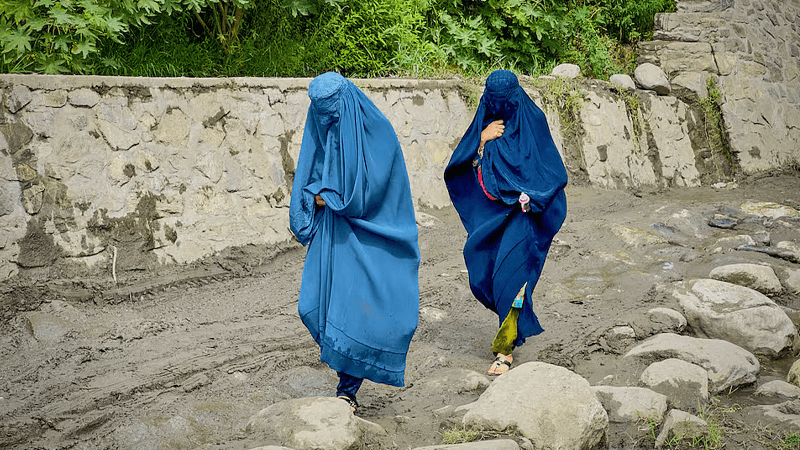

The new penal code published by the Taliban government in Afghanistan has raised serious concerns in the international community. A report by the British newspaper The Independent said that various sections of the new law have further narrowed the path for women to get justice.
It has been reported that the husband's permission has been added to file complaints of physical abuse against their husbands.
The 90-page new penal code, De Mahakumu Jazai Usulnama, signed by the Taliban's supreme leader Hibatullah Akhundzada, has been distributed to the country's courts. An analysis of the documents obtained by The Independent said that it has incorporated old harsh practices into the legal framework and divided society into strata.
The report mentioned that the new law takes social status into account in determining the punishment for crimes. Society has been divided into four levels - religious leaders or mullahs at the top; in their case, only advice or advice is provided as punishment.
The second class is for the elite; the highest punishment is a court summons or a summons.
The third class is for the middle class; imprisonment.
In the case of the lower class or working class, prison sentences are provided for, along with physical punishment or flogging.
Human rights activists claim that the new penal code treats women and slaves almost on the same level. It states that husbands can beat their wives under the punishment of ‘tajir’ if they want. According to critics, this has practically institutionalized domestic violence.
While the punishment for abusing women during the NATO-backed government was three months to one year in prison, the type of punishment has now changed. The report states that if a woman can prove that she was seriously injured, her husband can get a maximum of 15 days in prison.
According to the law, if a woman wants to file a complaint of abuse, she must show proof of her injuries to a judge and maintain a strict veil at the same time—which critics say is almost impossible in practice. Additionally, if she needs to go to court, she must obtain her husband’s permission and be accompanied by her husband or another male mahram. In most cases, the accused is the husband himself, which has effectively closed the way for complaints.
A legal advisor in Kabul, who spoke on condition of anonymity, said that a woman was humiliated by a Taliban guard when she went to visit her husband in prison. Later, when she went to seek justice, she was asked to bring a mahram, even though her only mahram, her husband, was in prison at the time.
Article 34 of the new penal code states that if a woman repeatedly goes to her father's house or a relative's house without her husband's permission and does not return despite her husband's request, she and her host family will be sentenced to three months in prison. Human rights organizations say that this has also narrowed the ways for abused women to seek refuge.
Human rights organizations allege that the Taliban have announced that discussing or criticizing this penal code will also be considered a crime. As a result, many people inside the country do not dare to speak out and reveal their identities due to the atmosphere of fear. Source: The Independent, AFP
Leave A Comment
You need login first to leave a comment