
AI can plan your trip—but should you trust it completely?
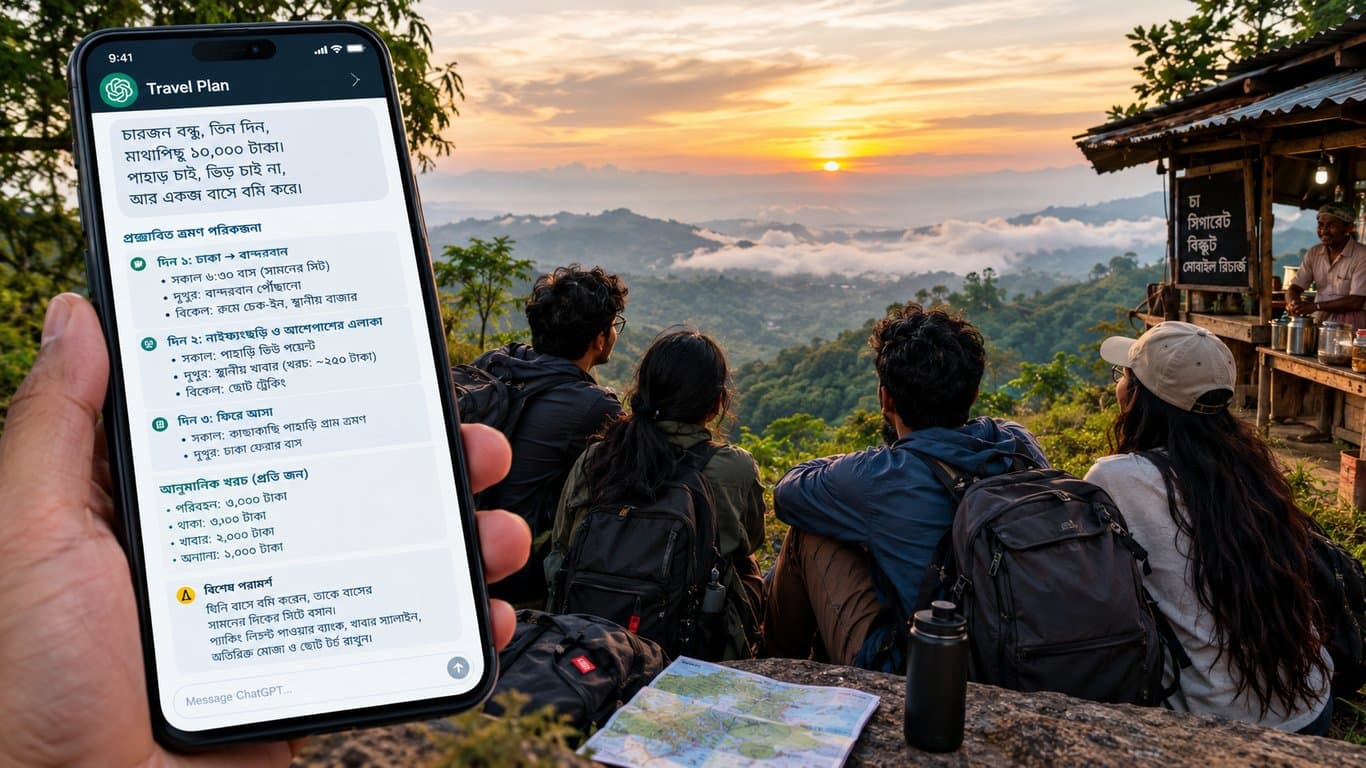

It is 1am. Three browser tabs, two travel groups and dozens of unread messages have failed to answer one simple question: where should four friends go for their next holiday?
Then an AI chatbot gets the job. Four friends, three days, a Tk10,000 budget per person, a preference for hills over crowds—and one traveller who gets sick on buses. Within seconds, the chatbot produces a day-by-day itinerary, accommodation suggestions, food options, an estimated budget and even advice to put the motion-sick friend in a front seat.
For many travellers, this is no longer a novelty. AI is increasingly becoming the starting point for planning trips, from choosing destinations and building itineraries to preparing packing lists and translating useful phrases.
The shift is particularly relevant on World Tourism Day, observed on September 27. This year’s theme focuses on how digital technology and artificial intelligence are reshaping tourism.
AI can be remarkably useful when the task is to organise information. It can break down a trip by day, suggest what to pack, divide a budget into categories, list visa requirements and offer ideas based on a traveller’s preferences. It can also save hours of searching and comparing.
The problem begins when travellers treat its answers as current ground truth.
Hotel prices change. Bus schedules are revised. Roads become inaccessible. Tourist attractions close temporarily, permits are introduced and local conditions can change within hours. An AI system may respond confidently using information that is outdated, incomplete or simply wrong.
That can turn a carefully planned itinerary into an expensive detour. A hotel recommended as an affordable option may have changed ownership or doubled its rates. A waterfall described as being nearby could turn out to require an entire day’s journey.
There is another concern: visibility. As AI increasingly influences which destinations travellers discover, recommendations could also become shaped by commercial interests or the prominence of larger tourism brands. Small homestays and lesser-known local businesses may struggle to appear alongside heavily marketed destinations.
That does not mean travellers should abandon AI. The smarter approach is to use it as a planning assistant, not a final authority.
The more specific the prompt, the more useful the starting plan is likely to be. Travellers should provide the number of people, duration, budget, preferences, restrictions and any special needs. Once an itinerary is generated, they can ask the chatbot to identify which details need to be verified before departure.
Those details should then be checked through hotels, transport operators, government notices, official tourism websites and recent experiences shared by travellers. Reviews also deserve a critical eye, particularly when several appear unusually similar.
In the end, AI can draw the map, organise the options and save time. But some of the best parts of a journey still come from places no algorithm has recommended—and from people who know them better than any chatbot ever could.
Leave A Comment