
AI misuse could kill 1 billion people: Bill Gates
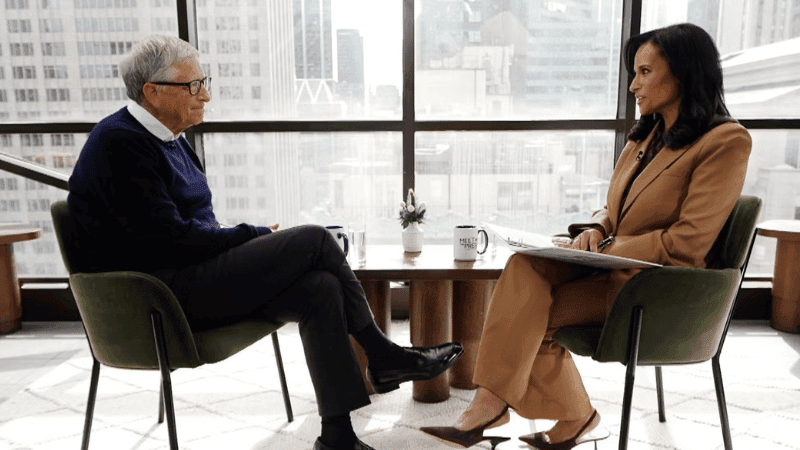

Microsoft co-founder Bill Gates has warned that misuse of artificial intelligence (AI) could lead to events killing 1 billion people. He said an emergency "kill switch" alone would not be enough to counter the risk, and that the technology's activity must be monitored and safeguards built into it.
In an interview on NBC's "Meet the Press" on Sunday, Gates said he was not opposed to a kill switch. However, he said that to curb harmful AI behaviour, there must be systems to monitor and keep records of what it is doing.
Gates singled out the risk of AI being used to carry out terrorist activity. He said the combination of the most advanced AI and people with malicious intent could produce weapons more powerful than anything seen before.
He said AI has the capacity to cause an event that could kill 1 billion people. Wiping out all of humanity would be difficult, he added, but the risk of AI being used for malicious ends remains extremely serious.
Gates also dismissed concerns that AI safety rules would slow the progress of US tech companies. Referring to the stance of US President Donald Trump, he said that while there were fears that regulating AI development could put the US behind China in the race, safety could not be ignored.
In Gates's view, active monitoring of AI models' behaviour in laboratories should be made mandatory, with a role for US lawmakers and law enforcement agencies. He said building international consensus on regulating AI could prove harder than the Cold War-era negotiations and treaties on nuclear arms control.
Among the immediate risks, Gates said, are malicious actors using AI to launch cyberattacks, scramble bank account data or shut down power grids. He said small groups can now use AI to do what only major states could once do.
He said governments must make various safeguards mandatory to prevent AI misuse, otherwise there is a risk of a major adverse event.
Trump has opposed federal government intervention in AI development. In a social media post earlier this month, he said the US was ahead of China and others in the AI race and would remain so.
Gates said the US has a long history of leading global consensus on safety standards. Citing past international agreements on aviation safety, environmental policy and nuclear arms control, he said humanity must work together on AI as well.
Concern about AI risks is also growing across the tech industry. Jacob Coxon, a former Anthropic employee, recently warned that the people building AI sincerely believe the technology could bring catastrophe for humanity before the decade is out.
Top tech executives, including Anthropic chief executive Dario Amodei and OpenAI chief executive Sam Altman, have also spoken of the need to manage the pace of AI development. In a blog post, Amodei wrote that leading companies should coordinate international safety standards while maintaining a competitive edge over China.
US lawmakers have likewise backed drawing up AI rules jointly with other countries. Ro Khanna, a Democratic representative from California, told NBC that Washington and Beijing should form a joint technical working group to assess AI risks.
Khanna said there should be a discussion about banning AI models capable of improving themselves. He said the US could lead an agreement that is enforceable and verifiable, with provisions for oversight of top AI labs.
Following a meeting between Trump and Chinese President Xi Jinping, the White House said the two countries had begun a working dialogue on assessing AI risks, and that further talks would follow.
In the interview, Gates also spoke about his past contact with convicted sex offender Jeffrey Epstein. He was asked about it after documents released by the Justice Department renewed discussion of their relationship.
Gates said Epstein had offered to help him raise hundreds of billions of dollars for global health, but the initiative ultimately failed
Leave A Comment