
Alternative tournament plan outside World Cup: Is FIFA facing a split?
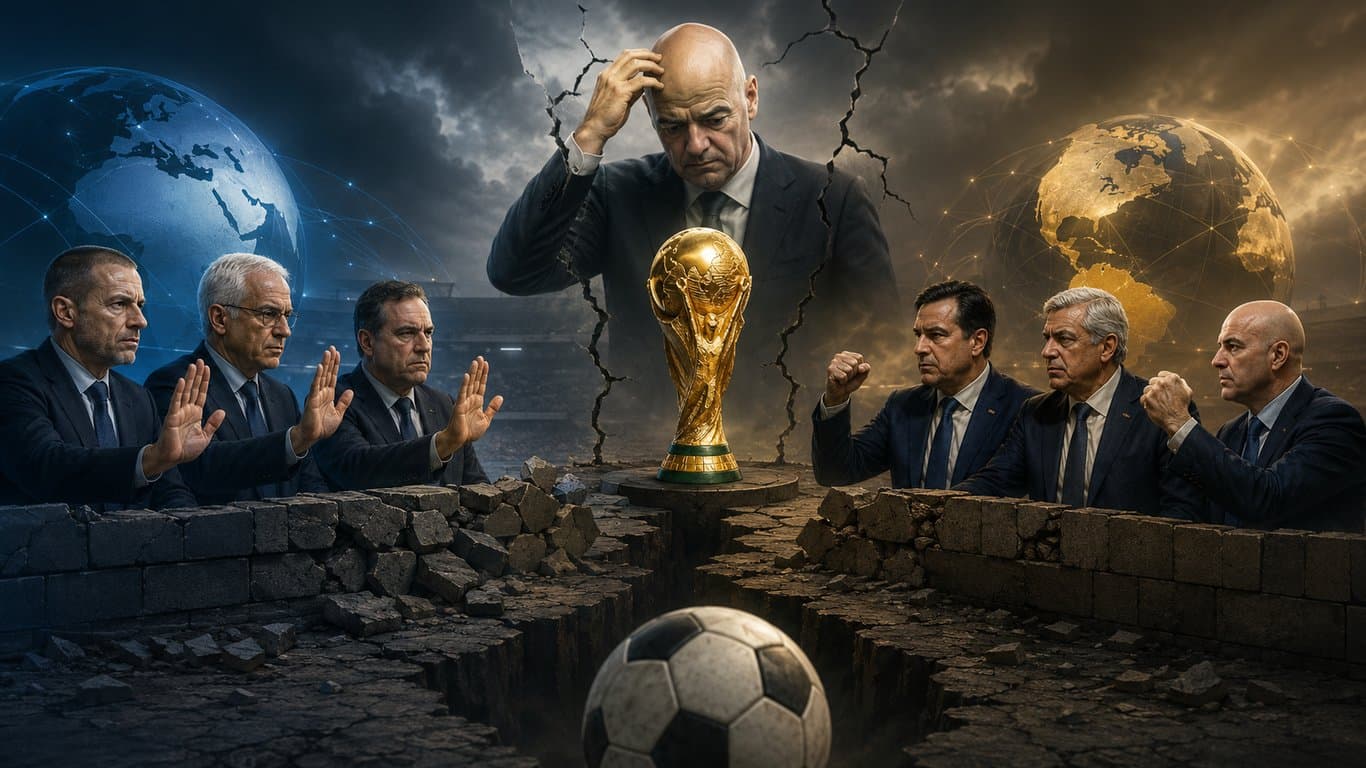

Rarely has world football witnessed a scene quite like this: FIFA’s president facing an open vote of no confidence from three of his own vice-presidents, with the dispute escalating to discussions about an alternative tournament to the World Cup.
Under Gianni Infantino’s leadership, a failed attempt to sell stakes in the commercial rights to FIFA competitions is no longer merely a dispute over a business decision. It has evolved into an open confrontation over power, trust and control of the global game. The heads of UEFA, the AFC and Concacaf have accused Infantino of breaching their trust through what they describe as a “deceptive” process and have raised the prospect of a change in leadership.
The biggest development, however, has come from elsewhere. If threats to boycott the World Cup become reality, the leaders of the three confederations have begun preliminary discussions about whether an alternative competition outside FIFA could be organised for international footballers. No name, format or participating teams have yet been decided. But the very fact that an alternative stage to football’s biggest international tournament is being discussed shows how deep the crisis inside FIFA has become.
The question is therefore no longer simply whether Infantino will remain in office. The bigger issue is whether the crisis of confidence surrounding his leadership is reaching a point where it could fracture the established structure of world football. If football’s three major continental powers were to move towards a World Cup boycott, the universality of the tournament—FIFA’s greatest asset—could face an unprecedented direct challenge.
The dispute began with an ambitious commercial plan by FIFA. When a proposal emerged to sell stakes in the commercial rights to the World Cup, it triggered a strong reaction in European football. UEFA’s 55 member associations held an emergency meeting and decided to boycott all FIFA competitions, including the World Cup.
Under mounting pressure, FIFA eventually withdrew the proposal, and Infantino formally apologised.
But the withdrawal did not heal the rift; instead, it developed into a much larger political crisis.
UEFA’s hard-line position has been backed by the Asian Football Confederation (AFC) and Concacaf, the football governing body for North, Central America and the Caribbean.
A joint letter was signed by UEFA president Aleksander Čeferin, AFC president Salman bin Ibrahim and Concacaf president Victor Montagliani—all three of whom are FIFA vice-presidents. At the heart of their concerns is one word: trust.
They allege that Infantino breached that trust during the process surrounding the proposed sale of stakes in the World Cup’s commercial rights.
Another significant aspect of the letter is the demand for an independent investigation. The three confederation leaders want an independent and impartial inquiry into how the abandoned commercial process was conducted, who was involved in the decision-making and what level of transparency was maintained.
The dispute, therefore, is no longer simply about differences in policy; questions are also being raised about the way the FIFA president makes major decisions.
Against this backdrop, the idea of an alternative tournament takes on even greater significance. If a World Cup boycott were to take place, footballers could potentially be left without an international competition.
It is reportedly to avoid such a scenario that alternative arrangements are being considered. The discussions, however, remain at a very early stage. There is no specific format or blueprint for a new competition yet, and the leaders involved are keeping all possible options open.
For Infantino, the biggest test may come at the FIFA Congress in March. A candidate needs 106 votes to be elected president by the 211 member associations. UEFA, AFC and Concacaf together represent 143 member associations. If all three confederations were to oppose Infantino, the electoral equation would become extremely difficult for him. The deadline for submitting presidential candidacies is 18 November.
Yet the numbers are not quite that simple. Each FIFA member association has one vote. Although UEFA controls 55 votes, the other five confederations together account for 156. The strength of European football on the pitch therefore does not automatically translate into a majority in FIFA’s electoral system.
To remove Infantino, UEFA would need to secure support from other confederations as well.
That is where Infantino retains significant leverage. At a recent meeting in Morocco, several senior FIFA officials expressed support for his leadership. The South American Football Confederation (CONMEBOL) and the Confederation of African Football (CAF) are also backing him. Argentina, Mexico, Paraguay, Qatar and Kuwait have personally pledged their support for Infantino.
There are therefore two battles unfolding—one over votes and the other over the future structure of world football.
Infantino is preparing for the fight to secure another term. On the other side, the football leaders of three continents are arguing that a crisis of trust cannot be resolved simply with an apology. If threats of a World Cup boycott become reality and discussions over an alternative tournament gather momentum, the crisis will no longer be about the FIFA presidency alone.
The question will then become much bigger: Is one World Cup enough for world football, or could the revolt against FIFA’s leadership ultimately give birth to another global stage?
For now, the answer remains unknown. But one thing is already clear: what is unfolding inside FIFA is not merely another administrative dispute. It could become one of the most consequential challenges to the structure of world football in the organisation’s history.
Leave A Comment