

International Day of persons with disabilities
An afternoon with CRP founder Valerie Ann Taylor
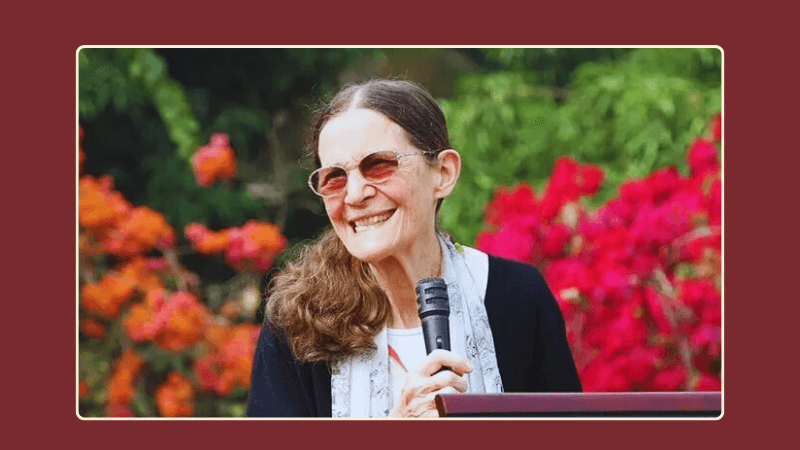

The International Day of Persons with Disabilities is being observed across the globe today (December 3). And, this is the best occasion to share my personal thought about my inspiration, Sister Valerie Ann Taylor. The story of Valerie Ann Taylor inspires all those who care for the distressed and the differently able.
Every person’s journey in life is different but some lives can become a shining example for others. A physiotherapist and philanthropist, Valerie Ann Taylor, is respected both at home and abroad for her outstanding contribution and services to society as well as the distressed humanity of Bangladesh. She has earned plaudits from people of all walks of life for dedicating her entire career to the people with disability as well as rehabilitating the paralyzed. In recognition of her noble work, Valerie was granted Bangladeshi citizenship in 1998.
I had the opportunity to spend an afternoon with the “Mother Theresa of Bangladesh" a few years ago. That moment came about in a very strange way which is a different story. But I can say this much, I sought her assistance while I was passing through a hard circumstance. She responded without a moment's delay to a call for help from a complete stranger like me. Thus, a field of conversation was created between us. One afternoon we sat face to face, and she shared her journey – the success, the struggles, and the satisfaction.
She had dedicated herself to the people with disabilities in Bangladesh and spend her entire life ensuring treatment for the paralyzed. I asked her about the story behind her choice. She told me: "First of all, I want to say, I fell in love with your beautiful country from the very moment I stepped into it and felt a desperate urge to do something for the paralyzed when I found that the patients suffering from spinal injuries were being treated with negligence at the Christian Hospital in Chattogram’s Chandraghona in 1969."
That time she came here with the Voluntary Service Overseas (VSO) to work as a physiotherapist and she really wanted to ease the sufferings of the helpless paralyzed. But she was then forced to leave Bangladesh during the Liberation War in 1971. Those patients left an unforgettable impression on her during her 15-month service in Chattogram and she decided to devote herself completely to the service of the paralyzed in Bangladesh, sister Valerie told me.
Asked about the establishment of the Centre for the Rehabilitation of the Paralysed (CRP), she said: "As I was concerned over the rehabilitation services for the people with disabilities in the country, I planned to build a rehabilitation center for the paralyzed and left for England to raise funds in 1973. I returned to Dhaka in 1975 with a very small amount of money which was not sufficient enough to set up the rehabilitation center. However, I did not lose hope and kept working on the project. It took another four years and CRP began its journey in 1979 from two cement storerooms in the grounds of the Shaheed Suhrawardy Medical College Hospital in Dhaka. Later in 1990, we managed to set up a permanent structure and moved to Savar. The current CRP-Savar occupies approximately 13 acres of land."
But that journey was not so smooth that time. She could recall the challenges she faced while building CRP. She said: "I am so happy now that finally, I managed to make my dream comes true, but the 21-year journey was not so easy. We faced a lot of challenges, especially raising funds for permanent land and setting up buildings. I along with some of my well-wishers did all this works step by step. It took almost two years to get approval from the Bangladesh
government to build the center and we got the initial funding from a number of sources, including globally renowned aid and development charity Oxfam."
She goes on: "Over time, CRP has become recognized as an internationally renowned organization that serves and rehabilitates people with disabilities."
At this stage of talking, sister paused for a moment and looked through the window. Several underprivileged children were seen enjoying pony ride in the field just outside the building. The joy on the faces of the kids evoked a positive emotional response in her. She smiled and continued: "Accidents and illnesses resulting in disability are part of life across the globe. But in Bangladesh these incidents are further complicated by poverty and kids are the worst victims. So, CRP provides medical treatment, rehabilitation and support services focusing on physical, emotional, social, psychological and economic aspects."
"CRP promotes the development of skilled personnel in health care and rehabilitation in the country. We promote empowerment of disabled people through community-based services, advocacy and networking on disability issues and empowerment of disabled girls and women," she added.
Mentioning that lack of awareness and empathy deprives persons, especially the children with disabilities, she said: "So, we try to raise awareness on disability issues nationally, regionally and internationally."
As she was speaking about the children with disabilities, I remembered that she established a residential school, first-of-its-kind, for differently abled kids. The school was named after Valerie's parents--William and Marie Taylor.
Asked about the school, she said: "You are right. The school was named after my parents—William Taylor and Marie Taylor. We have both residential and non-residential students."
I then asked her a direct question about a issue that had been disturbing me for quite a long time: "According to newspaper statistics, many children are being abandoned by their parents and relatives and you have rehabilitated some of the abandoned children. Do you have any further plan to work on any project that will give a permanent shelter to those children?"
She assured me: "Of Course, we want to provide shelter and special education to those children. We are bringing up some such babies with our limited resources. Sometimes we take help from some Korean nuns, who provide special service to the abandoned children. And we want to expand our capacity if we receive necessary funding and support from the people of Bangladesh."
We then spent the whole afternoon discussing various relevant matters. Before I leave the place, I held sister's hands tightly and said: "I respect you very much and you are my inspiration to move forward."
She smiled and replied: "Maria, I just want to say I love Bangladesh and I am happy that I have done something to ease the sufferings of people. I am also thankful to the people in the country for their love, respect, support and interest in me and my project. I have adopted two disabled Bangladeshi girls—Poppy and
Joyti—who are my family."
Valerie Ann Taylor, is a British-Bangladeshi physiotherapist, social worker and philanthropist. She is the founder of Centre for the Rehabilitation of the Paralysed (CRP) in Savar, Dhaka District. She was awarded Independence Day Award or Swadhinata Padak, the highest civilian award given by the government of Bangladesh, for her significant contributions to social service. In 1998, the then government granted her Bangladeshi citizenship.
Leave A Comment
You need login first to leave a comment