
Ancient Buddhist site of Sarnath inscribed on UNESCO World Heritage List
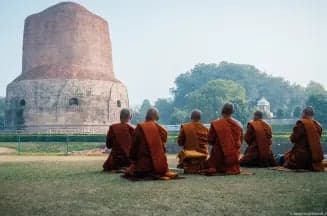

The Ancient Buddhist Site, Sarnath, in Uttar Pradesh, India, has been inscribed on the UNESCO World Heritage List during the 48th session of the World Heritage Committee – underway in the Republic of Korea. With this inscription, India now has 45 World Heritage sites.
Tim Curtis, Director and Representative, UNESCO Regional Office for South Asia, said: "On behalf of UNESCO, I warmly congratulate the government and the people of India on the inscription of the Ancient Buddhist Site, Sarnath, on the World Heritage List. For more than 2,500 years, Sarnath has been a place of pilgrimage and inspiration for Buddhists around the world. It is here that the Buddha delivered his first sermon, sharing teachings of compassion, wisdom and peace that continue to resonate today. Its temples, stupas, and monasteries bear witness to centuries of faith, devotion, and shared human heritage. Safeguarding this exceptional site is our collective responsibility for present and future generations."
Located in Varanasi, one of the world's oldest inhabited cities, the property preserves the architectural and archaeological remains of Sarnath. According to sacred Buddhist texts, the Buddha traveled to Sarnath in the sixth century BCE after attaining enlightenment. It was here that he met his first disciples and delivered his first sermon, an event regarded as the beginning of the spread of Buddhist teachings.
Over the centuries, Sarnath evolved into a major centre of Buddhist learning and pilgrimage. Successive rulers, patrons and monastic communities erected stupas, temples and viharas, transforming the site into one of the four key destinations of Buddhist pilgrimage in the world.
Today, this legacy survives in two protected archaeological sites: the Chaukhandi Stupa and the Archaeological Remains of Sarnath, which include the Dhamek Stupa and the Dharmarajika Stupa. Together, these monuments form the historic landscape widely known as Deer Park. In Buddhist tradition, the site is also referred to as Rishipatana, Isipatana, and/or Mrigadava – names preserved in different sacred texts through varying historical accounts and legends.
The inscription follows a decision by the World Heritage Committee, the body responsible for implementing the 1972 World Heritage Convention. The Committee identifies places of Outstanding Universal Value—sites whose cultural or natural significance transcends national boundaries and is considered part of humanity's shared heritage.
Since the Convention's adoption in 1972, the World Heritage List has grown to include 1,248 cultural, natural and mixed properties across 170 countries.
Leave A Comment