
Ascending to throne with father's blood-stained legacy
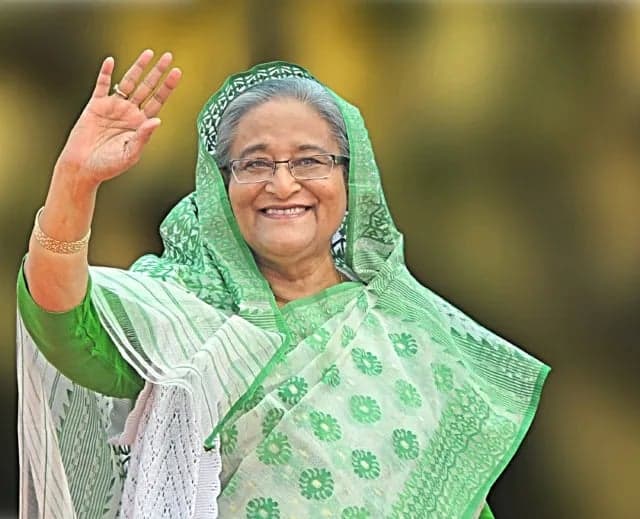
When I think about Bangladesh's honorable Prime Minister Sheikh Hasina, I am filled with mixed emotions. On one hand, I feel elated, thinking about how she has taken such a small South Asian country to great heights through her unwavering dedication.
On the other hand, I cannot help but feel the profound pain she must carry within her heart when the thought strikes her. She lost her father Bangabandhu Sheikh Mujibur Rahman, the father of the nation, to a brutal assassination. Sheikh Hasina has demonstrated remarkable strength and resilience in the face of adversity.
She has not only led her nation with determination but has also sought justice for her father's murder. In the annals of world history, we have witnessed the tragic assassinations of numerous political leaders. However, it is rare to see such a devastating loss suffered by a single family as we have seen in the case of the Sheikh family in Bangladesh.
What is even more noteworthy is that figures like Julius Caesar, Abraham Lincoln, Salvador Allende, or Anwar Sadat, after their assassinations, their spouses, children, or descendants did not channel personal grief into the collective concerns of their respective nations. Those who have done so, such as Indira Gandhi and her son Rajiv Gandhi, or Zulfikar Ali Bhutto and his daughter Benazir Bhutto, their actions must be acknowledged in the context of history.
In this regard, Sheikh Hasina's path is not unique. Sheikh Hasina, like a true stateswoman, has cultivated her education, political acumen, and a people-oriented mindset, much like her revered father, Bangabandhu Sheikh Mujibur Rahman. She is often referred to as the meaningful successor to her father's legacy.
Here, a significant portion of the truth lies in her dedication and effectiveness, not just as a daughter but also in her astute political vision and skillful problem-solving abilities. In the realm of practical leadership, she has admirably followed in the footsteps of her mother, the esteemed Bangamata Sheikh Fazilatunnesa Mujib.
If we remember the days of Bangabandhu Sheikh Mujibur Rahman's life after her return to the soil of the nation following the 21-year of exile and the harrowing experience of the Liberation War, we can appreciate the unwavering spirit that kept her going. Even after enduring twenty-one years of exile and the loss of many family members, her unbroken determination to lead her nation towards democracy remained intact. It is truly remarkable how she maintained her indomitable courage and resolve, even in the face of such immense personal tragedy.
Their tragedies may vary in nature and scale, but the common thread running through their campaigns is a deep sense of sorrow. Egypt's Queen Cleopatra, for instance, lost two of her lovers, Julius Caesar and Mark Antony. In England, Queen Elizabeth I's mother, Anne Boleyn, met a tragic end through execution. Queen Elizabeth herself was just a young girl of around two and a half years old at the time.
The first female ruler of the subcontinent, Queen Razia, was repeatedly dethroned by contemporary reactionary groups and ultimately assassinated, along with her husband. Lakshmibai, the Rani of Jhansi, saw her young son, Damodar Rao, declared heirless by the British under their "Doctrine of Lapse" policy, leading to the annexation of her kingdom.
These historical instances illustrate the challenges and adversities faced by powerful women in positions of authority in a male-dominated world, with their efforts often met with resistance and violence. Even in the modern era, we can observe instances where prominent female leaders in the Asian continent have faced tragic circumstances. Sirimavo Bandaranaike, the first female Prime Minister of Asia, ascended to power amid the assassination of her husband, Solomon Bandaranaike. Corazon Aquino, the first female President of the Philippines, also faced personal tragedy when her husband, Benigno "Ninoy" Aquino Jr., was assassinated before her presidency.
In India, Prime Minister Indira Gandhi lost her son Sanjay Gandhi in a tragic accident, although it was not an assassination. In the grand tapestry of history, when we reflect upon Sheikh Hasina's journey, we find that she has surpassed many renowned world leaders by a considerable margin. She has been tasked with the monumental mission of uplifting the lives of over 18 crore people, covering only a fraction of the world's landmass. In comparison, she has outshone all expectations.
The famous quote, "Your birth is for the suffering of the people," encapsulates her dedication and purpose. On September 27 in 1947, she saw the light of the world for the first time. Amidst the backdrop of her father's imprisonment, her mother's concerns and financial struggles, and the uncertainties in the lives of her siblings, she grew up. She pursued her Master's degree from Dhaka University and actively entered the world of politics.
In 1971, during a fragile period in the nation's history, she gave birth to her first child, Sajeeb Wazed Joy, on the 17th of July. With a young child in her arms, she witnessed the struggle for independence in her homeland. Her heart was filled with concern and anticipation as her father remained imprisoned in Pakistan. One year later, on December 7, her daughter Saima Wazed Putul was born. Can any psychologist explain how a tender mind can easily grasp such a challenging environment? Here comes independence, victory, and her father's return. Peace!
However, in the annals of history, Devi Cleo was stern and a great advocate of self-indulgence. On the 15th of August 1975, she was marked as the tragic central figure in the world's most heart-wrenching political assassination, along with her family. While Julius Caesar, Abraham Lincoln, Anwar Sadat, or Allende faced assassinations, it is not as complicated as this. From 1975 to May 1981, Sheikh Hasina had to live in exile, primarily in Germany, Belgium, the United Kingdom, and India.
The day she returned, she couldn't hide her long-held sigh of relief. We are certain that she looked toward the horizon of a decade-long history, refusing to let her deep breath be cut short. She could see a wounded territory, a nation's deep wounds emerging from the depths of life's blood. She searched for the embrace of a democracy. Where was the dawn of that democracy? Where was the sunrise in that land? Salam, Jabbar, Rafique's spirit weeps, as Asad's shirt is dusted off, bearing the weight of thirty-two thousand martyrs, while embracing Bangladesh with a long sigh.
Two hundred thousand silenced mothers and sisters, newly initiated. With an extraordinary determination mounted on his back, he sets forth for his homeland! With a face full of resilience, he takes the pledge to give voice to this language anew. It's like starting a game of snakes and ladders all over again. She played the game and confronted "Two-Decade Rule" with success.
To achieve this, she had to venture into districts, and the cycle of assassination loomed over her repeatedly. In 1996, she overcame countless obstacles and ascended to power. And she did so again and again until the present.
The outcome? Today, Bangladesh is participating in world cricket with honor, and women are conquering the Mount Everest. Foreign currency reserves are steadily increasing, and GDP is on the rise. All of this signifies Sheikh Hasina's leadership. Is it just that? Sheikh Hasina means the metro rail, Sheikh Hasina means the Karnaphuli Tunnel, Sheikh Hasina means the hidden Padma Bridge, and more, yes, even more. She is also an author, honored with honorary doctorates from many countries around the world.
Rabindranath Tagore's Visva-Bharati conferred upon her the title of 'Desikottama.' Her two children have earned worldwide acclaim for their educational qualifications and diligence. At the beginning of the year, Sheikh Hasina's unparalleled vision for providing textbooks to millions of students is something we don't see in any other country. Today, Bangladesh stands as a middle-income nation.
Above all, every year at the United Nations General Assembly, she delivers speech in Bengali, honoring Bangladesh's heritage, language, and its people with pride, thus elevating the significance of 1974 - the year her father, Bangabandhu Sheikh Mujibur Rahman, upheld the traditions and celebrated the Bengali language.
Leave A Comment