
Astronomers capture Betelgeuse's elusive companion star after century-long hunt
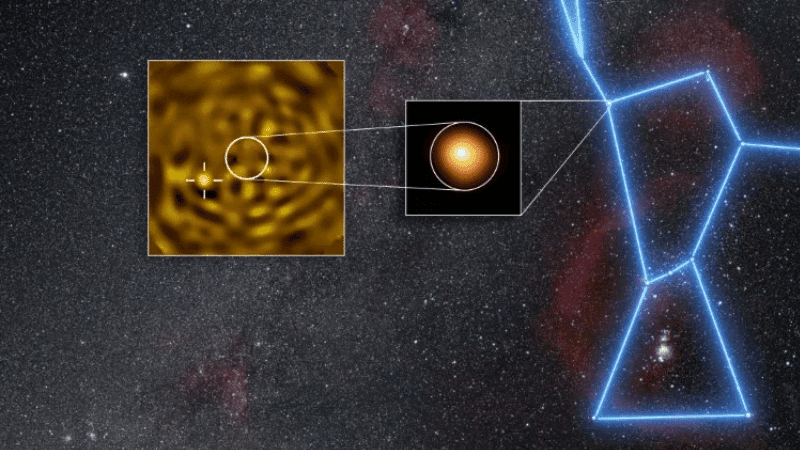

Astronomers have unveiled the clearest-ever image of a faint companion star orbiting Betelgeuse, bringing to a close a century-long search to explain the mysterious brightness variations of one of the night sky's most iconic stars.
The breakthrough, published Tuesday (July 28) in the journal Astronomy & Astrophysics, confirms that the red supergiant in the Orion constellation is not alone. Researchers say the discovery provides fresh insight into Betelgeuse's evolution and could reshape predictions about its eventual fate as a supernova.
Betelgeuse, often recognised as the shoulder of Orion the Hunter, has fascinated skywatchers for centuries. Historical records suggest that ancient Egyptian astronomers and Indigenous Australians had already noticed its cyclical changes in brightness thousands of years ago.
The cause of those fluctuations remained unresolved until two studies published in 2024 proposed that a much smaller companion star periodically influenced Betelgeuse's observed brightness. Those studies also predicted that December 2024 would offer the best opportunity to detect the elusive companion as it reached its greatest apparent separation from the giant star.
Taking advantage of that window, astronomers observed Betelgeuse on December 3 and 6, 2024, using the SPHERE instrument mounted on the European Southern Observatory's Very Large Telescope (VLT) in Chile's Atacama Desert. Designed primarily to detect exoplanets, the instrument successfully resolved the faint stellar companion after months of data processing and analysis.
Lead author Miguel Montargès of the Paris Observatory described the discovery as the culmination of a decades-long scientific pursuit.
"This marks the end of a century-long search. We have shown that Betelgeuse is not alone."
He said the processed images were so striking that he "jumped out of his chair" when he first saw them.
Scientists had long feared that Betelgeuse's immense brightness would completely overwhelm any nearby companion. The red supergiant is about 1,400 times the Sun's radius and shines roughly 100,000 times brighter than the Sun.
The observations revealed that the companion is considerably more massive than previously expected—between two and three times the mass of the Sun—making it detectable despite Betelgeuse's overwhelming glare. It was observed at an apparent distance of approximately 8.8 astronomical units (AU) from the primary star.
Co-author Anthony Boccaletti, also of the Paris Observatory, said the findings demonstrate that technology developed for exoplanet searches can also reveal companions orbiting evolved giant stars.
Researchers caution that additional observations will be required to conclusively confirm the discovery. They plan to observe the system again after the companion moves to the opposite side of Betelgeuse. Even so, Montargès said there is now "very little room for doubt."
The discovery also raises new questions about Betelgeuse's future. Astronomers expect the star to eventually explode as a supernova, but the presence of a companion could alter that timeline. According to the researchers, gravitational interactions between the two stars may either delay or accelerate the supernova process, opening an important new avenue for stellar evolution research.
Betelgeuse previously drew worldwide attention between 2019 and 2020, when it unexpectedly dimmed for nearly five months, fuelling speculation that it was on the verge of exploding. Later observations showed the dramatic fading was caused by a massive cloud of dust ejected from the star's surface, which temporarily blocked part of its light.
Leave A Comment