
Returning from Qiaojia, Yunnan
Baihetan hydropower plant: Flow of Jinsha River brings light to 75m people
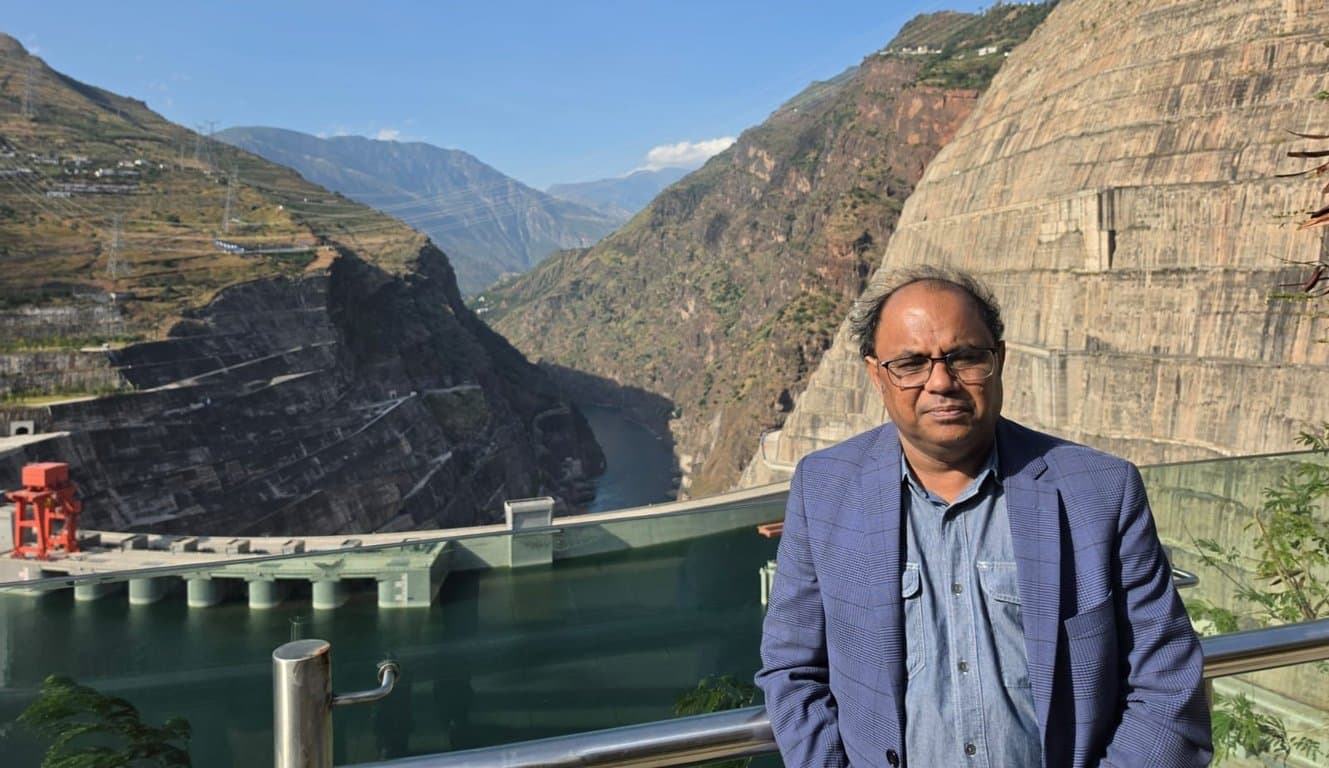

Qiaojia County is about 280 kilometres from Kunming. The journey takes travellers through more than a dozen tunnels along winding mountain roads. The Jinsha River runs alongside much of the route, its long, meandering course cutting through the rugged landscape. Impressive buildings dot its banks, some so modern that it is difficult to tell at first glance whether they belong to a town or a village.
Today, however, the Jinsha River is one of the main pillars of Yunnan's economy. That is because one of China's largest hydropower projects has been built along its course.
As we emerged from the final tunnel, an enormous concrete wall suddenly came into view, stretching between two mountains. Curving like a bow and anchored against the steep rocky slopes on either side, the structure appeared almost as if the mountains themselves were holding the river in their embrace.
This is the Baihetan Hydropower Station. After the Three Gorges Dam, it is the world's second-largest hydropower station and the largest and newest hydropower project in Yunnan.
A dam between two provinces
Baihetan's location is striking in itself. On one side of the dam lies Ningnan County in the Liangshan region of Sichuan Province; on the other is Qiaojia County in the Zhaotong region of Yunnan Province.
The Jinsha River, which flows between them, is the upper reaches of the Yangtze. Four major hydropower stations have been developed in a cascade along this stretch of the river. From upstream to downstream, they are Wudongde, Baihetan, Xiluodu and Xiangjiaba.
The planned development of successive hydropower stations along a single river is a defining feature of China's energy strategy.
The central structure of the project is a double-curvature concrete arch dam. Its surface curves both horizontally and vertically, allowing it to transfer much of the enormous pressure of the reservoir water to the rock formations on either side. This design makes it possible to build exceptionally high dams with less concrete.
The dam stands about 289 metres tall, roughly equivalent to a building of 90 to 95 storeys.
Power beneath the mountains
The real scale of Baihetan's generating capacity is not visible from the outside. The entire power-generation system is housed underground, deep inside the mountains.
Enormous underground powerhouses have been excavated into the mountains on both banks of the river. There are eight generating units on the left bank and eight on the right, making 16 in total.
Each unit has a capacity of 1,000 megawatts. Before Baihetan, no hydropower station anywhere in the world had installed turbines capable of generating one gigawatt from a single unit.
The station has a total installed capacity of 16,000 megawatts. To put that into perspective, this single facility accounts for more than half of Bangladesh's total installed power-generation capacity.
Officials at the station repeatedly emphasised that the giant generators were designed and manufactured entirely in China. From raw materials to components, they said, the equipment was domestically produced. For them, Baihetan is not merely a power plant; it is also proof of China's technological capabilities in manufacturing sophisticated heavy machinery.
Luo Yuanwang, shift supervisor in the station's operations department, said Baihetan was designed to generate an average of around 62.44 billion kilowatt-hours of electricity a year. That would be enough to meet the daily household electricity needs of approximately 75 million people.
By June 2026, the station's cumulative electricity generation had exceeded 250 billion kilowatt-hours.
Remarkably, only around 400 employees are needed to operate a facility of this scale. Its highly automated control systems make such a lean workforce possible.
From first survey to full operation
The story of Baihetan began long before construction started.
In June 1959, a team of Chinese specialists and another from what was then Czechoslovakia conducted a field survey in Qiaojia. The site was selected on the basis of that assessment. Several decades of surveys and preparations followed.
In 2010, China's National Development and Reform Commission approved the preliminary work. Construction began in 2017, with the project implemented by China Three Gorges Corporation.
Water impoundment began in April 2021. The first generating units were commissioned on 28 June that year. The final unit was connected to the power grid on 20 December 2022, bringing the entire station into operation.
Experts regard the completion of a project of this scale in such a remote and mountainous area within a relatively short period as an exceptional engineering achievement.
Powering China's eastern industrial heartland
The electricity generated at Baihetan does not remain in Yunnan or Sichuan. A substantial portion is transmitted more than 2,000 kilometres away to the industrialised eastern provinces of Jiangsu and Zhejiang through ultra-high-voltage direct-current transmission lines operating at ±800 kilovolts.
The project is a major example of China's strategy of transmitting electricity from the west to the east: power generated by rivers in the western mountains supplies factories along the eastern coast.
Environmental considerations are also central to the project. According to the authorities, Baihetan's operation saves approximately 19.6 million tonnes of standard coal annually. It also reduces carbon dioxide emissions by around 51.6 million tonnes a year.
Beyond electricity generation, the dam also contributes to flood control in the Yangtze basin, facilitates navigation and helps regulate sediment.
New lives along the river
Many of the impressive buildings we saw along the journey, which made it difficult to distinguish towns from villages, are part of new settlements developed as a result of the project.
As the reservoir filled, many riverside villages were submerged. Their residents were relocated to newly developed, planned housing areas. The appearance of Qiaojia County itself has changed considerably. Wide roads now run along the river, lined with multi-storey buildings and landscaped waterfront areas designed to attract visitors.
Once a poor and remote mountainous region, the area has seen new roads, employment opportunities and tourism emerge alongside the hydropower project.
But this transformation has another side. Large hydropower projects inevitably involve people leaving ancestral homes, changes to river ecosystems and pressure on biodiversity downstream. Environmental groups have long raised questions about these consequences.
China has sought to address such concerns through resettlement packages and programmes to conserve fish populations in the reservoir.
China has also demonstrated technological sophistication in building the power transmission infrastructure from Baihetan. Ultra-high-voltage transmission lines make it possible to deliver electricity safely and efficiently over distances of more than 2,000 kilometres.
On the return journey, we passed through the same tunnels and followed the same winding course of the Jinsha River. But the river looked different this time.
It seemed that every ripple in its waters was turning the wheels of a factory somewhere far away, or bringing light into a home.
Rased Mehedi
Editor, Views Bangladesh
Leave A Comment