

Bangladesh's Museum of Independence still remains sealed
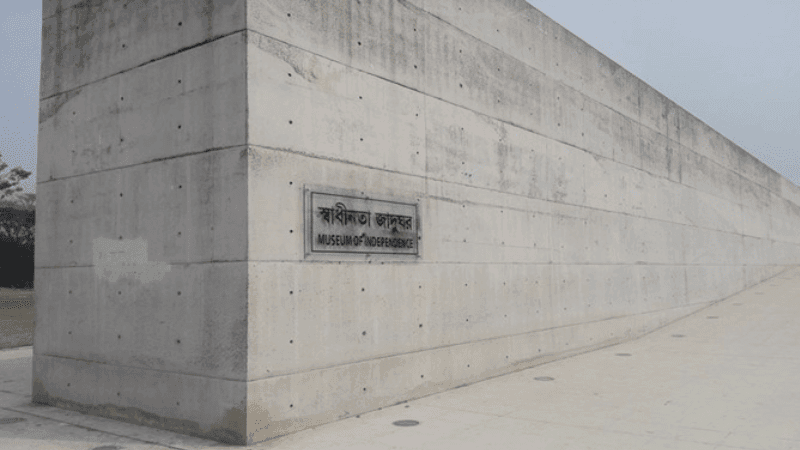
The Independence Museum, which suffered extensive damage and was reduced to rubble due to an attack by miscreants, remains locked. On August 5, 2024, a group of enraged individuals assaulted this first and only underground museum in Bangladesh, engaging in widespread vandalism and looting. Nearly 19 months have elapsed since that incident, yet this traditional museum continues to be 'abandoned' and closed.
On Wednesday, March 25, while visiting the spot it was observed that the museum situated in Suhrawardy Udyan is still locked. When Views Bangladesh attempted to enter and assess the current state of the museum, the security personnel present stated, 'You should speak to the authorities. If they grant permission, we can open it. They possess the key. We are not involved.'
The Independence Museum was previously operated under Bangladesh National Museum. Upon visit and inquiry, two officials remarked, 'Those who can provide information are currently out of the office. You will likely receive it on Sunday. Tomorrow is March 26, and it will not be available.' When requested the names and titles of those officials, they evaded the question. Subsequently, when Views Bangladesh sought the contact numbers of the higher authorities, they also sidestepped that issue.
The Museum of Independence was inaugurated for public access on the 44th Independence Day of Bangladesh in 2015. It operates under Bangladesh National Museum. The museum housed artifacts from various historical events, spanning from the Mughal era to the Victory Day of the Great Liberation War in 1971. As a tribute to the historic moment of December 16, 1971, the museum featured a special replica—the table on which the Eastern Commander of the Pakistan Army, Amir Abdullah Khan Niazi, signed the surrender document. Additionally, various other significant artifacts, including remnants of the cannons utilized by the freedom fighters, were displayed, preserving the memory of the independence struggle.
Over three hundred historical photographs were exhibited on 144 glass panels. Furthermore, there were terracotta items and numerous newspaper clippings documenting war events.
Furthermore, copies of news articles published in international newspapers supporting the Liberation War, along with propaganda posters advocating for the same, were also preserved.
However, when the Awami League succumbed to the student movement against discrimination on August 5, 2024, these significant documents were subjected to attacks, vandalism, looting, and destruction. None of the other vital monuments, including the statue of Bangabandhu Sheikh Mujibur Rahman, the architect of independence, remained unharmed.
Hena Rahman, who visited the Independence Pillar in Suhrawardy Udyan, stated to Views Bangladesh, 'Jamaat-Shibir and anti-liberation forces launched an attack and vandalized this site. Various documents detailing their and the Pakistani atrocities were present here. Their intent was to obliterate these records. They aim to make us forget the Liberation War. They seek to annihilate our independence and sovereignty.'
Aminul Islam Papon, who also visited the park, remarked to Views Bangladesh, 'The great Liberation War is a source of our pride. The anti-liberation forces are attempting to equate the movement to overthrow a government with the liberation war. They are responsible for the destruction that occurred here. Their goal is to erase our history. Their efforts continue unabated.'
Papon insisted on the necessity of renovating and reopening the Independence Museum, as well as ensuring that those responsible for the vandalism are held accountable.
On November 13 of the last year, a group of radical youths once again defaced the walls of the Independence Museum located in Suhrawardy Udyan. That afternoon, approximately 25 to 30 individuals, armed with sticks, hammers, and machetes, vandalized the sculpture of Bangabandhu Sheikh Mujibur Rahman situated at the upper section of the Museum within the garden, along with numerous other artworks. This sculpture was a replica of the speech delivered by Bangabandhu at Suhrawardy Udyan on the historic 7th of March in 1971, depicting him in the act of speaking. The significant declaration from this historic speech—‘This time the struggle is our struggle for freedom, this time the struggle is our struggle for independence’—was inscribed on the wall in front of the sculpture.
When questioned regarding the renovation and reopening of the structure last year, Faruk-e-Azam, the then interim government’s Liberation War Adviser, informed reporters that the structures related to the Liberation War, which were damaged during the attack and vandalism on August 5, would be restored. However, this plan was not executed subsequently.
Despite numerous attempts to reach Md. Golam Kausar, Deputy Keeper of the History and Classical Arts Department at Bangladesh National Museum and the officer responsible for the Museum of Independence, Views Bangladesh could not talk to him. Consequently, it was impossible to obtain his comments on the issue.
Afsana Mimi, the Public Relations Officer of the Ministry of Cultural Affairs, stated to Views Bangladesh, 'The ministers and state ministers assumed their roles on the 17th of last month, and they have not yet grasped all the details. They are making efforts to understand every matter. There has been no discussion regarding this issue thus far. Yesterday, the Minister visited the Zia Memorial Museum in Chittagong and discussed various relevant issues. However, it is likely that everything will be organized in phases.'
Has there been any inquiry into the attack and damage inflicted on the Independence Museum? Will there be an investigation and legal proceedings against the perpetrators? When will it be accessible to the public? In response to these inquiries, she remarked, 'I cannot provide any information on this. I joined on the same day the Honorable Minister did. There has been no discussion with me regarding this matter. No issues have been brought to my attention.'
The Museum of Independence is the first and only underground museum in Bangladesh. The museum plaza is adorned with 5,669 square meters of tiles. Bangladeshi architects Kashef Mahbub Chowdhury and Marina Tabassum won the national architectural design competition in 1997 and were entrusted with this project. The entire project, which spans 67 acres, was projected to cost approximately Tk175 crore.
There was a reservoir in the middle of a circular room. Water used to flow continuously from a spout, symbolizing the tears of the mothers of millions of martyrs and women who were victims of torture. This fountain, called ‘Ashrupat’, is now closed. Although the ‘Ashrupat’ was stopped using force, this locked structure is the cause of heartache of thousands of freedom-loving Bangladeshis.
Leave A Comment
You need login first to leave a comment