
Bellingham steps up again to seal semifinal spot amid fierce Norway VAR debates
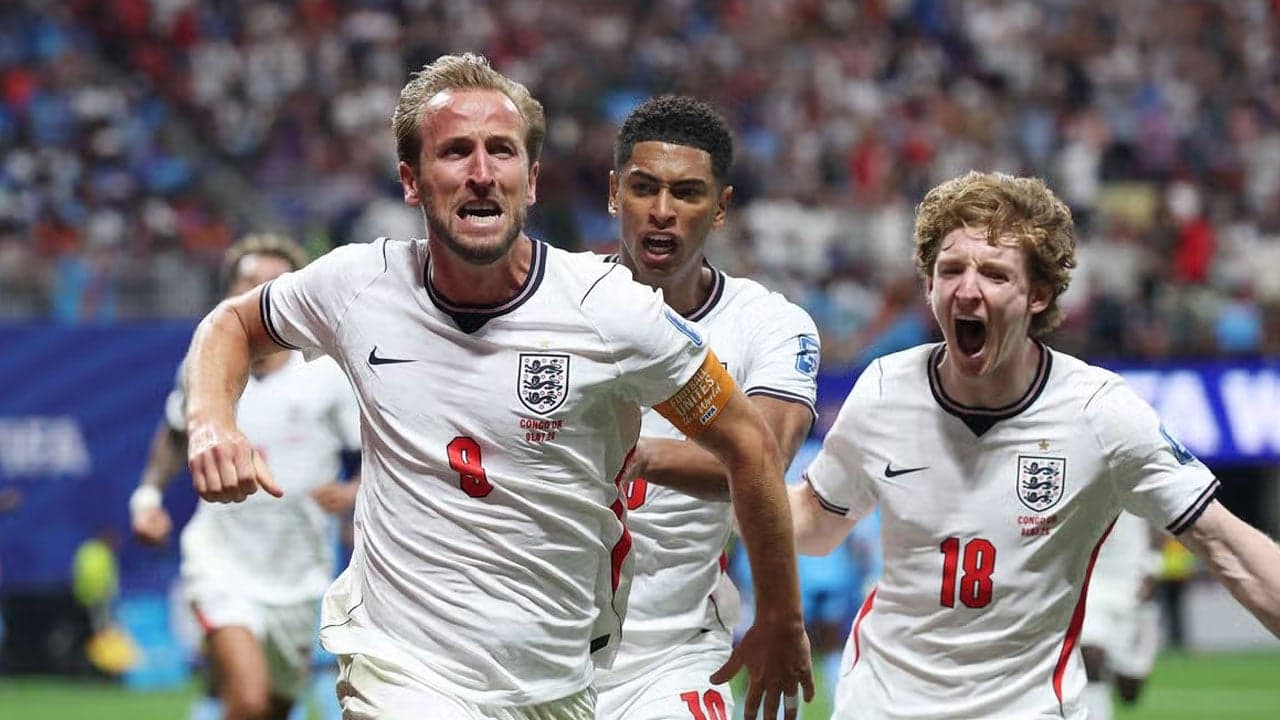

England advanced to the World Cup semifinals with a highly controversial victory over Norway, driven by a two-goal performance from Jude Bellingham.
Although England controlled possession early in the match, they struggled to generate clear opportunities, prompting an animated reaction from coach Thomas Tuchel during the hydration break. Norway responded more effectively, first threatening with an Erling Haaland header that was saved, and then taking an extraordinary lead when Andreas Schjelderup scored off the far post from the left side of the penalty box.
A deeply controversial equalizer followed. Norway maintained that goalkeeper Orjan Nyland’s upfield goal kick struck an overhead sky camera wire before dropping to Elliot Anderson. Anderson passed to Anthony Gordon, who set up Bellingham to drive into the box and score. FIFA stated that its ball chip technology indicated no contact with the camera or wire.
Norway's frustration intensified after halftime when a goal by Torbjorn Heggem was disallowed due to an initial push by Haaland during a corner. While Norway controlled the second half, England still threatened as a Bukayo Saka cross required a clearance from right under the crossbar, and Bellingham sent a header wide during stoppage time.
Early in extra time, Nyland saved a header from Harry Kane but subsequently spilled a shot from Morgan Rogers, allowing Bellingham to pounce on the rebound and score his second goal. The drama continued when England was awarded a penalty after Djed Spence went down in the box, though referee Clement Turpin overturned the decision following a review. Norway substituted Haaland at the midpoint of extra time, and England successfully held on for the victory.
England will face either Argentina or Switzerland in Atlanta on Wednesday. The winner of that semifinal will advance to the World Cup final at MetLife Stadium on July 19 to play either France or Spain, who face each other on Tuesday.
Are England fans believing the hype again?
The narrative surrounding England at major tournaments almost always loops back to that familiar question, but this performance was more about survival than swagger.
While the result puts England in the World Cup semifinals for just the fourth time in their history, the 2-1 extra-time victory over Norway in the intense Miami heat was far from straightforward. A promising opening stretch collapsed into a highly disorganized second half. Thomas Tuchel's decision to substitute Declan Rice at halftime threw the team out of sync, leaving them struggling to find their structural footing for a long stretch. They even dodged a massive bullet when VAR overturned a Torbjorn Heggem goal that would have put Norway ahead.
Ultimately, England advanced because they clung on long enough for Jude Bellingham to do what he does best. Bellingham carried the team with pure, decisive impact, scoring the critical 1-1 equalizer late in the first half of normal time and then burying the game-winner early in extra time. His shift was so grueling that he had to be replaced for the final 10 minutes by Dan Burn, who replicated his role from the Mexico match by simply heading away every ball that came near the box.
England heads to Atlanta for Wednesday's semifinal with their spirit intact, having fought through a match that was uniquely tougher than their encounter with Mexico. However, they carry significant tactical baggage with them. Tuchel faces urgent questions regarding Rice's fitness, the visible exhaustion of key stars like Bellingham and Harry Kane, and exactly how his side managed to completely lose control of the game for such a long period. They are now just one win away from the World Cup final, but the path there looks incredibly demanding.
Is there any stopping Jude Bellingham at this World Cup?
The tournament has upended the sporting world, humorously challenging centuries of astrophysical consensus by proving that Jude Bellingham possess a gravitational pull stronger than any planet in the solar system.
Bellingham's inevitability defined the quarterfinal against Norway. In the first half, England began to drift following a drinks break, looking completely deflated after Andreas Schjelderup’s opening goal. Bellingham then intervened unstoppably, delivering a miniature marvel of an equalizer that showcased exceptional movement and precision, making a goal look completely unlikely right until the moment it became certain.

Later in the match, as midnight passed back in England, a familiar exhaustion took hold of the team. England looked leggy and imprecise, making the transition into extra time feel like a victory in itself as a penalty shootout began to look like their most probable route to advancement.
Instead, Bellingham struck again. When a long-range strike from Morgan Rogers befuddled goalkeeper Orjan Nyland into a fumble, Bellingham appeared second favorite to reach the loose ball. He quantum-leaped to the rebound anyway, slamming home his sixth goal of the tournament. The decisive effort dragged his nation into the World Cup semifinals and pulled everyone even further into the starry swirl of the Judeverse.
Why was Erling Haaland substituted?
Erling Haaland endured a highly frustrating match that ultimately ended in an early exit halfway through extra time. He recorded the fewest touches of any player on the pitch, with his own goalkeeper, Orjan Nyland, managing more than double his total. While the 25-year-old frequently operates on the periphery of matches before striking, he was heavily crowded out in the center by England's defense and was rarely given opportunities to chase the ball in behind.
When he did drop deep to get involved, he struggled to make an impact, mustering just two shots on goal. His first chance, a header from a stood-up cross, lacked sufficient power, while his second attempt was a header flicked wide from a second-half corner.
Norway manager Ståle Solbakken made the incredibly brave decision to withdraw his star striker during the extra-time interval. Suggestions of a slight injury emerged when Haaland was seen receiving a massage on the touchline shortly after coming off. Without his intimidating presence in the middle, Norway lost their attacking edge.
The tactical gamble ultimately failed to pay off, as Haaland’s replacement, Jørgen Strand Larsen, managed just four touches and looked completely isolated during his 15 minutes on the field. Given that Haaland had scored over half of Norway's goals on their historic run to a first-ever World Cup quarterfinal, his subdued performance and premature substitution marked a sad conclusion to the country's tournament.
What made England’s equalizer so controversial?
England’s equalizer sparked intense controversy because Norway believed the ball struck an overhead skycam cable during a clearance upfield just prior to Jude Bellingham’s goal. Goalkeeper Orjan Nyland and coach Ståle Solbakken were both certain of the contact, pointing toward the sky in protest. Solbakken actively pressed his case to the match officials during England’s celebration and again at halftime. While video images appeared to show the ball changing trajectory, FIFA maintained that its ball-chip data confirmed no contact with the wire occurred.
The tournament utilizes "Connected Ball Technology," featuring an Adidas 500Hz inertial measurement unit motion sensor embedded inside the ball. This sensor delivers data 500 times a second to clarify the precise moment a ball is touched, primarily aiding offside calls and detecting player contact.
According to refereeing expert Graham Scott, a case for outside interference technically requires a dropped ball, but practice dictates there must be clear evidence of impact. Scott noted that play is typically allowed to continue if a ball hits minor debris like a paper cup without affecting the game. Given FIFA's ball-chip data showed no touch, he deemed it highly unlikely that the VAR would even check a high camera angle during the attacking phase review. The VAR would instead focus on the players' actions during the buildup, especially under directive not to be overly forensic or delay the game to find faults with a seemingly valid goal.

According to The Athletic’s refereeing expert Graham Scott, you can, strictly speaking, make a case for outside interference, which means there should be a dropped ball. But in practice there has to be some evidence of impact.
What other decisions frustrated Norway?
Norway was further angered when an initial push by Erling Haaland cost his side a goal during a corner kick. Haaland utilized a clear, two-handed push on Elliot Anderson to create space before the set piece was delivered. While the striker likely thought little of the contact, having gotten away with similar physical play in the Premier League for several seasons, he was penalized due to FIFA’s tougher stance on upper-body fouls at set pieces. Under a change in the law, attackers can now be penalized for offenses committed even before the ball is actively in play.
Anderson made the most of the contact, and Haaland subsequently challenged for the ball, an action that became a central part of the VAR review. Refereeing expert Graham Scott noted that had the incident occurred nowhere near the actual play, it might have been allowed to pass.

Despite Haaland committing the foul, Norway was generously permitted to retake the corner because the infraction occurred before the ball entered play.
What prompted Declan Rice’s halftime substitution?
Declan Rice was substituted at halftime because he was visibly struggling with the effects of a sickness bug that had hindered him in the buildup to the match. Although his inclusion in the starting lineup initially appeared to be a massive boost for England, he looked completely out of sorts once the game began. His typical bounding runs were noticeably absent, his overall influence was heavily diminished, and even his usually dangerous dead-ball deliveries were off.
While Rice deserved credit for making himself available to play, his halftime exit came as no surprise. He was withdrawn alongside Noni Madueke, who worked hard on the right flank but ultimately produced very little with the ball.
Bukayo Saka replaced Madueke to provide more cutting edge on the wing, while Eberechi Eze came on to replace Rice in midfield. Although Eze brought more energy to the pitch, he could not replicate the level of control a fully fit Rice normally provides. Consequently, the second half began to drift away from England as Norway's Patrick Berg and Sander Berge took control of the midfield battle.
Was Schjelderup’s opening goal intentional or a fluke?
Andreas Schjelderup's opening goal was one of the most confusing moments of the World Cup. As he shifted the ball onto his weaker left foot, everyone anticipated a floated, stood-up cross directed toward Erling Haaland at the back post. Instead, the ball flew from his boot, cannoned in off the far post, and bounced around the goal frame like a ping-pong ball, leaving viewers wondering if it had actually gone in.

The opportunity arose when Schjelderup challenged Ezri Konsa out wide. This matchup had been widely discussed before the game since the Aston Villa defender was playing out of position, but Konsa did the right thing by forcing the winger down the outside. At halftime, questions were raised about goalkeeper Jordan Pickford, who appeared to pull his hand away at the vital moment. However, Pickford was likely hindered by the sheer element of surprise, combined with the speed and movement of the ball as it careered toward the far post.
Considering Haaland's movement in the middle, Schjelderup was almost certainly shaping up to cross the ball. Even so, connecting so sweetly on his weaker foot during his country's first-ever World Cup quarterfinal is an achievement the winger will not let anyone take away from him.
Did Norway’s opening goal deserve to stand?
There was no valid reason to disallow Norway's opening goal. Harry Kane made a half-hearted appeal for a free kick shortly before Norway scored, but the gesture was clearly driven by hope rather than any genuine expectation of a foul.
While certain video assistant referees have intervened unnecessarily during this World Cup—most notably during a highly controversial match between Egypt and Argentina—the officials remained uninvolved this time. The VAR for this fixture at Hard Rock Stadium was Jérôme Brisard, the exact same official who controversially disallowed Egypt's goal against Argentina, but he was completely unmoved by Kane's claim.

Any physical contact prior to the goal was minimal. It fell well below the foul threshold that French referee Clément Turpin was actively applying on the field.
Leave A Comment