
Boro Devi Puja: 500 years of royal tradition in Cooch Behar
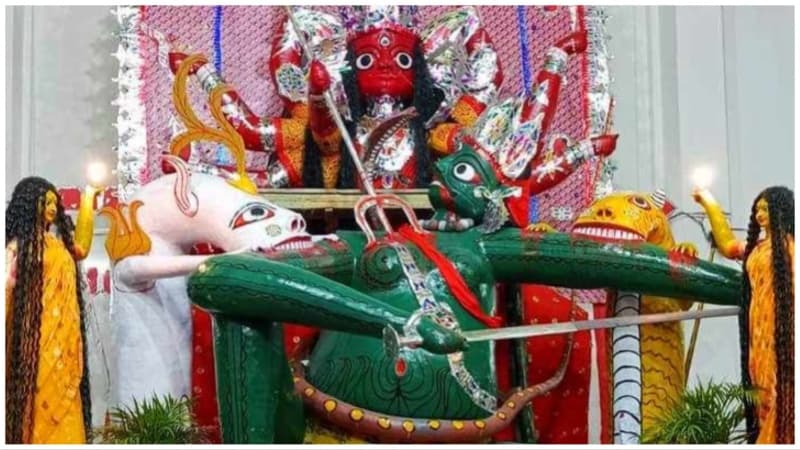

The worship of Boro Devi or Boro Maa is associated with the royal traditions of Cooch Behar. This 500-year-old religious celebration started around 1530 during the reign of Maharaja Naranarayan.
Like the previous years, this time people are offering prayers to Goddess Boro Devi with due religious sentiment. The 500-year-old royal tradition is preserved and practiced with great reverence.
The distinctive color of the idol and the many interesting rituals and stories surrounding it distinguish this puja from other celebrations. Some claim that Maharaja Naranarayan received the command in a dream to start the Devi Puja. Others believe that Maharaja Biswa Singha started worshiping Goddess Durga at the age of nine by making an idol out of dried Myna wood branches and bamboo. This practice has since become a cherished tradition of the royal family.
Boro Devi idol is sculpted using Myna wood. Mayna wood was first consecrated in Dangrai temple in Cooch Behar on Shukla Ashtami of Shravan. Later that evening, the idol is kept for a month-long puja at Madan Mohanbari in Cooch Behar. On Radhastami, the Myna wood is carried in a palanquin to the Devibari temple where the idol of Goddess Boro Devi is skillfully sculpted within the Myna wood structure. Members of the artiest families of Cooch Behar faithfully follow this time-honored tradition of expertly crafting idols. Prabhat Chitrakar, a member of the family, has been making this idol for the last 33 years.
Significantly, there is no Ganesha, Lakshmi, Saraswati or Kartika on either side of the Boro Devi idol, rather there is Jaya and Vijaya.
In the past, locals claim that one of the rituals of this puja was human sacrifice but this practice has been stopped. However, the practice of donating human blood during Boro Devi Puja still exists. A special puja known as 'Gupta Puja' is conducted on 'Ashtami' night, during which members of the royal family of Siddheshwari area of Cooch Behar follow the ancient practice of blood donation by cutting their fingers. Common people are not present during this ceremony. Also on Ashtami day, a buffalo is sacrificed as per tradition. Although now there is no king. Despite the absence of the king, all the rituals of the royal era are still in place.
A fair was also organized in the Devibari temple area which attracts visitors not only from Cooch Behar but also from Assam and neighboring districts. Royal priest Hirendra Nath Bhattacharya said, “All the rituals of this puja initiated by the Maharajas of Cooch Behar continue as a testament to the royal era. Offerings and sacrifices on Saptami, Ashtami and Navami is a part of the puja. On Ashtami, the District Magistrate of Cooch Behar, as the royal representative, offers the first 'Anjali', after which the general public begins the ritual. The tradition of Boro Devi Puja in Cooch Behar continues to enthrall people by preserving the royal legacy.”
The immersion of the Durga idol starts in Eastern India with the immersion of Boro Devi. No other idols are being immersed before the immersion of Boro Devi.
Leave A Comment