
Canada eyes trade preferences for Bangladesh until 2032
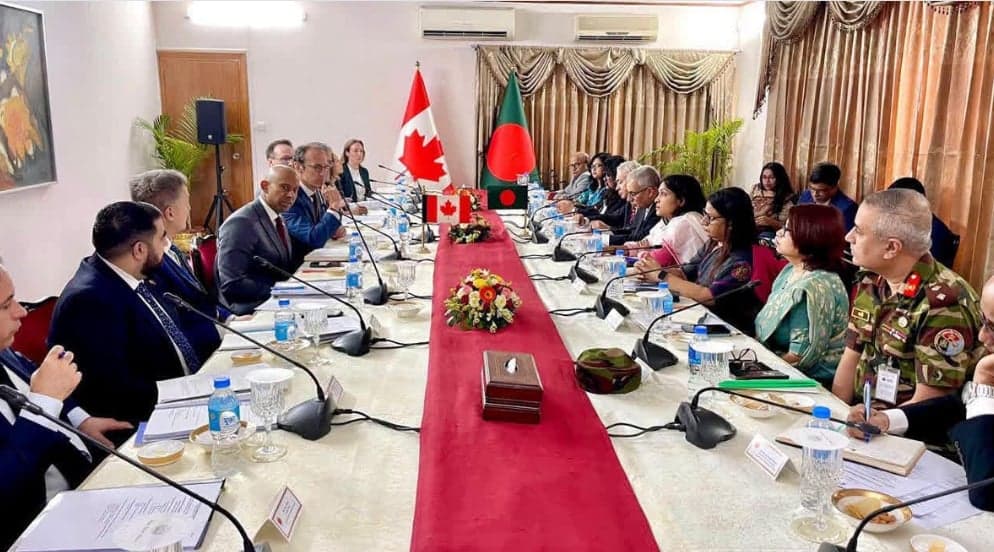

Bangladesh and Canada have reaffirmed their commitment to strengthening bilateral ties, with Ottawa expressing its intention to continue preferential market access for Bangladeshi products until 2032.
The two countries concluded their sixth bilateral consultations in Dhaka on Tuesday (November 24), focusing on trade, investment, development cooperation and regional and global issues of mutual interest.
The talks were co-chaired by Bangladesh Foreign Secretary Salahuddin Noman Chowdhury and Weldon Epp, Assistant Deputy Minister (Indo-Pacific) at Global Affairs Canada, according to a joint press release.
Both sides welcomed the rapid growth in bilateral trade, which rose by nearly a quarter to exceed C$4 billion in 2025.
They discussed opportunities to expand trade and investment in agriculture, energy, security and defence, and technical and vocational education and training (TVET).
The two countries also stressed the importance of structural reforms to ensure Bangladesh's smooth and sustainable graduation from least developed country (LDC) status.
In this regard, Canada expressed its intention to maintain preferential market access for Bangladeshi products under its relevant trade preference scheme until 2032.
Both sides also committed to strengthening people-to-people ties and business engagement.
The consultations highlighted the longstanding development partnership between the two countries, with Canada reporting that it has provided more than C$6.3 billion in development assistance to Bangladesh since 1972.
The Canadian side also referred to the C$45 million in new funding announced by Secretary of State for International Development Randeep Sarai during his October 2026 visit to Bangladesh.
The funding is intended to support economic governance, institutional reforms, private-sector development, trade competitiveness, and agricultural innovation, in line with Bangladesh's development priorities.
Both sides discussed further cooperation in skills development through vocational training, knowledge transfer and educational partnerships.
The talks also covered migration, security cooperation, climate resilience and regional and global issues of shared concern.
On the Rohingya crisis, both countries acknowledged Bangladesh's continued hosting of more than 1.2 million forcibly displaced Rohingya from Myanmar.
Canada highlighted its contribution of more than C$700 million to the Rohingya humanitarian response since 2017 and reaffirmed the importance of sustained international assistance for refugees and host communities in Bangladesh.
Both countries reiterated their commitment to working with international partners to create conditions for the voluntary, safe, dignified and sustainable return of Rohingya refugees to Myanmar.
They also welcomed the International Court of Justice's (ICJ) November 19 ruling in The Gambia v. Myanmar, which found Myanmar responsible for genocide against the Rohingya during its 2017 military operations in Rakhine State.
Bangladesh and Canada expressed confidence in the future of their partnership and agreed to continue working together to advance shared economic, development, multilateral and geopolitical objectives.
Leave A Comment