
Centenarian luminary
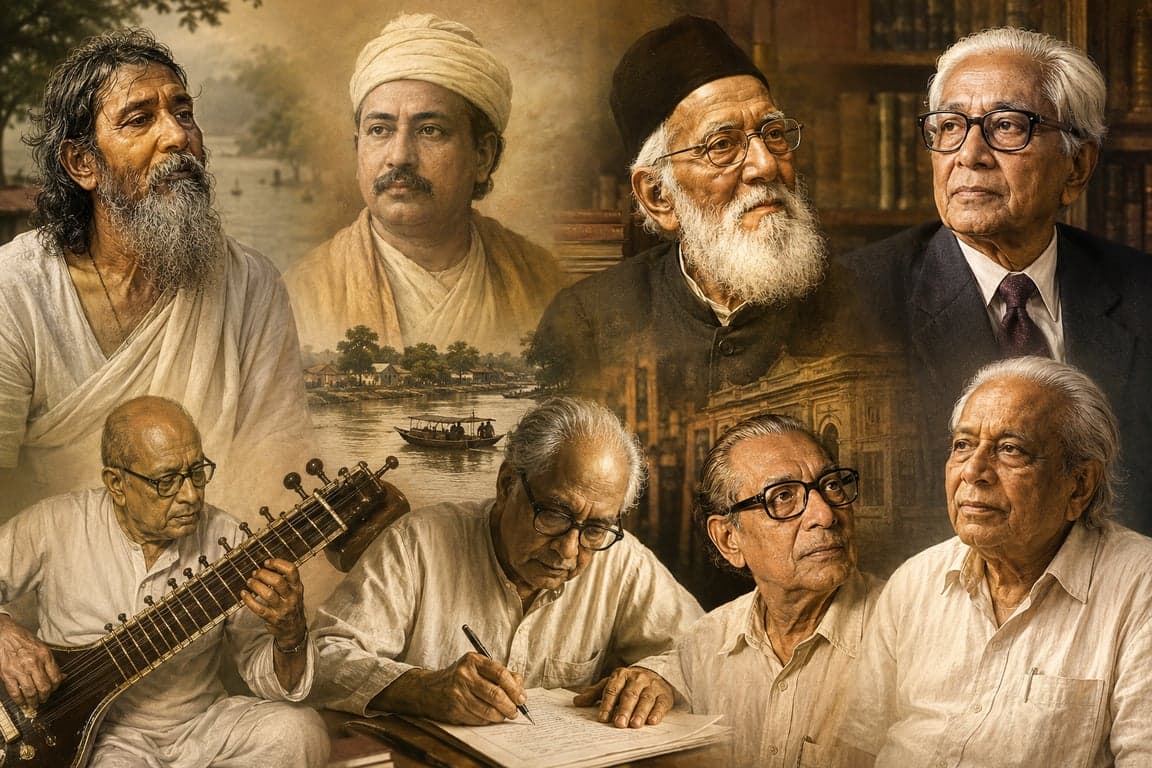
Centenarian Bengalis: Part 1
Prologue
"All who are born must die; who has ever lived forever?" These immortal lines by the great Bengali poet Michael Madhusudan Dutt remain an eternal reminder of the inevitability of death. Although we all know that human beings are mortal, we often choose to forget this fundamental truth. This is precisely why Yudhishthira's famous observation in the Mahabharata remains profoundly relevant:
"Every day countless people die, yet each person believes, 'I shall never die.' What could be more astonishing than this?"—Kim āścaryam ataḥ param?
How long does a human being live? In general, the average human lifespan rarely exceeds one hundred years. Curiously, nature offers many remarkable contrasts. Glass sponges have been known to survive for nearly 15,000 years. Scientists estimate that the famous bristlecone pine named Methuselah, growing in California, is approximately 4,850 years old. Some corals in Hawaii have lived for nearly 5,000 years, while certain species of tortoises survive for four to five centuries. Compared to these extraordinary examples, the human lifespan is remarkably short.
Among all recorded and verified cases in world history, the longest-lived person was the Frenchwoman Jeanne Calment, who lived for 122 years and 164 days (1825–1997). She is followed by Japan's Jiroemon Kimura, who lived for 116 years and 54 days, and Britain's Ethel Caterham, who reached the age of 115 years and 216 days.
India, too, has produced a number of exceptionally long-lived individuals. One notable example is Colonel Nizamuddin, the personal driver and bodyguard of Netaji Subhas Chandra Bose. During the struggle for India's independence, he reportedly shielded Netaji from enemy gunfire with his own body and miraculously survived. When he passed away in 2017, he was said to be 117 years old. At that time, his wife, Ajbul Nisha, was still alive at the age of 107.
Centenarian Bengalis
Bengalis, too, have produced a considerable number of centenarians. It is important to remember that, apart from famous personalities, the longevity of ordinary people has seldom been documented through rigorous research. Moreover, there has long been a tendency to exaggerate the ages of exceptionally elderly individuals. Nevertheless, the aspiration to live a hundred years has been cherished since ancient times. The Upanishads beautifully express this wish in the phrase, "Jīvema śaradaḥ śatam"—"May we live for a hundred autumns."
However, merely living a long life is not enough. The Upanishads also emphasize a life of purposeful action: "Kurvanneveha karmāṇi jijīviṣec chataṁ samāḥ"—one should aspire to live a hundred years while actively performing one's duties.
The Earliest Centenarian Bengali in History
Madhusudan Saraswati (1540–1643)
One of medieval Bengal's greatest scholars was Madhusudan Saraswati, whose intellectual reputation extended throughout the Indian subcontinent. Born in Kotalipara of present-day Faridpur in eastern Bengal in 1540, he died in 1643, having lived for approximately 103 years.
A distinguished philosopher of Advaita Vedanta, he earned nationwide recognition through his celebrated work Advaita Siddhi. He was a contemporary of Sri Chaitanya, Guru Nanak, and Tulsidas. After completing his education in Kashi (Varanasi), he is also believed to have met the Mughal Emperor Akbar in Delhi.
Lalon Fakir (1774–1890)
Lalon Fakir needs little introduction. Born in 1774—the same year traditionally assigned to Raja Rammohan Roy, although some historians suggest 1772—he passed away on 17 October 1890 at the remarkable age of 116.
His lifetime overlapped with many of Bengal's greatest figures, including Sri Ramakrishna, Ishwar Chandra Vidyasagar, Michael Madhusudan Dutt, Mir Mosharraf Hossain, Bankim Chandra Chattopadhyay, Rabindranath Tagore, and Swami Vivekananda.
Through his songs and mystical philosophy, Lalon established one of the most distinguished chapters in the cultural history of eighteenth- and nineteenth-century Bengal. Even today, countless Baul singers across both Bangladesh and West Bengal continue to carry his spiritual message to new generations, ensuring that his legacy will endure far into the future.
Rasik Mohan Vidyabhushan (1838–1947)
Born in Ekachakra village of Birbhum, Rasik Mohan Vidyabhushan was a renowned Vaishnava scholar and prolific author. His long life spanned two defining moments of Indian history—the Revolt of 1857 and India's independence in 1947.
He authored more than forty books and maintained acquaintance with literary giants such as Girish Chandra Ghosh and Rabindranath Tagore. Among his best-known works are Sri Krishna Madhuri, Raya Ramananda, and Vidyapati-Chandidas.
Ustad Alauddin Khan (8 October 1862 – 6 September 1972)
Few names command greater reverence in the history of Indian classical music than Ustad Alauddin Khan. Living for nearly 110 years, he dedicated his entire life to the mastery of instrumental music, particularly the sarod, sitar, and surbahar, leaving an indelible mark on the classical musical tradition of the Indian subcontinent.
His disciples included some of the greatest musicians of the twentieth century, among them Pandit Ravi Shankar, Nikhil Banerjee, his son Ali Akbar Khan, Timir Baran, Bahadur Khan, Pannalal Ghosh, and violin maestro V. G. Jog. Even the celebrated filmmaker Ritwik Ghatak studied the sitar under him for a period.
Yet perhaps his finest disciple was his own daughter, Annapurna Devi, who later married Ravi Shankar and became one of the greatest but most reclusive maestros of Hindustani classical music.
Alauddin Khan also founded the legendary Maihar Band, which remains one of his enduring contributions to Indian music.
Born in Shibpur of Brahmanbaria, he spent most of his life in Maihar, Madhya Pradesh. In 1935, he toured Europe alongside the renowned dancer Uday Shankar.
His unparalleled contribution earned him numerous honours. Queen Elizabeth II conferred upon him the title "Sur Samrat" (Emperor of Melody). The Government of India awarded him the Padma Vibhushan, Visva-Bharati University honoured him with the title Desikottama, and both the Universities of Delhi and Dhaka conferred honorary Doctor of Letters (D.Litt.) degrees upon him. Above all, he earned the admiration and respect of music lovers throughout the world.
It is worth noting that his daughter, Annapurna Devi (1927–2018), narrowly missed becoming a centenarian, falling just eight years short of her hundredth birthday.
Centenarian Bengalis: Part 2
Mohammad Nasiruddin (20 November 1888 – 11 June 1994)
Born in Chandpur, Mohammad Nasiruddin was one of the foremost pioneers of modern Bengali Muslim journalism and literature. In 1918, he founded and edited Sawgat, a literary magazine published from Calcutta that would become one of the most influential periodicals in Bengali Muslim intellectual history.
Sawgat provided an unprecedented platform for the literary and cultural awakening of Bengali Muslims. Nasiruddin actively encouraged women writers at a time when conservative social norms discouraged their participation in public life. Distinguished authors such as Begum Rokeya, Begum Sufia Kamal, and Motahera Banu Begum, along with many other Muslim women, found a welcoming space in the pages of his magazine.
The publication also carried numerous writings by Kazi Nazrul Islam, while literary giants including Rabindranath Tagore, Sarat Chandra Chattopadhyay, and Manik Bandopadhyay were equally welcomed. His editorial vision transcended religious and ideological boundaries.
Following the Partition of India, Nasiruddin moved to Dhaka in 1950 and revived Sawgat with renewed enthusiasm. His work anticipated the intellectual reform movement known as the "Freedom of Intellect Movement", initiated in 1926 by Muhammad Shahidullah and Kazi Abdul Odud.
In 1946, he launched another groundbreaking publication, Begum, a magazine dedicated to women. Defying conservative opposition, he not only published women's writings but also printed their photographs—an act considered revolutionary at the time.
A committed journalist, editor, and literary activist, Mohammad Nasiruddin devoted his life to combating social conservatism and encouraging progressive thought. In 1976, he established the Nasiruddin Gold Medal to recognize promising young writers. Among its recipients were Syed Ali Ahsan, Syed Shamsul Haq, Sikandar Abu Zafar, and Syed Waliullah.
The Government of Bangladesh honored him with the Ekushey Padak in 1972 and the Independence Award in 1984.
Nirad C. Chaudhuri (23 January 1897 – 2 August 1999)
Brilliant, controversial, and remarkably erudite, Nirad Chandra Chaudhuri remains one of the most distinctive intellectuals produced by Bengal.
He was born in Katiadi, Kishoreganj, then part of greater Mymensingh. After completing his early education there, he moved to Calcutta to study at Ripon College (now Surendranath College), where one of his classmates was the celebrated novelist Bibhutibhushan Bandopadhyay. Later, Chaudhuri, Bibhutibhushan, and Dakshinaranjan Mitra Majumdar, author of Thakurmar Jhuli, lived together in the same boarding house.
Although he enrolled in History at the University of Calcutta, he never sat for the final examination. During his professional life in Calcutta and Delhi, he began contributing essays to influential journals such as Modern Review, Shanibarer Chithi, and Probashi.
In 1937, he became private secretary to Sarat Chandra Bose, elder brother of Netaji Subhas Chandra Bose, a position that enabled him to meet leading political figures including Mahatma Gandhi, Jawaharlal Nehru, and Netaji himself.
He joined All India Radio's Delhi station in 1941 and made his first overseas journey in 1955. Later that year, he settled permanently in England.
His literary career reached international prominence with the publication of The Autobiography of an Unknown Indian (1951). This was followed by notable works including Thy Hand, Great Anarch, The Continent of Circe (1965), Bangalir Jibane Ramani, Atmaghati Rabindranath, and Atmaghati Bangali. Many of these books generated considerable debate for their unconventional interpretations of Indian history, culture, and nationalism.
Throughout his life, Chaudhuri received numerous prestigious honors. Queen Elizabeth II appointed him a Commander of the Order of the British Empire (CBE) in 1992. He also received Desikottama from Visva-Bharati University, recognition from the Sahitya Akademi, and an honorary Doctor of Letters from the University of Oxford.
Remarkably, he continued writing almost until his death at the age of 102. His close friend and admirer, the distinguished writer and editor Khushwant Singh, regarded him as one of the finest non-fiction writers of modern times.
His wife, Amiya Chaudhuri, was herself a writer, remembered especially for her well-known book Thor Bori Khara.
Binod Bihari Chowdhury (10 January 1911 – 10 April 2010)
The name Binod Bihari Chowdhury is inseparably linked with the historic Chittagong Armoury Raid of 1930, led by the legendary revolutionary Masterda Surya Sen. For four remarkable days, the revolutionaries raised the flag of a free India in Chittagong, striking a powerful blow against British colonial rule.
Born in Boalkhali, Chittagong, Binod Bihari joined the revolutionary movement before completing his Master's degree at the University of Calcutta in 1939, for which he was imprisoned.
On 18 April 1930, he fought alongside revolutionaries such as Ananta Singh, Ganesh Ghosh, Ananda Gupta, and Himangshu Sen in the Battle of Jalalabad Hill. Among the participants was even fourteen-year-old Subodh Roy. Under the leadership of Surya Sen, they resisted British forces with extraordinary courage.
Binod Bihari himself was wounded in the battle and witnessed twenty-two of his fellow revolutionaries attain martyrdom before his eyes.
Following the Partition of India in 1947, he chose to remain in Chittagong. He remained politically active until 1958, when Ayub Khan imposed martial law and banned political parties. Thereafter, he withdrew from politics and practiced law in Chittagong.
In recognition of his outstanding contribution to Bangladesh's history, the Government of Bangladesh honored him with the Independence Award.
Dilip Kumar Roy (29 April 1917 – 23 September 2022)
This Dilip Kumar Roy should not be confused with the son of poet-playwright Dwijendralal Roy. He was the grandson of Rajanikanta Sen, one of Bengal's most beloved devotional poets, through Rajanikanta's eldest daughter, Shantilata Devi.
Born in Bhangabari of Pabna, Roy received his earliest musical training from his mother. He earned a Bachelor of Science degree in Chemistry in 1938 and later taught at St. Xavier's College.
He devoted much of his life to preserving and promoting his grandfather's songs while carefully documenting their authentic musical notation. His first gramophone record was released in 1938, and he became an artist of All India Radio, Calcutta, in 1939. He also served as a trainer for HMV.
Besides performing Rajanikanta's songs, he sang compositions by Rabindranath Tagore, Atul Prasad Sen, and modern Bengali songs. Numerous celebrated singers—including Pankaj Kumar Mullick, Krishna Chattopadhyay, Chhabi Bandopadhyay, Hemanta Mukhopadhyay, Sandhya Mukhopadhyay, Manabendra Mukhopadhyay, and Arghya Sen—recorded songs under his musical direction.
He was also a lyricist. The famous devotional singer Pannalal Bhattacharya recorded several of Roy's compositions, including Ami Mantra Tantra Kichhui Jani Ne Ma ("Mother, I Know Neither Mantras nor Rituals") and Ami Shob Chhere Ma Dharbo Tomar Ranga Charan Duti ("Mother, Forsaking Everything, I Shall Hold Your Crimson Feet").
Largely through his efforts, the West Bengal State Music Academy published the complete notations of Rajanikanta's songs in two volumes, preserving an invaluable part of Bengal's musical heritage.
Centenarian Bengali Women
So far, this survey has focused primarily on men. Yet Bengal has also produced an impressive number of women who lived beyond one hundred years. Their lives deserve equal recognition.
Hatu Vidyalankar (1775–1875)
A contemporary of Raja Rammohan Roy and the celebrated Shyama Sangeet composer Kamalakanta Bhattacharya, Hatu Vidyalankar was born in Kalaijhuti village of Burdwan.
In her era, opportunities for women's education were almost nonexistent. One need only recall the extraordinary determination of pioneers such as Rassundari Devi, Nawab Faizunnesa, Begum Rokeya, Begum Sufia Kamal, and Ashapurna Devi to appreciate the formidable barriers women faced.
Hatu's achievement was even more remarkable because she did not belong to a Brahmin family. Nevertheless, she mastered Sanskrit grammar, Smriti, logic, and medicine under the renowned scholar Acharya Gokulananda Tarkalankar of Sargram.
Remaining unmarried throughout her life, she adopted many outward symbols traditionally reserved for male scholars. She kept her head shaven, underwent the sacred-thread ceremony, and even maintained a traditional shikha (tuft of hair).
Her scholarship in Nyaya philosophy, Smriti, Sanskrit literature, Navya-Nyaya, and medicine earned widespread admiration. Male students sought instruction from her, and she later established her own tol (traditional Sanskrit academy) in Kashi (Varanasi).
It should be noted that another learned woman known as Hati Vidyalankar lived during the same period; the two are distinct individuals. Hatu was also known by the name Rupamanjari.
Leela Majumdar (26 February 1908 – 5 April 2007)
Leela Majumdar belonged to one of Bengal's most illustrious literary families. Just as Jorasanko in Calcutta produced generations of extraordinary talent, the village of Mashua in present-day Kishoreganj also became renowned as the birthplace of remarkable intellectuals, including Upendrakishore Ray Chowdhury, Sukumar Ray, and Satyajit Ray.
Centenarian Bengalis: Part 3
Leela was the daughter of Pramadaranjan Ray, the younger brother of Upendrakishore Ray Chowdhury. Her mother was Surama Devi. She was therefore Sukumar Ray's cousin and Satyajit Ray's aunt.
An exceptionally gifted student, she graduated with distinction from the University of Calcutta, standing first in her M.A. in English. In 1933, against her family's wishes, she married Sudhir Majumdar. They had a son, Ranjan, and a daughter, Kamala.
In 1956, she joined All India Radio, Calcutta, and later taught at Visva-Bharati University in Santiniketan.
Her literary career began astonishingly early. At the age of just fourteen, she published her first work in Sandesh, the celebrated children's magazine founded by Upendrakishore Ray Chowdhury. Later, from 1963 to 1994, she served as its associate editor while Satyajit Ray was editor.
Leela Majumdar wrote an extraordinary number of stories and novels, primarily for children. Among her best-known works are Nakugama, Maku, Shob Bhuture, Podipisir Bormi Baksho—later adapted into a film by Arundhati Mukherjee—Kheror Khata, and Ar Konokhane. Her autobiography, Pakdandi, remains an invaluable record of her life and times.
Her immense contribution to Bengali literature earned her numerous honours, including the Ananda Puraskar, Desikottama from Visva-Bharati, the Sangeet Natak Akademi Award, the Vidyasagar Award, the Bhubaneswari Award, and the Bhubanmohini Dasi Award. Several universities also conferred honorary Doctor of Letters (D.Litt.) degrees upon her.
Amala Shankar (27 June 1919 – 20 July 2020)
Amala Shankar, the legendary dancer, was born in present-day Magura District, formerly part of Jessore. Her father, Akshay Nandi, was a distinguished jeweller of his time.
The year 1931 proved to be a turning point in her life. When her father travelled to Paris to participate in the International Colonial Exposition, exhibiting his jewellery, twelve-year-old Amala accompanied him.
At the same event, the celebrated dancer Uday Shankar was performing with his dance troupe. It was there that the young Amala first met him—a chance encounter that would eventually blossom into a lifelong partnership and marriage.
Amala later chronicled this memorable journey in her book Sat Sagarer Par ("Across the Seven Seas"), which deeply impressed both Rabindranath Tagore and Subhas Chandra Bose.
Together, Uday Shankar and Amala Shankar became one of the most celebrated couples in the history of Indian dance. When Uday established the India Cultural Centre at Almora, Amala played an indispensable role in its development.
In 1948, Uday Shankar directed the landmark film Kalpana, in which Amala delivered a memorable performance as Uma. When the restored film was screened at the Cannes Film Festival in 2012, she was invited as a guest of honour.
Besides dancing, Amala was also an accomplished painter. Her family itself became synonymous with artistic excellence: her brother-in-law Ravi Shankar, her son Ananda Shankar, her daughter Mamata Shankar, and her daughter-in-law Tanusree Shankar all achieved distinction in music and dance.
She received the Padma Bhushan in 1991 and the Banga Bibhushan in 2012.
Jahan Ara Rahman (Born 27 December 1922)
Jahan Ara Rahman was among the earliest students of Lady Brabourne College in Calcutta, joining its very first batch. Born in Cumilla, she passed the Matriculation Examination in the First Division in 1939. In 1946, she married Dr. Mujibur Rahman.
She contributed regularly to Begum and several other newspapers and magazines.
In 1960, as President of the East Pakistan branch of the All Pakistan Association, she attended a national conference in Murree. During the devastating floods of the 1950s, she personally travelled to Khulna with relief supplies for affected communities.
She also played a leading role in establishing W.V.A. College at Lalmatia, Dhaka. In recognition of her distinguished career, Lady Brabourne College honoured her with a special reception in 2014.
Throughout her life, she had the opportunity to meet many of the most influential personalities of the twentieth century, including Mahatma Gandhi, Muhammad Ali Jinnah, Huseyn Shaheed Suhrawardy, and many others. She also met Rabindranath Tagore twice at Jorasanko.
The Final Name on the List
As this survey draws to a close, one striking observation emerges: almost every individual listed so far was born in eastern Bengal. Could the region's climate have contributed to their remarkable longevity? It is an intriguing question worthy of further study.
Undoubtedly, a few names may have been omitted. Such omissions, however, are entirely unintentional.
The final person in this survey was not merely a centenarian; by virtue of his birth and death, he became a witness to three different centuries. Born in the seventeenth century and passing away in the nineteenth, his life bridged one of history's most extraordinary spans.
Jagannath Tarkapanchanan (13 September 1684 – 19 October 1807)
Jagannath Tarkapanchanan was born in Tribeni, Hooghly, during the reign of the Mughal Emperor Aurangzeb. By the time he died in 1807, the future Italian patriot Giuseppe Garibaldi had already been born.
Gifted with an extraordinary memory, Jagannath became one of the foremost authorities on Sanskrit grammar and Hindu jurisprudence. During the early years of British rule in India, colonial administrators frequently sought his expertise in formulating legal principles based on indigenous traditions.
He produced numerous scholarly commentaries on Navya-Nyaya (New Logic). Among his most significant works are Ashtadasha Bibader Bichar and Bibadabhangarnava.
The latter, extending to nearly 970 pages, is a monumental compilation of the writings of celebrated scholars of logic. Completing this work required four years of painstaking labour.
His reputation attracted the friendship and respect of many prominent figures, including Maharaja Nandakumar, Raja Nabakrishna Deb, Maharaja Kirtichandra of Burdwan, Warren Hastings, John Shore, Henry Thomas Colebrooke, and Sir William Jones.
Recognising his unparalleled scholarship, the East India Company appointed him as a legal adviser with the remarkable monthly salary of three hundred rupees—a substantial sum in that era.
His father was the eminent scholar Rudra Deb Tarkabagish, while his mother was Sushila Devi. Jagannath also maintained his own traditional Sanskrit academy (tol), where more than three hundred students lived and studied.
He is the only person in this survey who was born in present-day West Bengal.
Concluding Remarks
A number of other distinguished Bengalis came remarkably close to joining the ranks of centenarians but fell short by only two, three, or five years. Among them were Annada Shankar Ray, Mrinal Sen, Badruddin Umar, Nirendranath Chakraborty, and Shankar (Mani Shankar Mukherjee).
Their absence from the list inevitably evokes a sense of regret. It is rather like a batsman being dismissed just a few runs short of a well-deserved century.
Their lives and achievements deserve a separate study—and perhaps another article altogether.
Leave A Comment