
China races ahead with AI, while young workers fall behind
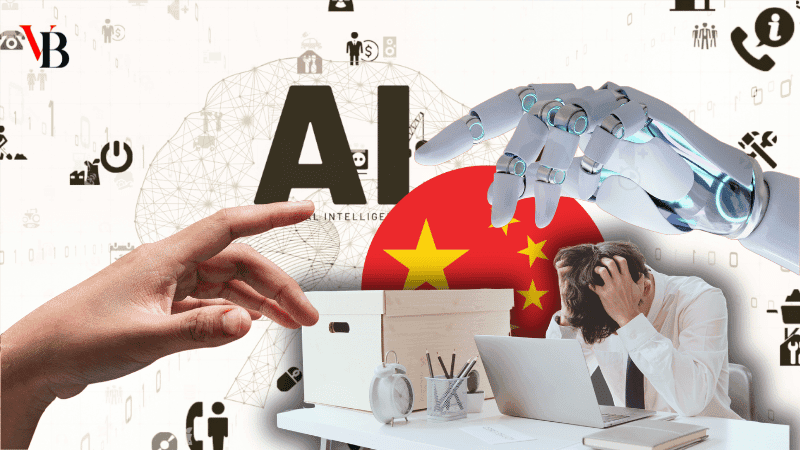

China is in a hurry to reach the future. Artificial intelligence is in its hands, robots are moving beside it, and an entirely new technological economy is beginning to take shape. But there is another picture behind all that speed.
It is the picture of a fresh university graduate searching for a first job, a mid-level programmer wondering whether his work can now be done by software, a translator watching fees fall, a researcher discovering that what once took several people can now be completed by one person with a few AI tools.
The machines are learning quickly. For many workers, the workplace is changing almost as quickly.
Fei Zhaojun, a computer programmer in Beijing, learnt that in a rather direct way. One day, his supervisor asked whether artificial intelligence could write code much like a human programmer. Fei did not have to wait long to see where the question was heading. Two weeks later, he lost his job. About 160 of his colleagues were laid off as well.
Fei later told the Associated Press that many tasks once handled by programmers with moderate levels of experience could now be done by AI. The result is easy to understand. A company that once needed a large team may now be able to run with a much smaller one. His story is personal. The problem is not.
China, the world's second-largest economy, is now living with two very different realities at the same time. It wants to move faster in artificial intelligence, automation and robotics as its technological competition with the United States intensifies. Beijing sees these technologies as central to its economic future.
Yet some of the very technologies meant to make China more productive are beginning to narrow the path into parts of the labour market.
The pressure is particularly visible in jobs involving data collection, translation, coding, basic research, writing and routine office work. The numbers already make for uncomfortable reading.
In August, unemployment among urban Chinese aged 16 to 24, excluding students, reached 18.9 percent. It had been 17.9 percent a month earlier. At roughly the same time, around 12.7 million university graduates were entering the labour market.
The South China Morning Post has reported that weak domestic demand is already making life difficult for young jobseekers. The fear that AI may reduce the number of entry-level positions has added another layer of anxiety.
It would be too simple, however, to blame China's youth unemployment problem on AI alone.
The economy has been struggling with a prolonged property downturn. Consumer spending remains weak. Businesses are cautious. Millions of graduates are entering the market every year, while the economy itself is going through a structural transition.
The Financial Times has also treated the property slump, weak consumption and automation as parts of the same broader employment problem. AI, then, is not the whole story. But it is changing the story.
For years, automation was usually discussed as a threat to factory workers. Machines could weld metal, sort packages or assemble products. The office worker, sitting behind a desk with a university degree, appeared relatively safe. That assumption is no longer so comfortable.
Claire Zhang worked for four years as a research analyst at a corporate consultancy in Beijing. Her job was the sort of work many educated young people spend years preparing for. She studied markets, examined rival companies, went through documents and sometimes helped produce reports running to hundreds of pages.
Then she was told the company did not need as many analysts as before. AI could do a growing share of the work. Zhang lost her job. Two colleagues were later laid off as well.
The South China Morning Post reported another change that may prove even more significant. Some clients of the consultancy had begun using AI to conduct their own research rather than paying outside analysts to do it. This is where the real disruption begins.
AI does not always replace a worker in the straightforward sense of a machine taking someone's chair. Sometimes it changes the arithmetic of an entire business.
A task that once required five people may now require one experienced employee, assisted by several AI tools. That does not mean the remaining four workers have suddenly become incapable. It means the company may no longer need them. The same pattern is emerging elsewhere.
Du Chunchun, a part-time translator in Chengdu, has said that she still finds work training AI translation systems. But the money is not what it used to be. Her pay has fallen by more than half compared with a few years ago.
China's fast-growing short-video and mini-drama industry is changing too. According to figures cited by the Associated Press, the number of short-form and vertical video series produced with real actors fell by around 75 percent in the first quarter of 2026 from a year earlier.
Generative AI is now being used to write scripts, create images, generate voices, edit footage and build scenes. And the changes are not confined to white-collar work. Robots are being tested in postal sorting centres. They are turning up in traffic management, coffee shops and food delivery.
Humans have certainly not become unnecessary. Far from it. But when a technology leaves the laboratory and enters the market, companies tend to ask a familiar question: can the same amount of work be done with fewer people?
In China, that question matters because AI adoption is moving at remarkable speed.
Citing data from market research firm IDC, the Associated Press reported that only 9.6 percent of Chinese industrial enterprises were using AI models or agents in 2024. By 2025, that figure had risen to 47.5 percent. And this transformation is not simply being left to the market.
It is state policy. Under China's "AI Plus" initiative, the government wants the use of next-generation intelligent devices and AI agents to exceed 70 percent by 2027 and 90 percent by 2030.
That creates a peculiarly Chinese contradiction.
The country is ageing rapidly. In the years ahead, its working-age population is expected to shrink. From that point of view, automation may eventually become part of the solution. Robots and AI could help an older China cope with a shortage of workers.
But that shortage belongs to the future.
Today's problem is almost the opposite.
Millions of young Chinese need work now.
So a technology that may help China deal with labour shortages 20 years from today can, at the same time, make it harder for a 22-year-old graduate to find a first job today.
There is another side to the story. AI is creating jobs as well.
Demand is growing for AI engineers, product managers, data trainers and other highly specialised professionals. New industries are appearing around the technology.
But the transition is not neat.
The jobs disappearing and the jobs being created do not demand the same skills. A translator cannot become an AI engineer in a few weeks. A junior researcher displaced by an automated system cannot simply walk into the team that designed it.
A few highly paid technical jobs may be created while a much larger pool of ordinary entry-level positions becomes thinner.
That may turn out to be one of the most important questions in China's AI experiment.
The challenge is not simply whether the technology works. It clearly does.
The more difficult question is what happens to the people caught between the old economy and the new one.
Factories may become smarter. Offices may become leaner. Productivity may rise.
But an economy is not made of output alone. It is also made of people earning wages, paying rent, raising families and buying what those highly efficient factories produce.
If jobs become harder to find and incomes fail to grow, another problem appears.
Who buys the extra goods?
For all the remarkable things artificial intelligence can already do, no algorithm has yet solved that political and economic contradiction.
China is unlikely to slow its AI drive. There is too much at stake in its technological competition, industrial ambitions and long-term demographic challenge.
But the harder race may be taking place somewhere else.
Machines are learning how to work faster.
The question now is whether the economy can learn, just as quickly, how to create enough new work for the people they are beginning to replace.
Leave A Comment