

Complex equation of shortening office hours: Naive triangular thinking

Whenever news of a supposedly 'groundbreaking' decision emerges from the inner circles of the country’s policymakers, ordinary people like us spend half the day trying to figure out whether we should feel delighted or simply sit with our hands on our heads in confusion.
Recently, we heard that with the noble aim of saving fuel, office hours are being reduced by one hour, ending at 4pm Moreover, everything must be wrapped up by 6pm—meaning shopping malls and other businesses will have to close as well.
After hearing the news, my simple mind keeps nagging me with questions. The problem, they say, is related to fuel consumption. But how exactly will reducing office hours or shutting down shopping malls affect fuel usage? That mathematical mystery is something I just cannot seem to solve. I have never been very good at mathematics, and even with age, my head hasn’t grown any wiser!
Our Bengali nation already seems well qualified to be world champions when it comes to cutting corners. If once shown a 'broken fence,' we might end up tearing down the entire house. If office hours are reduced from eight hours to seven, will people suddenly spread their wings and fly home in that saved one hour? Of course not! Rather, at least 15 minutes before 4pm, everyone will start packing their bags and stand by the door ready to leave.
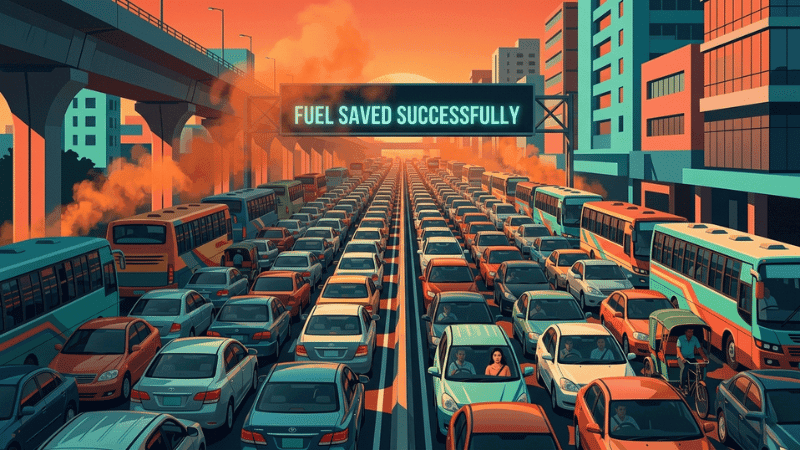
Then, when thousands of people and vehicles pour onto the streets at the same time, the catastrophic level of traffic congestion that will follow is enough to give one a fever just imagining it. Shoppers heading out of malls around the same time will also join the rush on the roads—at that point, what else would be left but a grand 'road show' of chaos?
The fuel rationing system also doesn’t quite make sense to me. You go from pump to pump, stand in long queues, manage to get a tiny bit of fuel, and it’s gone in no time—then you have to go again! Half the fuel is practically used up just getting to and from the petrol pump. If the tank were filled at once, there would be no need to go repeatedly.
Anyway, perhaps these things are not meant to be understood by people with limited intellect like me. Of course, the cynics say something else—apparently some people are bringing fuel home and stockpiling it. Well, we are Bengalis after all; it wouldn’t be entirely impossible!
The logic goes like this: if the goal is to save fuel, why not reduce the number of office days? Keeping offices open five days a week means vehicles are on the road all five days. If, instead, offices ran longer—say nine hours instead of eight—but with three days off per week, at least a day’s worth of commuting fuel would be saved.
We could work from 9 a.m. to 6 p.m., four days a week, and spend the remaining three days comfortably at home, “saving” fuel. This would reduce lines at petrol pumps, ease traffic congestion, and keep working hours intact. But our policymakers probably think that if people leave an hour early, they will suddenly sprout wings, fly home through the sky, and no wheel will turn on the road!
Now let’s turn to the matter of children’s education. Reducing school hours is like adding insult to injury. The irreparable loss in learning over the past few years—can cutting one hour from school really fix that?
If proper planning had been done, schools could have reduced the number of working days while extending class hours. With three days off each week, parents would have more time to focus on their children, which could at least partially make up for what’s missing in school. But as things stand now, children won’t get enough learning at school, and because of the traffic, parents will return home exhausted and collapse onto their beds. In the end, the sweetness of any benefit will be eaten up by the ants.
Thinking about the commercial losses makes one even more alarmed. With the emerging culture of cutting office hours and closing markets right at evening, how will the wheels of the economy keep turning? Halting the machinery of production in any way is unacceptable.
If the time for shopping, transactions, or urgent commercial work is taken away, the financial shortfall that will arise—can that gap be filled with a tiny saving in fuel? Absolutely not. This is, in fact, a kind of “foolishness” that we are being forced to swallow under the name of development.
It’s really hard for ordinary people like us to understand who sits inside the government and comes up with these “strange” ideas. Perhaps they have huge calculators where one hour equals saving millions of liters of fuel. But why don’t they account for the fuel wasted while stuck in traffic, which we see with our own eyes?
Why don’t they realize that reducing office hours actually lowers productivity? At the end of the day, people could spend more time with their families if the number of office days were reduced. That would strengthen family bonds and genuinely save fuel.
Those who imagine that leaving the office at 4pm will let them stroll home in royal comfort and lounge in the drawing room, please make sure to carry a large bottle of water, a fully charged smartphone, some snacks, and at least two full-length movies on your laptop. Because when offices close at 4 p.m. and markets shut at sundown, the streets will erupt into a “grand festival”—more or less a live “road show”!
In that festival, you and your car will stand shoulder to shoulder in a jam, turning the government’s “saved” fuel into smoke. And when that smoke fills your lungs, you’ll close your eyes in blissful peace and think—Ah! How wonderfully the country is saving fuel!
Perhaps a fool like me cannot grasp that this so-called saving ends up cutting into our pockets and wasting our time. Who is this saving really for? Is it saving at all, or merely a poetic lesson for Suja to understand?
AKM Jasim Uddin, Development worker
Leave A Comment
You need login first to leave a comment