
Court orders fail to curb pollution as toxic air chokes Dhaka
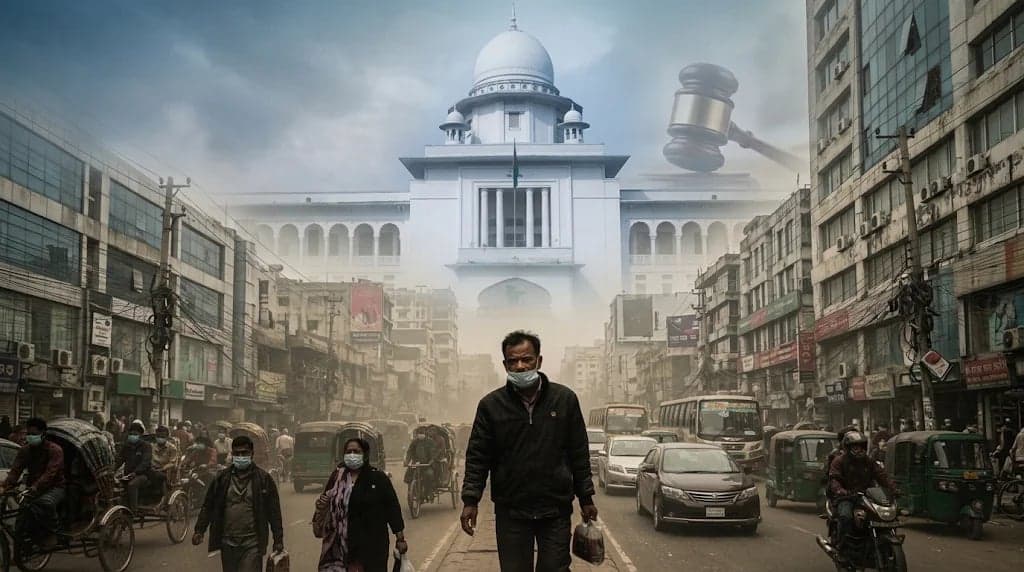

A thick layer of dust hangs over the capital, while toxic particles fill the air. Air pollution is worsening with the onset of winter, and neither repeated court directives, various government initiatives nor official pledges to protect the environment have managed to contain its alarming spread.
Millions of people continue to breathe polluted air day after day. Dhaka moves between second and third place on global rankings of the most polluted cities, and on some days tops the list as the world's most polluted city. Living with pollution has seemingly become part of everyday life in the capital.
The latest data from Swiss air quality monitoring company IQAir reflects the scale of the concern.
According to IQAir's live rankings for November, Dhaka's average Air Quality Index (AQI) stood at 310 this month, a level classified as “hazardous”. This means the capital's air is not merely unhealthy but has reached a level that poses a direct threat to public health. On the morning of November 16, Dhaka ranked as the world's most polluted city.
Kolkata, India, ranked second on the list this month, with an average AQI of 256. Lahore recorded a score of 220, followed by Mumbai at 172, Karachi at 170, Delhi at 163 and Kathmandu at 161. In contrast, Oslo in Norway emerged as the world's cleanest major city, with an AQI of just 10.
While people in some parts of the world breathe clean air, residents of Dhaka are forced to contend with toxic pollution every day.
Under the AQI scale, a score of 0–50 is considered good, 51–100 moderate or acceptable, 101–150 unhealthy for sensitive groups, 151–200 unhealthy, 201–300 very unhealthy and 301 or above hazardous.
The pollution crisis is not confined to the city's overall air quality readings. Air quality measurements in Dhaka and surrounding areas also point to an alarming situation. Dhaka and Savar recorded AQI scores of 354, while Tongi registered 350 and Azimpur 316. Gazipur scored 232, placing it in the “very unhealthy” category. Although the air in Sreepur was relatively better, its AQI still stood at 116. This indicates that the pollution has spread beyond the capital into neighbouring areas.
The High Court's intervention to address Dhaka's air pollution is not new. In 2019, Human Rights and Peace for Bangladesh (HRPB) filed a public interest writ petition. Following the petition, the High Court on January 28, 2019, directed the authorities to control dust from construction and renovation work, spray water twice a day in pollution-prone areas and have the Department of Environment conduct mobile court drives twice a week.
Later, on January 13, 2020, the High Court issued nine directives to the government and relevant agencies to control air pollution in the capital. These included ensuring that vehicles carrying soil, sand and waste were covered, enclosing construction sites, regularly spraying water on roads, seizing vehicles emitting black smoke, shutting down illegal brick kilns and taking action against factories operating without environmental clearance. The court also ordered that waste from markets and shops be placed in bags and removed at designated times.
With little effective progress in implementing those directives, the High Court intervened again on January 12, 2025. A bench comprising Justice Farah Mahbub and Justice Debasish Roy Chowdhury ordered the authorities to take effective measures to control pollution within seven days and implement the earlier nine-point directives. It also asked them to submit a progress report.
As no visible improvement followed, the court on October 30, 2025, directed the authorities to fully implement the nine-point directives within three weeks and submit a report.
On November 2 this year, the High Court issued fresh instructions on the same issue. A bench comprising Justice JBM Hasan and Justice Aziz Ahmed Bhuiyan asked the relevant authorities to submit affidavits within two weeks detailing the steps taken to implement the 2020 directives.
Earlier, the court had also summoned the deputy commissioners of five districts for failing to submit reports on the implementation of its directives. Yet the situation remains unchanged, with Dhaka seemingly becoming more polluted by the day.
Manzil Morshed, president of Human Rights and Peace for Bangladesh and a senior Supreme Court lawyer, told Views Bangladesh that the level of toxic pollution in Dhaka's air was rising, while questions remained over how effectively the agencies responsible for controlling pollution were coordinating their efforts and ensuring accountability.
“The level of toxic pollution in Dhaka's air is rising, yet it remains unclear how effective coordination and accountability are among the agencies responsible for controlling pollution. On one side are the court's directives, and on the other is the relentless rise in pollution. Caught between the two is the urban population's right to live and breathe clean air. Dhaka's position at the top of the list of the world's most polluted cities is therefore not merely a statistic, but also a reflection of longstanding failures in environmental management,” he said.
Leave A Comment