
Death descends from Kailash: The curse of ice in a warming world
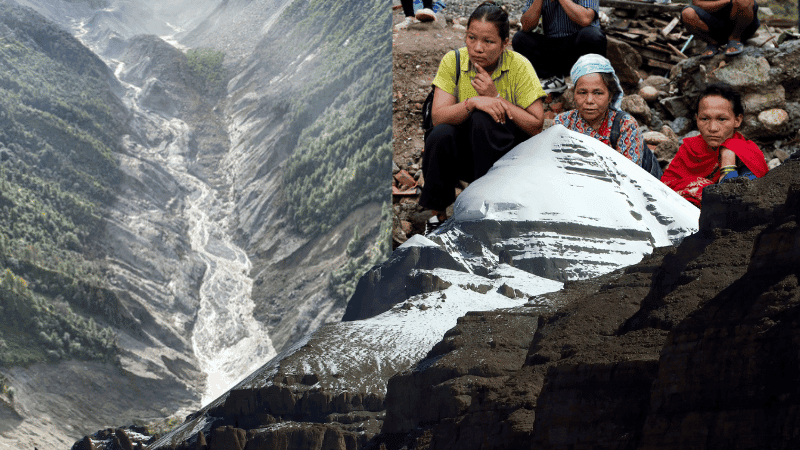

Kailash—the divine land of mythology. Where Lord Shiva resides in the pristine whiteness of snow, where the silence of the mountains has been understood by generations as a language of sanctity. But this time, from near that very Kailash, a different current descended—not just water, but a torrent of ice, rock, mud and death. In an instant, the familiar landscape of the Himalayas was transformed. Green mountains were buried under grey debris, rivers turned into raging torrents, and those on pilgrimage paths encountered the messengers of death.
In Hindu mythology, the arrival of Goddess Durga in autumn brings joy. But this Himalayan disaster in a warming world seems to recall another form of the goddess—Kali, fierce and terrifying. The impact of a world steadily heated by human hands has now burst through the frozen chest of the mountains into the valleys below.
According to information gathered so far, a massive glacial collapse was the primary trigger for the devastating flash flood and landslide along the Nepal-Tibet border. However, this event is not merely the story of a broken glacier. Deep within lie the tectonic movements of the Earth's crust over millions of years, the birth of the Himalayas, the fragile geology of the mountains and a terrifying equation of a changing climate.
The collision that created the Himalayas
As stable as the Himalayas may appear from the outside, geologically they are highly unstable. Nepal sits at the junction of the Indian and Eurasian tectonic plates. The Indian plate continues to push northward, colliding with the Eurasian plate at a rate of about 20 to 21 millimetres per year.
This movement is almost invisible to the human eye. But this collision, ongoing for hundreds of millions of years, has reshaped the Earth's map. The Himalayas were built from this collision, and the process has not stopped. The mountain range is still rising by a few millimetres each year.
In other words, the mountains we perceive as permanent are actually being continuously built, altered and eroded.
The relentless collision creates immense pressure within the Earth's crust. As a result, many slopes in the Himalayas are geologically active and relatively weak. A minor tremor, excessive rain, or the pressure from melting ice—any of these can destabilise the balance. And then, the mountains begin to fall.
The fall of ice, the fury of rivers
This disaster appears to follow a similar sequence. A large section of a glacier at approximately 5,200 metres broke off and crashed down to the valley nearly 1,200 metres below. The descent incorporated rocks, soil and vast amounts of sediment. Then began the second chapter.
That massive ice-rock avalanche blocked the river's flow, creating a temporary natural dam. Water accumulated upstream. When the dam finally burst, the stored water and debris surged down together, unleashing a devastating glacial lake outburst flood.
This combined avalanche of ice and rock is not like a regular flood. It does not just carry water; it brings down rocks torn from the mountain's body, mud, trees and debris. As a result, the flow becomes extremely dense and destructive.
According to preliminary assessments by ICIMOD, such an ice-rock avalanche blocked the Lende Khola River, and the subsequent breach released a powerful torrent. The water level in the river rose by about 9 metres in just 30 minutes at Galchi, a testament to its ferocity.
Not an earthquake, but the avalanche caused the tremor
Initial speculation pointed to an earthquake as the cause, as tremors were felt minutes before the disaster. However, later analysis dismissed that idea. The US Geological Survey said the seismic signals initially thought to be an earthquake were actually generated by the glacial avalanche and debris flow. In other words, the ice did not fall because the mountain shook; rather, the fall of ice and rock had shaken the mountain itself.
This distinction is crucial. It suggests that a major earthquake may not be necessary for such disasters. A combination of an unstable glacier, a weak mountain slope and accumulated water can sometimes be enough.
The shadow of a warming world
The question now is, why are glaciers becoming so unstable? Scientists have not yet confirmed a direct link between climate change and this specific event. But the bigger picture is alarming. Nepal's ice-covered peaks have lost nearly one-third of their ice in just over three decades. Glaciers in the Hindu Kush Himalayan region are also melting at an accelerated rate.
Rising temperatures cause glaciers to melt faster. As ice recedes, mountain slopes change. When permafrost—the long-frozen layer of soil and rock—melts, it can weaken the bonds within the mountains. New glacial lakes form, while older ones swell. Natural dams become fragile. Then a small event can open the door to a catastrophe.
Nepal has over 2,000 glacial lakes, at least 21 of which are identified as potentially dangerous. If the natural dam of any of these lakes were to break, a devastating flood could descend in an instant.
Limitations of early warning systems
The suddenness of this disaster has added to its severity. Since there was no major rainfall before the event, the effectiveness of conventional flood warning systems has also been called into question.
Hydrologists say that when a flow of mud, ice and rock becomes visible, there is often no time to escape. For the future, they say we must monitor not just weather forecasts but also river water levels, glacial movements and changes in mountain slopes simultaneously. Because danger in the Himalayas does not always come from the clouds. Sometimes, it comes from within the ice itself.
Those who were on the path to Kailash this time had gone driven by faith—some seeking a vision of Shiva, some seeking the sacred waters of Mansarovar. But the mountain revealed another face of nature, where religious sanctity and scientific warnings seem to converge.
We call the Himalayas the abode of gods. But that mountain is also not beyond the warmth of the Earth. Ice is melting. Mountains are shifting. Slopes are weakening. Glaciers are retreating. Nature seems to be telling us that its patience has a limit. The question remains: Will we consider cooling our warming world before nature's patience shatters completely? And if not, then some morning, without any warning, an even more terrible torrent of death may descend from the heart of Kailash once again.
Leave A Comment