

December 8: A historic day on the eve of victory
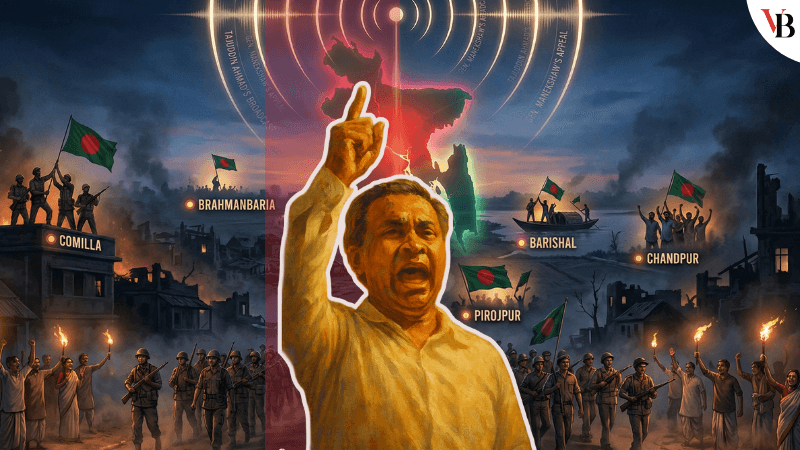

In the final phase of Bangladesh’s Liberation War, December 8 became a decisive turning point. On this day, developments across the military, political and international fronts made Pakistan’s defeat inevitable and brought the dream of independence within reach.
Tajuddin Ahmad’s decisive addres
Prime Minister of the Mujibnagar Government, Tajuddin Ahmad, declared in a radio address that “Independent and sovereign Bangladesh is now an established reality.”
He urged freedom fighters and citizens to unite for the final assault against the weakened Pakistani forces. He also thanked the Soviet Union for its UN veto and sharply criticised the policies of the United States and China, highlighting the global political tensions surrounding the war.
General Manekshaw’s call for surrender
Indian Army Chief General S H F J Manekshaw addressed Pakistani troops through All India Radio in Hindi, Urdu and Pashto, urging them to surrender. He warned that they were fully surrounded, without air support or reinforcements.
His message further broke the morale of the Pakistani military and accelerated the rapid advance of the liberation forces.
State-building preparations in Kolkata
The Provisional Government of Bangladesh in Kolkata announced plans to nationalise jute mills, tea estates, banks, insurance companies and other industries. Preparations to appoint district commissioners and expand the cabinet indicated that the administrative structure of a new state was already taking shape.
Political turmoil in Pakistan and mounting global pressure
Pakistan’s Deputy Prime Minister Nurul Amin and PPP leader Zulfikar Ali Bhutto left for New York to attend the UN session, while President Yahya Khan appealed for a nationwide “war fund,” reflecting the regime’s desperation.
At the United Nations, India’s Permanent Representative Samar Sen stated that the creation of Bangladesh was now a reality Pakistan had to accept. UN Secretary-General U Thant proposed a neutral safe zone for evacuating UN officials from Dhaka, confirming the international community’s recognition of the unfolding situation.
Two major news agencies reported that in a UN vote, 104 countries supported a resolution related to the crisis, while only 11 opposed it. The resolution required Pakistan to create conditions for the safe return of Bengali refugees—something Pakistan resisted.
According to The New York Times, Pakistan’s representative Agha Shahi declared that Islamabad would not negotiate with “the Bengali rebels.”
Torchlight rush in blackout-stricken Dhaka
Following renewed curfew and blackout orders on December 8, Dhaka saw a surge in demand for torches and batteries. Newspapers reported that supplies in local shops were nearly exhausted and prices had sharply increased.
Countrywide liberation gains
December 8 was one of the most eventful days of the war, marked by the liberation of multiple districts.
Cumilla was freed in a joint operation by the Mukti Bahini and Indian forces, and the flag of Bangladesh was raised at the town hall.
Brahmanbaria was liberated without resistance, and advances toward Ashuganj opened the route to Dhaka.
Barishal was freed after air strikes forced Pakistani troops to flee by river.
In Chandpur, Pakistani naval vessels were heavily damaged in air attacks, and the national flag was hoisted.
Pirojpur was fully liberated by dawn after Pakistani troops retreated overnight.
On the Mymensingh–Dhaka front, three columns under General Aurora pushed rapidly toward Dhaka, tightening the encirclement.
December 8 was more than a day on the calendar—it was the eve of victory. With rapid military successes, decisive political leadership and growing global recognition, Bangladesh stood on the threshold of independence.
The events of this day brought the nation directly to the brink of the ultimate triumph of December 16.
Leave A Comment
You need login first to leave a comment