

December 9: The final march towards victory
December 9, 1971. The countdown to the final victory of the great Liberation War has begun. Pakistani occupying forces were surrounded from all sides. The allies and the liberation forces are advancing from all sides with the aim of reaching Dhaka quickly. Only a few more days to wait, which became clear in the inauguration ceremony of the Bangladesh Mission in Delhi and in every news from the battlefield.
Inauguration of the Bangladesh Mission in Delhi and diplomatic activities
Bangladesh Mission in Delhi was formally inaugurated on this day. The ceremony was attended by Indian Tourism Minister Dr. Karan Singh, Industries Minister Mainul Haque and Foreign Secretary SK Banerjee. Mission Chief Humayun Rashid Chowdhury said in a firm voice in his speech, 'Dhaka will be liberated within the next few days.' With the fall of Dhaka, our motherland will be free from the clutches of the invading enemy.’ He warned, ‘If Pakistan does not withdraw its attack against India, the Mukti Bahini will continue the war with the Indian soldiers in West Pakistan as well.’ In his speech, he expressed deep gratitude and emotion towards Indian Prime Minister Indira Gandhi and Bangabandhu Sheikh Mujibur Rahman.
On the same day, a joint meeting of the Cabinet and Advisory Council of the Bangladesh government (comprising the Awami League, NAP, Communist Party and National Congress) was held. This was the first meeting after the recognition of India and Bhutan, where emphasis was laid on civil administration, food, medical treatment and rehabilitation in the liberated areas.
The Indian government formed a liaison team consisting of 12 IAS officers to provide administrative assistance to Bangladesh. Additional Secretary of the Foreign Office B. R. Gupta was made its head, and it was decided that this team would leave for Dhaka immediately after the liberation of Dhaka.
India's political position and threats
In the session of the Indian Lok Sabha, Prime Minister Indira Gandhi clearly stated, 'India has rejected the unrealistic proposal made in the UN General Assembly for a ceasefire and withdrawal of troops. We have been hit so far, now we are also hitting back.'
In separate speeches, Indian President V. V. Giri and Defense Minister Jagjivan Ram condemned Pakistan's atrocities and confirmed that the Indian army was on the way to final victory by defeating the Pakistani army in Jessore, Sylhet and Comilla. The West Bengal Pradesh Congress Committee announced the celebration of 'Bangladesh Day' on December 12.
International polarization: Seventh Fleet and the Cold War
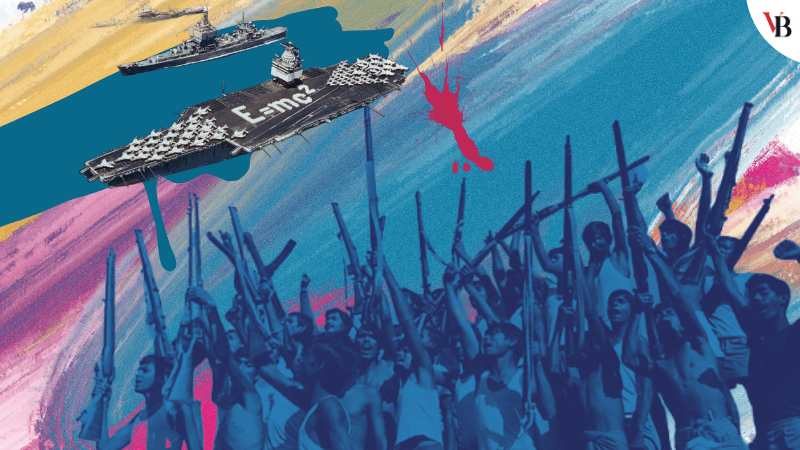
Tensions in the international community were at their peak. Knowing that Pakistan's defeat was certain, US President Nixon ordered the Seventh Fleet to sail towards the Bay of Bengal to save them. The aim was to thwart the Indian naval blockade and break the morale of the freedom fighters. In response, the Soviet Union also sent 20 of its warships to the Indian Ocean. Former British Prime Minister Harold Wilson made it clear that Pakistan was responsible for the situation in the subcontinent.
Meanwhile, Pakistan's representative to the United Nations, Mahmud Ali, returned home and expressed gratitude to China and the United States and criticized the Soviet Union. Pakistani Prime Minister Nurul Amin called on the people to stand up against Indian 'attacks' and 'conspiracies' in a radio address.
Battlefield picture: Four-pronged attack
On this day, the Eastern Command Chief of the Allied Forces, Lieutenant General Jagjit Singh Arora, announced at a press conference in Kolkata, 'We are now ready for a major battle.' He said that PT-67 water tankers and supplies were ready for river crossings.
The Allied forces continued to advance towards Ashuganj-Daudkandi in the east, the Madhumati River in the west, and Mymensingh and Kushtia in the north. A total of 700 Chhatrisena troops were landed near Tangail. Indian Army Chief General Manekshaw called on the Pakistani soldiers to surrender, saying, "If you want to live, lay down your arms, otherwise a cruel death is inevitable."
The situation was so critical that Pakistan General Niazi, for the first time, admitted the seriousness of the situation and sent a message to Rawalpindi and appealed for Chinese help.
Nationwide resistance and liberated areas
On December 9, various places in the country were liberated from the invaders. Notable among these were—Gaibandha, Netrokona, Kapilmuni in Khulna, Kumarkhali in Kushtia, Daudkandi in Comilla, Titas in Brahmanbaria, Sreepur in Gazipur, Hathazari and Nazirhat in Chittagong, Ishwarganj, Gafargaon, Trishal in Mymensingh, and Nakla in Sherpur.
Kapilmuni in Khulna: Kapilmuni was liberated after 4 days of continuous fighting. 155 Razakars surrendered. Later, they were sentenced to death by the verdict of the People's Court.
Brahmanbaria and Ashuganj: A fierce and bloody battle was fought between the Pakistan army and the 'S' Force and allied forces in Ashuganj. In this, 140 Pakistani soldiers were killed and 40 allied soldiers were martyred.
Jamalpur and Sherpur: After the Indian airstrike, 600 Pakistani soldiers surrendered in Jamalpur. 150 freedom fighters hoisted the flag in Nakla.
Kumarkhali, Kushtia: Kumarkhali was liberated after a fierce battle with the Razakars Feroz Bahini. The army committed genocide in the city before fleeing.
Netrokona: A total of 3 freedom fighters were martyred in a three-way clash and Netrokona was liberated.
Trishal and Bhaluka: Freedom fighters under the leadership of Afsar Bahini Company Commanders Ansaruddin and Abdul Bari attacked Trishal and forced the Razakars to surrender.
Chittagong: Battles were fought under the leadership of Lieutenant Shawkat at Nazirhat and under the leadership of Group Commander Nazim Uddin at Betbunia in Kaukhali. Commander Nazim and freedom fighter Zafar were martyred in the battle of Betbunia. With the liberation of Daudkandi, the entire eastern region of Meghna was liberated. It came under the control of the Mukti Bahini.
Atrocities of the Pakistan Army
Despite knowing that defeat was certain, the Pakistan Army did not stop their atrocities. In Rajshahi, under the leadership of OC Shamsul Alam, they blindfolded and abducted four people including Shawkat Reza from the Rajshahi University hostel and tortured them. For a whole 9 months, they used the Shaheed Shamsujoha Hall of Rajshahi University as a slaughterhouse.
Thus, on December 9, 1971, with diplomatic pressure on one side, the Cold War of the superpowers on the other, and the indomitable courage of the freedom fighters on the battlefield, the victory of the Bengalis became inevitable.
Leave A Comment
You need login first to leave a comment