
Dhaka-Delhi ties 'organic', dialogue must continue: Bangladesh's outgoing High Commissioner to India
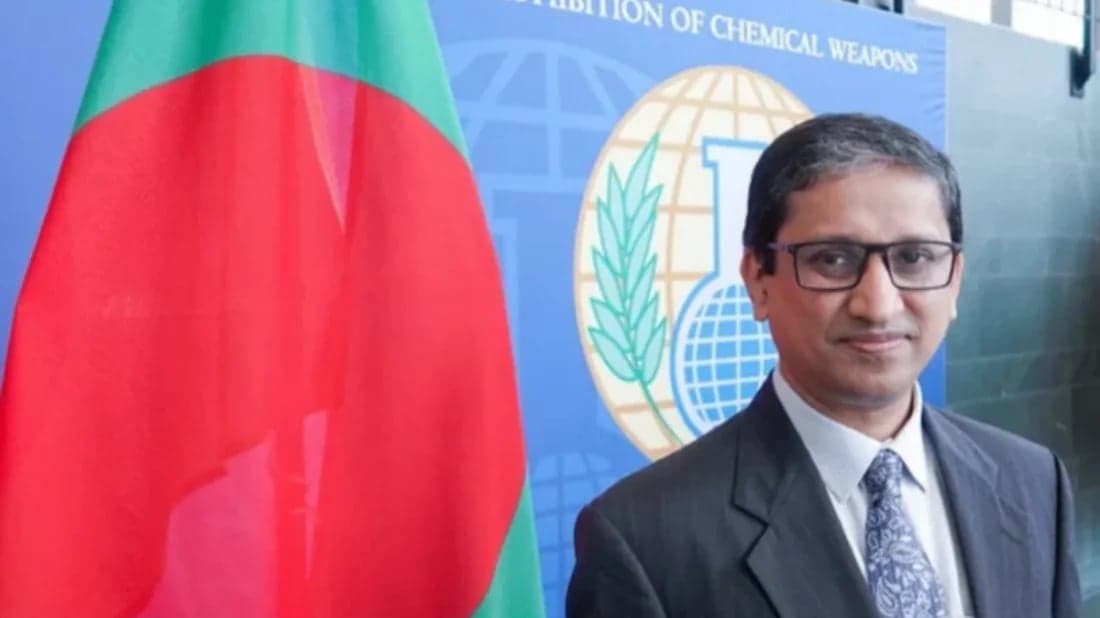

Bangladesh's outgoing High Commissioner to India, M Riaz Hamidullah, has described the relationship between Bangladesh and India as 'organic' and one built on mutual dependence and shared interests. He said communication and dialogue must continue even if there are differences between the two countries.
In an interview with Indian media outlet ANI, he said, "To put it very simply, this is a relationship that I have at various times referred to as an organic relationship... a relationship of mutual dependence. It is a relationship of shared interests."
Riaz Hamidullah assumed charge as Bangladesh's High Commissioner to India on April 7, 2025. He will leave New Delhi early next month. After that, he will take up a new assignment as Bangladesh's Permanent Representative to the United Nations in Geneva, according to United News of Bangladesh (UNB).
Riaz Hamidullah said that, like any close relationship, differences in opinion, perspective and approach between Bangladesh and India are natural. Such differences can be expected, especially between two geographically close countries.
However, he remarked that despite these differences, the two countries must continue communication. In his view, people-to-people communication and the scope of mutual understanding between the two countries need to be expanded far more than at present.
Emphasising increasing people-to-people communication, Riaz Hamidullah said communication between the people of the two countries should not be limited to conventional exchanges but expanded further. This could create communication among millions of people and strengthen mutual understanding between the two countries.
He said, "This is an unexplored area that is still lying fallow."
He noted that although communication between ministries and governments is important, there is scope for broader communication in the social and educational sectors.
As an example, he spoke of increasing communication among students, schoolchildren and university students. In his view, greater communication in these areas could reach "millions" of people and bring significant change to the relationship between the two countries.
Recalling his recent experience in India, Riaz Hamidullah mentioned his visit to Delhi Public School (DPS) Srinagar in Kashmir on his verified X account. After arriving in Srinagar on September 3, he visited the school. He said he was particularly drawn to the participatory and education-oriented environment there, with more than 5,000 students.
DPS Srinagar was established in 2003 through the D P Dhar Memorial Trust on the initiative of Vijay K Dhar. The Dhar family has long-standing ties with Bangladesh. The late D P Dhar played an important role during Bangladesh's independence and its early years.
Riaz Hamidullah said his conversation with the school's students gave him a different perspective on how young people view issues such as borders and identity.
A twelfth-grade student at the school, RJ Fatima, introduced herself as a radio jockey and invited him to the school's digital radio station. The High Commissioner said the station has been operating since 2019.
Riaz Hamidullah said, "She just invited me and took me to the radio studio. There our conversation began."
He said one of Fatima's questions surprised him the most. The question was, "How do you see the border?"
Riaz Hamidullah said, "Imagine, a girl sitting in Srinagar is asking such a question." He said he took the question very openly and answered it accordingly.
Recently, Indian High Commissioner to Bangladesh Dinesh Trivedi also called for continuing trade, cultural exchange and people-to-people communication between Bangladesh and India. He said these matters should not be held up due to the political situation.
Speaking to journalists after a cultural event in Dhaka earlier this month, he said the two countries will continue discussions on various issues. However, matters such as the Maitree Express, the Ganges water treaty, trade and cultural exchange should not be held up.
He said, "These are matters of ordinary people." He emphasised keeping ordinary people at the centre of the relationship between the two countries.
Dinesh Trivedi said trade restrictions on both sides must be eased. Otherwise, ordinary people will suffer.
He further said the political process should be allowed to move at its own pace, and there is no need to rush it. However, work related to ordinary people must continue.
Earlier on Tuesday, India also reiterated its interest in taking Bangladesh-India relations forward in a positive, constructive and future-oriented manner. Indian Ministry of External Affairs spokesperson Randhir Jaiswal said this in response to a question on bilateral relations at a press briefing in New Delhi.
He said India is ready to discuss all bilateral issues with Bangladesh through the existing structured mechanism.
Leave A Comment