
Digital age press freedom: Opportunity or new control mechanism?
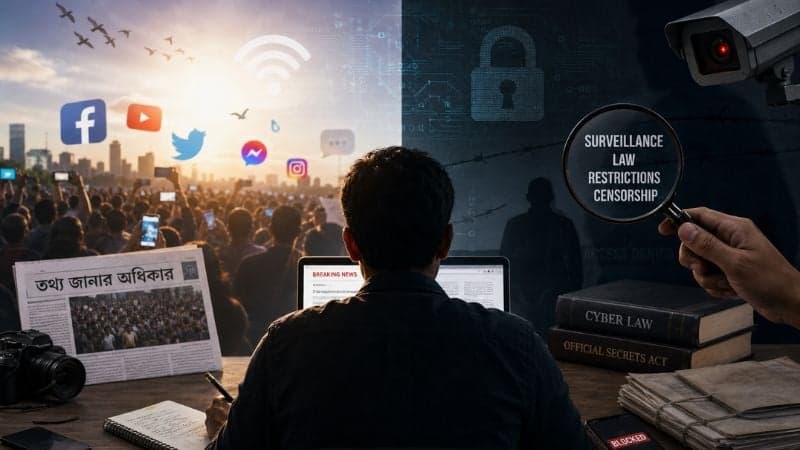

The digital revolution has changed journalism more rapidly than any previous era. News now spreads instantly through smartphones, social media platforms, and online news portals, removing many of the traditional barriers that once controlled information flow. In principle, this shift has expanded press freedom by allowing more voices to publish and reach global audiences without depending entirely on established media institutions.
Across the world, including Bangladesh, journalists now operate in a complex digital environment where freedom of expression and restrictions often coexist within the same platforms.
Yet on World Press Freedom Day, a critical question arises: has digitalisation truly strengthened press freedom, or has it replaced old forms of control with newer, less visible ones?
Expansion of Access and New Voices
One of the most significant achievements of the digital age is the democratisation of content creation. Today, anyone with a smartphone and internet access can report news, share opinions, and reach large audiences without needing a traditional newsroom.
In Bangladesh, this shift has contributed to the rise of independent digital media outlets, online investigative journalism, and citizen reporting through platforms such as Facebook and YouTube. Young journalists and freelancers are increasingly bypassing traditional gatekeepers, producing content on social issues, local governance, corruption, and community-level problems that often receive limited attention in mainstream media.
This expansion has diversified the media landscape and created opportunities for underrepresented voices to participate in public discourse.
However, this openness is not absolute.
Invisible Control Through Algorithms and Platforms
Unlike traditional censorship, which is often direct and visible, digital control mechanisms are subtle and embedded in technology itself. Social media platforms and search engines use algorithms to determine which content is prioritized and which remains unseen.
These algorithms typically favor engagement-driven content—such as sensational headlines or emotionally charged posts—over in-depth investigative reporting. As a result, important journalistic work may struggle to reach audiences unless it aligns with platform-driven visibility patterns.
A Dhaka-based media researcher notes: “Control in the digital age is not always about banning content. It is about deciding what becomes visible and what disappears in the feed.”
This shift means that journalists are increasingly required to consider not only editorial standards but also platform algorithms when producing content.
Bangladesh Context: Regulation, Risk, and Self-Censorship
In Bangladesh, digital journalism has expanded significantly, but it exists within a sensitive regulatory environment. Cyber-related laws and monitoring frameworks have raised concerns among media professionals about legal risks associated with online reporting.
As a result, many journalists practice self-censorship, particularly when covering politically sensitive issues, governance, or security-related topics.
A senior journalist in Dhaka, speaking anonymously, said: “We do not always need direct pressure. The fear of consequences is enough to influence what we choose to publish.”
This anticipatory form of self-censorship represents one of the most significant challenges to press freedom in the digital space.
At the same time, digital platforms have also enabled more investigative opportunities. Journalists now use open-source data, digital archives, and public submissions to uncover stories that were previously difficult to access.
Global Perspective: Surveillance and Digital Threats
The challenges faced in Bangladesh reflect a broader global trend. Around the world, journalists increasingly face digital surveillance, hacking attempts, and online harassment.
Reports from international media watchdogs indicate a rise in the use of spyware and monitoring tools targeting journalists’ communications. Additionally, coordinated online harassment campaigns have become a growing threat, particularly for investigative reporters and women journalists.
A global media analyst observes: “Press freedom today is not only challenged by governments but also by technology systems and digital ecosystems that can silently restrict information flow.”
Data Snapshot
More than 70 countries have introduced new digital media or cyber laws in the last decade affecting online expression
Over 60 percent of global news consumption now occurs through social media and search engines
A significant number of journalists report self-censorship due to legal or digital risks
Online harassment of journalists has increased substantially in the past decade, especially on social platforms
The digital age has transformed press freedom rather than simply expanding or restricting it. Journalism now operates within a system shaped by technology, algorithms, regulations, and digital behavior patterns.
For journalists in Bangladesh and across the world, the central challenge is no longer only access to information, but ensuring that truthful reporting remains visible, credible, and protected within increasingly complex digital ecosystems.
On World Press Freedom Day, the question remains open: the digital era has given journalism unprecedented reach—but it has also created new, often invisible mechanisms that continue to redefine what press freedom truly means.
Leave A Comment