
Durga Puja: Religion, history, literature and festival culture of Bengal
At the outset, let us correct one misconceptions that have long been repeated. That is-- Durga Puja should be called Sharadotsav, or the autumn festival.
Strictly speaking, Sharadotsav should refer to a festival held during the autumn season. In the Bengali calendar, Bhadra and Ashwin constitute autumn. Yet the Indian calendar reveals an interesting complication: when Durga Puja falls in Ashwin one year, it may fall in Kartik the following year, which belongs to the Hemanta season, or late autumn. Durga Puja, therefore, cannot be described as an exclusively autumnal festival in the strictest sense. Nevertheless, the name Sharadotsav has secured a permanent place in popular usage and literature.
The sixteenth-century poet Mukundaram Chakraborty wrote in his Chandimangal, also known as Abhayamangal: “In Ashwin, people worship Ambika, offering sacrifices of goats, buffaloes and sheep.” Centuries later, Rabindranath Tagore, too, wrote of the season: “In mid-Ashwin, the drums began to sound.” There is little point, therefore, in dwelling too long on the fine distinction between whether Durga Puja belongs to autumn or late autumn.
The Hindu pantheon encompasses a vast array of deities. Among them are Kali, Lakshmi, Saraswati, Shiva, Krishna, Ganesha and Kartikeya, known to Bengalis simply as Kartik. There are also Vishwakarma, Shitala, Manasa, Ma Shashthi, Dakshin Rai, the tiger deity, Santoshi Mata, the deities associated with Chhath and Kamakhya. India is home to people of numerous linguistic, ethnic and cultural backgrounds, and each region has its own traditions of worship and distinctive pantheon of deities.
Among the deities worshipped by Tamil communities is Murugan, the god of war and beauty, regarded as the Tamil counterpart of Kartikeya. Perumal is a form of Vishnu in Tamil religious tradition, while Meenakshi is identified with Parvati or Durga. In Andhra Pradesh, Venkateswara and Bhramaramba are worshipped. Odisha venerates Jagannath, Balabhadra and Subhadra. Rajasthan has its own regional deities, including Gogaji, associated with serpents, and Pabuji, regarded as a protector of camels and cattle.
Punjab, meanwhile, is home to people of different religious communities, including Hindus, Sikhs and Muslims. The worship of Surya, the sun god, and Baba Balak Nath is also found in the region. Some nomadic communities worship Sanjhi Mata, while the Rajbanshi community has traditions of worship associated with Masai.
Polytheism, in fact, forms an important part of the history of human civilisation. It once flourished in many parts of the world, including ancient Egypt and Greece. Even in pre-Islamic Arabia, the Kaaba in Mecca was associated with the worship of multiple deities. Historical accounts refer to idols of Hubal, also spelt Habal, Al-Lat, Manat and Nasr, among others. According to traditional accounts, as many as 360 idols were housed there.
During the Vedic period of Indian history, the worship of various deities developed alongside philosophical ideas about a supreme reality. The history of Islam, meanwhile, records that the worship of multiple gods was widespread in Arabia before the advent of Islam. The Prophet Muhammad preached the worship of Allah alone, establishing the foundation of Islam as a monotheistic religion.
The principal observances of Durga Puja traditionally extend from Shashthi, the sixth day of the lunar fortnight, to Dashami, the tenth. The preceding Panchami is sometimes included in the festival period, as idols are brought into the pandals and rituals involving flowers and lamps are performed. Depending on the duration of the lunar dates, the celebrations may last four, five or six days. In 2026, the festival is expected to extend over six days because of the prolonged duration of Saptami; counting Panchami as well would make it a seven-day celebration.
Few other deities are worshipped in a festival that commands such an extended period of public celebration. This is one of Durga Puja's distinctive features. Another is the extraordinary number of magazines and literary publications released to mark the occasion.
Kolkata, one of the principal centres of Durga Puja, naturally leads the way in publishing special festive editions. Daily newspapers, too, bring out elaborate puja numbers, often featuring an impressive collection of fiction, essays, poetry and other literary works.
The magazines Desh and Anandamela played a notable role in the literary worlds associated with Satyajit Ray, whose popularity endured for more than five decades. Sagarmoy Ghosh, the editor of Desh, decided that each year's Puja edition should feature a novel by a younger writer alongside works by established authors. This initiative helped bring writers such as Sunil Gangopadhyay, Shirshendu Mukhopadhyay and Buddhadeb Guha to a wider readership.
Non-commercial magazines appear in even greater numbers than their commercial counterparts, often astonishing readers with their diversity of subjects. One publication might devote itself entirely to mime; another might explore rivers, Native American literature, a celebrated thinker, cremation grounds, the Sundarbans or people who have lived beyond a hundred years.
According to some literary historians, Rabindranath Tagore's Sadhana, published in 1892 (Bengali year 1299), has a strong claim to being the first fully developed autumnal special issue. The magazine's editor at the time was Sudhindranath Tagore, the poet's nephew. It carried Tagore's short story Swarnamriga. Later, in 1913, the magazine Bharatbarsha appeared in a specially designed edition for the Puja season. More than a century has passed since then. So many magazines, rich in short stories, novels and essays, have appeared over the years that their history could easily sustain a dozen research volumes.
Yet this history also has its melancholy side. Once, several remarkable literary magazines appeared around the Puja season, including Ekkhon, Bibhab, Pratikshan, Baromas, Prama and Bartika. Readers eagerly awaited their arrival. Ekkhon attracted particular attention because it regularly published screenplays by Satyajit Ray.
What an extraordinary coincidence! Ray died shortly after the screenplay of Agantuk was published. And before the printed screenplay could reach the market, Nirmalya Acharya, the magazine's editor, also died. Soumitra Chatterjee had been associated with Ekkhon in its early days, but Acharya later ran it on his own.
Let us return, then, to Durga Puja.
One of the earliest references to a goddess associated with Durga in the subcontinent appears in the ancient Upanishadic tradition. In the Kena Upanishad, Uma appears as a divine figure who explains the significance of the supreme power underlying the universe. Over the centuries, the goddess's form and modes of worship have evolved. In ancient times, she was also worshipped as Bon Durga, or the goddess of the forest. Her significance in the lives of ancient forest-dwelling communities is not difficult to imagine.
Even today, Bon Devi, the forest goddess, is worshipped on the full-moon day of the Bengali month of Poush in the Baikunthapur forest near Siliguri, in West Bengal. In Bankim Chandra Chattopadhyay's novel Devi Chaudhurani, the region is also associated with the secret refuge and place of worship of Bhavani Pathak and Devi Chaudhurani.
Goddess Shakambhari is another form associated with Durga. According to the Markandeya Purana, the demon Durgamasura tormented the earth for a hundred years, bringing drought and famine in his wake. Goddess Parvati then assumed the form of Shakambhari and produced fruits and vegetables from her own body, relieving humanity's hunger. She eventually killed Durgamasura. The story of this victory is also associated with explanations of the goddess's name, Durga.
Shakambhari is worshipped on the full-moon day of Poush as well. Her principal centres of worship include the Shakambhari shrine in Rajasthan and the Shakti shrine in Saharanpur, Uttar Pradesh.
One of the most significant elements of Durga Puja is the Nabapatrika, literally a collection of nine plants. Each plant is associated with a particular form of the goddess or another deity. The banana plant, or kadali, represents Brahmani; colocasia represents Kalika; turmeric represents Uma; the wood apple represents Shiva; pomegranate represents Raktadantika; the ashoka tree represents Shokarahita; mankachu, a variety of taro, represents Chamunda; and paddy represents Lakshmi.
The association of these plants with different goddesses is intriguing. Nabapatrika suggests that the festival may have had an agricultural foundation, rooted in the worship of a deity associated with crops and fertility.
The scholar Shashibhushan Dasgupta wrote: “This bride of the harvest must first be worshipped as the goddess's symbol. The reason is that the original form of the autumnal worship was probably the worship of this very harvest deity. Various interpretations of Nabapatrika were subsequently introduced into the different rituals of Durga Puja.”
The connection raises an interesting question. Paddy is closely associated with Lakshmi, the goddess of prosperity and abundance. Yet, in popular Hindu mythology, Lakshmi is regarded as a daughter of Durga. How, then, did a symbol of Lakshmi come to represent Durga herself?
The nine plants of Nabapatrika are gathered together, and two wood apples are bound together to symbolise the goddess's breasts. The arrangement is then tied to a banana plant with a white aparajita creeper and placed on the right-hand side of the Durga idol. Before being installed, the Nabapatrika is ceremonially bathed in a river or pond under the supervision of the priest. Its worship marks the formal beginning of Durga Puja.
Sandhi Puja
Sandhi Puja is one of the most important observances of Durga Puja. It takes place at the juncture between Ashtami, the eighth lunar day, and Navami, the ninth. The prescribed period consists of the final 24 minutes of Ashtami and the first 24 minutes of Navami, making a total of 48 minutes.
What is the deeper significance of Sandhi Puja?
According to the Puranic narrative, Chanda and Munda were two demons serving as commanders under the demon kings Shumbha and Nishumbha. While the goddess was engaged in battle with Mahishasura, the two demons attacked her. She then manifested Chamunda through the power of her third eye and killed them. This episode is known as the slaying of Chanda and Munda.
Some popular legends also describe the goddess as having sustained 108 wounds during battle. Mahadeva, or Shiva, is said to have advised her to bathe in Devideha. According to one version, 107 lotuses covered her wounds, while the remaining wound was healed by Shiva's tears, from which another lotus emerged. Different versions of this story exist, however, and it should not be treated as a universally accepted account from the Puranas.
The offering of 108 lotuses is a traditional feature of Sandhi Puja. Hibiscus flowers are also used, and Chamunda is worshipped during the ritual. The association with the slaying of Chanda and Munda gives this observance its special significance within the larger festival.
The Ramayana tradition also contains a story of Durga worship. Before confronting Ravana, Rama is said to have worshipped the goddess to seek her blessings. When 108 lotuses were required for the ritual, Hanuman gathered them. To test Rama's devotion, the goddess concealed one flower. Rama, known in popular tradition as Padmapalashalochana, or lotus-eyed, then prepared to offer one of his own eyes in its place. Pleased by his devotion, the goddess stopped him and returned the missing lotus.
This story is associated with Rama's Akal Bodhan, or untimely invocation of the goddess, and with the wider tradition of Durga worship. Different religious interpretations exist regarding its relationship with Sandhi Puja.
These mythological narratives and ritual associations help explain the special importance attached to Sandhi Puja.
Kumari Puja
Another notable ritual of Durga Puja is Kumari Puja, the worship of a prepubescent girl as a manifestation of the divine feminine. The practice is supported by Tantric traditions and is described in texts such as the Yogini Tantra, Yamala Tantra and Kularnava Tantra. It is also discussed in Tantrasara, a work attributed to Krishnananda Agamavagisha, a renowned seventeenth-century scholar from Nadia. At its heart lies the recognition of the sacred and transcendent potential of womanhood.
In this context, a kumari is a girl who has not yet begun menstruating. According to certain scriptural traditions, girls between the ages of one and sixteen may be worshipped as kumaris. Different names are assigned to them according to age, including Sandhya, Saraswati, Tridhamurti, Kalika, Subhaga, Uma, Malini, Kubjika, Kalasandarbha, Aparajita, Rudrani, Bhairavi, Mahalakshmi, Pithanayika, Kshetrajna, and Annada or Ambika. Kumari Puja is generally performed on Maha Ashtami.
Evidence of the practice's antiquity includes a Bengali manuscript titled Kumari Puja Prayoga, preserved at the Bangla Academy in Dhaka under catalogue number 159. Today, Ramakrishna Mission centres in different parts of the world conduct Kumari Puja during Durga Puja, worshipping the young girl as an embodiment of the Divine Mother. Swami Vivekananda played a significant role in popularising the practice.
According to traditional accounts, Vivekananda worshipped a Muslim girl as a kumari in Kashmir in 1898. The episode carries particular significance in the social and religious context of its time. When Durga Puja was introduced at Belur Math in 1901, several girls were worshipped as kumaris. Vivekananda himself is said to have performed the ritual for four of them. The practice has continued at Belur Math during Durga Puja ever since.
In Bangladesh, Kumari Puja is also held at several centres run by the Ramakrishna Mission, particularly in Dhaka, Habiganj and Dinajpur.
The worship of the goddess in the form of a young girl is also linked in some mythological narratives with the slaying of demons. One traditional account attributes the slaying of Banasura to the goddess in her youthful form.
Interestingly, Kumari Puja is also practised in Nepal, both during the Durga festival and at other times of the year. Under Nepal's living goddess tradition, girls are selected before puberty according to criteria that include age, physical characteristics and religious requirements. The tradition also provides for a pension or allowance after a living goddess relinquishes her ceremonial role.
In Nepal, the practice is not confined to Hindus. Buddhists, too, revere the kumari as a living manifestation of the divine feminine. She is associated with Taleju Bhawani and regarded as a living form of Durga or Kali. The tradition has deep historical roots in Nepal's medieval cities. Living goddesses are generally selected from Shakya or Vajracharya Buddhist families.
In Bengal, however, caste and religious identity have not always been treated consistently in the selection of girls for Kumari Puja. Although the principle of the ritual does not necessarily require a single community background, Brahmin girls have traditionally been selected in many instances.
It is worth mentioning that British filmmaker Alan Ereira made a documentary titled The Living Goddess about Sajani Shakya, a girl who was worshipped as a living goddess in Nepal.
The stories and traditions associated with Durga Puja are virtually inexhaustible. This account has attempted to convey something of their diversity and scope.
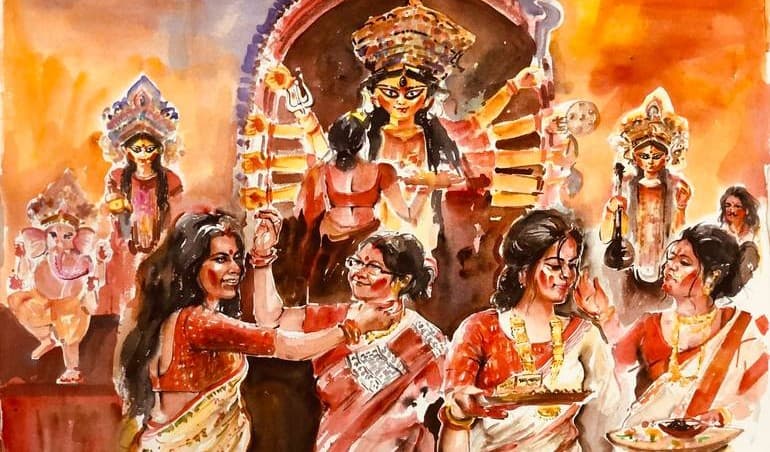
Durga Puja, however, extends far beyond religious rituals. It encompasses the artistry of pandal construction, the aesthetic appeal of idols depicting Durga and the deities accompanying her, ceremonial offerings of food, anjali or flower offerings, communal feasts, the rhythmic beat of dhak drums, and crowds moving from one pandal to another. It is also a season of romance among young people, new clothes, elaborate dressing and social gatherings.
Finally, before the immersion of the idols, married women participate in Debi Boron, a ritual farewell to the goddess, followed by Sindoor Khela, the playful smearing of vermilion. Then begins the wait for another year—for the goddess to return.
It is this annual anticipation of her homecoming that breathes new life into Durga Puja year after year.
Leave A Comment