

Earthquake in the Concrete Trap: Life and Risk
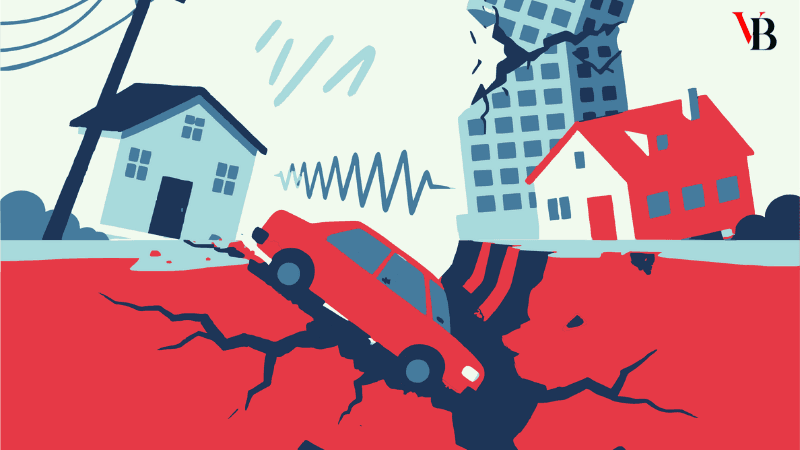

Dhaka—once known as the city of mosques—has now turned into a massive “Concrete trap.” Loaded by unplanned urbanization, high-rise buildings, and extreme population density, the city stands on what feels like a living volcano, moving steadily toward disaster. After the recent 5.7-magnitude earthquake, experts have spoken serious concerns about Dhaka’s frightening level of risk—concerns that have shaken us to the ultimate. The common people feel helpless and anxious, wondering what will happen if something bigger strikes. Especially with disasters like earthquakes and fires, Dhaka’s vulnerability is no longer a theoretical discussion; it is now a harsh reality.
Tectonic Plate Instability and Bangladesh
According to experts, Bangladesh is geographically located at the junction of three tectonic plates—the Eurasian Plate, the Indian Plate, and the Burmese Plate. Fault lines along the Himalayas in the north and near the Myanmar border in the east have accumulated enormous energy. Geologists warn that these faults could release that energy at any time, potentially causing an earthquake of magnitude 7.5 or higher. Moreover, Bangladesh’s soil is rich in muddy sediment, which can amplify seismic waves and make shaking far more powerful. Data suggests that nearly 85% of buildings in Dhaka were not constructed in compliance with the national building code, the BNBC (Bangladesh National Building Code). In many cases, buildings have been extended beyond their foundation capacity. There are also allegations of substandard rods and construction materials. Experts fear that if a powerful 7.5-magnitude earthquake hits, around 1.7–1.8 million buildings in Dhaka could collapse.
Dhaka as a Death Trap: A Living Time Bomb
As it sounds painful, it is true: the detachment of policymakers, pressure from profit-oriented developers, and public negligence have turned this city into a living time bomb. Some may think this echo like a horror movie plot, but close your eyes and think for a moment—this is a sleeping, uncomfortable truth.
Underground Gas Lines: A Hidden Hell: Underneath Dhaka, old and leaking Titas gas pipelines spread like a net. Overhead, there hangs an enormous junk of electrical cables. Within the first few seconds of a major quake, underground gas lines could falling-out. Gas trapped under the surface, combined with sparks from cracked electrical wires, could ignite fires underground and blast like dynamite. In other words, before buildings even collapse, people could burn from fires rising from below the ground.
A Cemetery of Ornamental Glass: In the name of modernity, the use of ordinary glass in Dhaka’s buildings has increased dramatically. During an earthquake, that glass could turn into deadly blades. As soon as shaking begins, large chunks of glass could fall like rain from multi-storied buildings onto the streets below. People trying to escape may be torn apart by sharp shards. “This can be described as a ‘non-structural death trap.”
Soft Story and the Domino Effect: Many buildings in Dhaka have ground floors supported only by pillars—often for parking. In Engineering language, it calls a “soft story.” Under strong shaking, these ground floors can collapse like a house of cards, pulling down the floors above. In dense areas, one tilting building can crash on to the next, triggering a chain collapse like dominoes. In such a scenario, there may be no space left for rescue operations.
Liquefaction: A significant part of Dhaka has been built on filled wetlands. During an earthquake, this reclaimed, sediment-heavy soil can behave like thick slurry. A building may not visibly collapse, yet it could sink several floors into the ground. Areas such as Banasree, Aftabnagar, Badda, and parts of Bashundhara are at especially high risk. Buildings standing on sand may literally disappear like sand dams washed away.
Piles of Bodies and Death Without Rescue: If 1.7–1.8 million buildings collapse, the number of dead would be unimaginable. Dhaka’s current rescue capacity—fire service manpower and equipment—could perhaps manage rescue operations in a few buildings at best. Millions of people could remain trapped under bricks for days, slowly dying. Ambulances would not reach them because roads would be blocked by rubbles. Without drinking water, surrounded by the stench of rotten bodies, Dhaka would become a scary for survivors.
Breakdown of Hospitals and Emergency Services: One of the most terrifying realities is that even major hospitals in Dhaka (such as Dhaka Medical College) are themselves highly vulnerable. The hospitals meant to save lives could collapse first. If doctors, nurses, and emergency responders are trapped under rubble, treating hundreds of thousands of injured people would become nearly impossible.
Thousands of Rana Plazas: We struggled to handle the collapse of just one Rana Plaza. Now imagine thousands of Rana Plazas collapsing across Dhaka at once—without open routes or empty spaces for rescue. The air would be heavy with cries, but there would be too few hands left to help. This is not fantasy; it is a scientific warning.
Critical Gaps in Management and Preparedness: Bangladesh’s disaster preparedness is still largely focused on cyclones and floods. Specialized earthquake response teams are severely lacking. Experts note that if one million buildings are damaged, rescue operations cannot be carried out with only a few hundred responders. The country also lacks a functioning National Operation Center and an effective “dead body management” system. Japan has thousands of seismometers (earthquake measuring instruments). Even if Bangladesh has some, it remains uncertain whether they are truly active and effective.
State and Policy Actions: The Time to Stand Up Is Now: Saving Dhaka from becoming an unavoidable field of ruins requires more than individual awareness. It demands immediate, strict, and uncompromising action at the national level. Disasters do not categorize; when destruction arrives, neither palaces nor slums will be spared.
DAP and Public Interest Must Come First: The Detailed Area Plan (DAP) must not remain a document on paper. Sadly, influential groups and developers often weaken its spirit by securing approval for high-rises in narrow lanes for business profit. This is suicidal policymaking. The government must remember: DAP is not a commercial document; it is a guarantee of citizens’ right to survive. Stopping wetland filling, controlling density, and ensuring open spaces must involve zero political or business compromise.
Rule of Law and Accountability: RAJUK and city corporations must not be mere approval-issuing agencies; they must become strict enforcement bodies. Those who violate building codes and create “death traps” must face exemplary punishment. High-rise approvals must be determined not only by height but by safety standards and soil conditions.
Shared Safety: We must remember: “Until everyone is safe, you are not safe.” You may spend a fortune to strengthen your building, but if a weak building collapses and blocks the narrow road in front of yours, fire service and ambulances will not reach you also. Dhaka is one interconnected unit. Safety planning must be collective—ward-based and area-based.
A Final Warning: If we do not change our habits today, if we do not stop hunting profit through legal loopholes, then this so-called modern “concrete trap” will one day become a mass grave for us all. Nature’s revenge is brutally unforgiving. Let us not become “a failed generation” in the eyes of our future generation. Now is the time to revise the DAP, make RAJUK transparent, and build a sustainable Dhaka where every citizen’s life is valued equally.
A Way Forward: The Struggle to Survive: Denying today’s danger would be nothing less than collective suicide. We are standing on a massive “pit of death” while celebrating an endless festival of high-rise construction. The city that should shelter us has become our greatest threat. Yet we must remember: natural disasters are not in our hands, but preparedness is. To build a resilient Dhaka, we need immediate coordinated action:
Political Will and National Policy: Disaster management is not only a technical issue; it is political. In the coming days, political parties must prioritize disaster preparedness in their election manifestos. RAJUK and all service agencies must be brought under full transparency, beyond corruption. The state must adopt policies where human life is valued above profit.
Building Safety and Engineering Standards: There must be zero compromise in enforcing the BNBC. When buying a flat, consumers must confirm whether the building can withstand a 7.5-magnitude earthquake. Thousands of old and risky buildings must be identified and urgently strengthened through retrofitting.
Community Empowerment and Volunteer Teams: The first 30 seconds and the next 72 hours after an earthquake are the most critical for survival. Instead of waiting for government rescue, every community must build trained volunteer response teams with equipment and training so local people can act as first responders.
Education, Awareness, and Household Preparedness Planning: Regular disaster drills must be mandatory from school level. Civil defense practices need to coming back. Every family must develop a personal disaster plan: who will shut off the gas, who will switch off the main power, where everyone will take shelter, and where the family will reunite after the shaking stops.
Our Safety Is in Our Hands
Let preparedness—not fear—be our greatest strength. Starting today, let every family and community ensure these steps:
1) Is Your Building Safe?
• Arrange an assessment of your building by a qualified structural engineer (visual inspection/testing).
• If cracks or weaknesses exist, arrange urgent retrofitting.
• Keep stairways and corridors clear of gas cylinders, furniture, or obstacles.
• Ensure rooftop doors and emergency gates are not locked during emergencies.
• Before buying a new flat, verify BNBC compliance and earthquake safety features.
2) Household Preparedness
• Identify safe zones inside the home (corners near strong beams, under sturdy tables).
• Anchor wardrobes, refrigerators, and heavy furniture to walls.
• Avoid heavy chandeliers (Jharbati) or decorations that could fall and injure people.
• Keep an emergency kit ready: dry food, water, flashlight, whistle, medicines, and a first-aid box.
3) Immediate Response: The Golden Seconds
• Do not run in panic. Try to protect yourself where you are.
• Follow “Drop, Cover, and Hold On.” Cover your head with a pillow or cushion if possible.
• Build the habit of quickly turning off gas stoves and the main switch if safe.
• Do not use lifts.
4) Community Unity
• Form a neighborhood/apartment response team.
• Learn and practice the use of fire extinguishers together.
• Check today whether emergency exits are open; aware everybody and ensure the accessibility if they are locked.
Closing Message
It is not too late to change our luck. Countries like Japan and Chile have proven that even in high-risk earthquake zones, smart planning and courage can defeat mass death. If we hold each other’s hands and replace the mindset of “every man for himself” with a commitment to “survive together,” no earthquake can erase us. No matter how deep the darkness of disaster may be, human awareness and collective will are even brighter. Let us build Dhaka as a safe home for future generations—not a concrete cemetery. Because nothing is more valuable than life. If we act now, within the next 5 to 10 years it is possible to transform Dhaka into a resilient city. If Japan can shake again and again and still stand smiling, then with planning and unity, we can too. Our small steps can save millions of lives. “When preparedness lives in the mind, strength grows with every moment.”
Leave A Comment
You need login first to leave a comment