
Egypt's 92-year World Cup journey
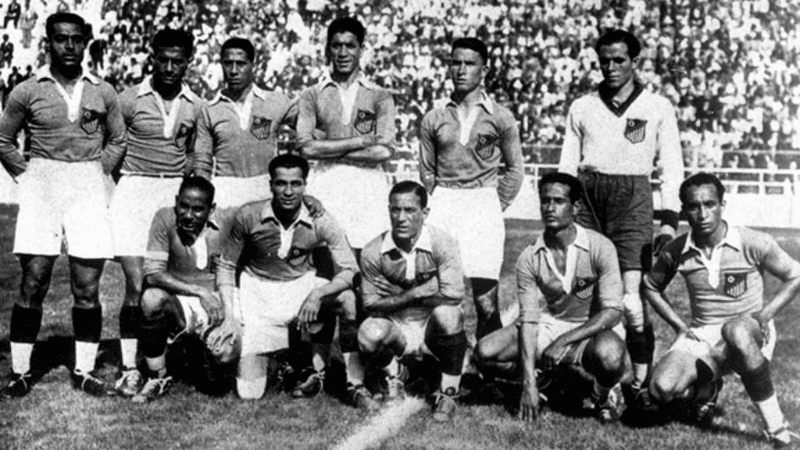

The story begins in 1934 in Italy on a pitch in Naples where Egypt became the first nation from Africa and the Arab world to step onto the World Cup stage. Facing Hungary that day, a young forward named Abdulrahman Fawzi scored a brace to cement his name in history as the first African footballer to score in a World Cup. Despite his heroic performance, Egypt fell to a 4-2 defeat. Under the tournament format of that era, there was no group stage, and play commenced directly in a knockout setup, meaning Egypt's first match was effectively their first Round of 16 experience. Following that single appearance, the Pharaohs faded into obscurity, and their presence vanished from the global football map for decades.
A long and exhausting silence followed. Driven by wars, political tensions, and the marginalization of African football, Egypt had to wait 56 years to return to the World Cup stage. When they finally returned in 1990, it marked the longest gap between appearances in World Cup history.
During that campaign, Egypt displayed a stubborn, defensive style of football, battling to a 1-1 draw against the Netherlands and a 0-0 stalemate with Ireland. However, a single goal from England's Mark Wright ended their dream, preventing them from progressing past the group stage.
Another 28 years passed before Egypt returned for the 2018 edition in Russia. This time, they arrived with renewed hope in Mohamed Salah, who had just completed an explosive, world-class season with Liverpool. While many expected history to change, Salah, playing through a shoulder injury, could not carry the team alone as Egypt suffered defeats in all three matches against Uruguay, Russia, and Saudi Arabia. Despite the exits, the tournament provided an enduring memory when 45-year-old goalkeeper Essam El-Hadary became the oldest player in World Cup history and stopped a penalty against Saudi Arabia, even though the team ultimately lost the match.
The turning point arrived in 2026. Attending the tournament co-hosted by the United States, Canada, and Mexico, Egypt presented a completely transformed squad. Salah remained the heartbeat of the team, but manager Hossam Hassan had constructed a far more organized and mature unit around him. Drawn into Group G alongside Belgium, Iran, and New Zealand, Egypt took the lead in their opening match against Belgium through a brilliant 20-yard strike from Emam Ashour. However, they could not hold the advantage, as an own goal from Mohamed Hany off Romelu Lukaku's first touch after coming on as a substitute forced a 1-1 draw. Egypt then faced New Zealand, where they overturned a 1-0 deficit. Salah scored the equalizer and assisted Trezeguet to secure a 3-1 victory, marking Egypt's first-ever win in a World Cup match across their 92-year history. A 1-1 draw against Iran in the final group fixture allowed Egypt to qualify for the knockout rounds as group runners-up on goal difference.
That setup led to the definitive night in Dallas. Facing Australia in the Round of 32, Egypt took an early lead in the 13th minute when Emam Ashour scored a powerful header off a precise cross from Karim Hafez. The vulnerabilities returned after the interval when another own goal by Mohamed Hany allowed Australia to equalize. The 1-1 scoreline held through the end of extra time. In the dying moments, a header from Ramy Rabia was denied by an incredible stop from Australian goalkeeper Patrick Beach, producing one of the top saves of the tournament and sending the match to a penalty shootout.
Australia failed to convert their opening attempt, allowing Egypt to take the lead through Mahmoud Saber's successful strike. Jackson Irvine equalized for Australia, but Ramy Rabia restored the Egyptian advantage. After Awer Mabil pulled Australia level once more, Salah stepped up to convert his first career World Cup penalty with composure. Australia's fourth attempt was missed by Lucas Herrington, leaving Hossam Abdelmaguid to step up for the final shot to end the 92-year wait. The ball found the back of the net, sparking celebrations across the stadium. Winning the shootout 4-2, Egypt achieved their first-ever knockout victory and secured a spot in the Round of 16 for the first time. Exactly 92 years after their solitary match in 1934, the Pharaohs crossed their greatest historical boundary.
With this victory, Egypt became the second African nation to secure a place in the Round of 16 at this World Cup. Their upcoming opponent will be either Argentina or Cape Verde. Regardless of the matchup, another stern test awaits Egypt, but the definitive night in Dallas confirmed that football history for the nation has changed under Salah's generation. The Pharaohs are no longer just participants, but true contenders.
Leave A Comment