
FIFA approaches $10 billion revenue milestone with expanded 2026 World Cup
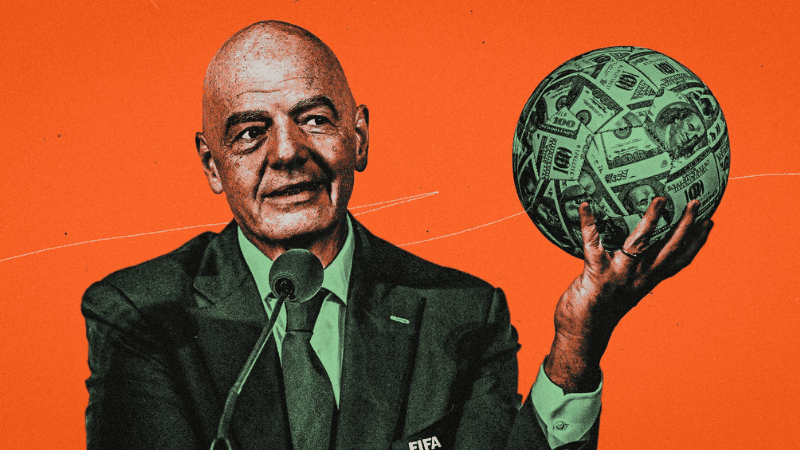

World football’s governing body is on the verge of making sporting history as FIFA President Gianni Infantino’s projections put the 2026 World Cup on track to become the first-ever $10 billion sporting mega-event. Following an unprecedented $5.8 billion haul from the 2022 World Cup in Qatar, FIFA has effectively targeted the highly lucrative North American market to double its financial output over a single four-year cycle.
The record-shattering growth is heavily driven by tournament expansion and aggressive monetization strategies across the United States, Mexico, and Canada. This year’s revamped iteration features 48 teams competing in a massive 104-game tournament—up from the traditional 32-team, 64-game format. The tournament, which concludes this Sunday with a highly anticipated final between Spain and Argentina, has completely eclipsed rival sporting properties, including the Paris Olympics and the European Championship, both of which generated roughly half of FIFA’s projected 2026 revenue.
Unprecedented ticketing and commercial explosion
By anchoring 78 of the 104 matches within the United States, FIFA tapped into a mature sports market accustomed to premium event pricing. Total live attendance has officially breached the six-million mark. To maximize its matchday earnings, FIFA introduced untethered dynamic ticket pricing and launched a specialized secondary resale platform where the governing body extracts a 15 percent fee from both the buyer and the seller on every single transaction. Ticket and hospitality earnings for this cycle are projected to reach $3.5 billion—nearly tripling the record set in Qatar.
Simultaneously, corporate sponsorship has grown exponentially. Mainstay long-term partners such as Adidas, Coca-Cola, Visa, Aramco, and Hyundai continue to anchor operations with deals valued between $80 million and $100 million annually. However, the true financial catalyst has been the tournament's regional appeal to American corporate giants. Major brands like Bank of America and McDonald’s have shelled out up to $100 million for tournament-specific partnerships, while a tier of secondary domestic sponsors, including Home Depot and American Airlines, brought in additional individual commitments of up to $40 million.
Global broadcast shift and future sustainability
Broadcasting rights remain FIFA's primary economic engine, contributing an estimated $5.2 billion to the 2023–2026 cycle. Despite facing stiff legal restrictions and low-competition joint-bidding structures in Europe—which prevent placing matches behind a paywall and keep free-to-air broadcast fees relatively flat—FIFA compensated by seeing exponential media growth across the Middle East, North Africa, and domestic North American networks. A record-breaking 30 million viewers tuned into Fox Sports within the U.S. during the tournament, signaling massive future valuation increases when local media rights are put up for tender next cycle.
While FIFA’s financial architecture has proven to be an absolute juggernaut this summer, industry experts question whether an 11-figure revenue baseline can be realistically sustained. The governing body's own internal financial reports hint at a projected $938 million reduction in ticket and hospitality revenue for the 2027–2030 cycle, acknowledging that the co-hosts for the centenary 2030 World Cup—Morocco, Portugal, and Spain—lack the same hyper-commercialized domestic corporate market as the United States.
To bridge any impending deficits, FIFA is already laying the groundwork for further aggressive growth, leaning heavily on its revamped Club World Cup format and leaving the door wide open for another international tournament expansion to a 64-team field by 2030.
Leave A Comment