
FIFA referee is now a walking tech lab
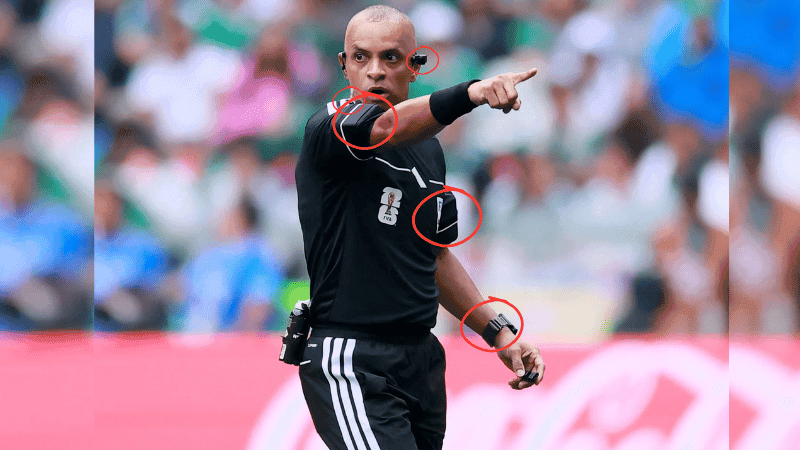

For most of football's history, a referee walked onto the pitch with a whistle, a yellow card, and a red card. That was it. No screens, no sensors, no AI whispering in their ear. Just a human being making split-second decisions in front of a hundred thousand people and hoping they got it right.
Three devices, one referee
Every referee at the 2026 World Cup carries three devices on their body — a microphone, an earpiece, and the Ref Cam. The camera weighs just 14 grams but delivers something football has never had before: the referee's exact line of sight, live, in broadcast quality.
When a penalty is given, when a tackle is disputed, when a goal-mouth scramble ends in chaos — broadcasters can now cut directly to what the official actually saw in that moment. FIFA has deployed the cameras across all 104 games of the tournament, with footage woven into replays and key moments throughout every match.
Getting there wasn't simple. Raw head-mounted footage shakes violently with every stride, making it unwatchable. Lenovo solved that problem by developing AI stabilization technology specifically for the World Cup, smoothing the motion in real time and turning a shaky first-person feed into clean, broadcast-ready television.
The road to this point was long. MLS first trialled referee cameras back in 2013. A Premier League referee wore one in a competitive match for the first time in 2024. FIFA tested the concept at the 2025 Club World Cup — and then committed to bringing it to the biggest stage in football.
The voice in the ear
The most consequential piece of technology at this World Cup is one nobody in the stadium can even see. It lives inside the referee's earpiece.
FIFA's upgraded Semi-Automated Offside Technology — SAOT — no longer routes decisions through the VAR room before reaching the officials on the pitch. The moment a clear offside is detected, the system speaks directly into the assistant referee's ear: "offside, offside, offside." The precision threshold has been tightened to just 10 centimeters, down from 50 in previous trials.
The difference from Qatar 2022 is significant. Before, the AI flagged the offside, sent it to VAR, and a human operator relayed the verdict to the pitch. That chain of communication is now gone. Decisions arrive faster, stoppages are shorter, and the game flows more naturally as a result.
The AI is powerful but deliberately limited. It handles positional offside only — where a player's body is standing when the ball is played. Subjective calls, like whether an offside player actually interfered with play, still belong entirely to the human referee. The technology assists. It does not replace.
The infrastructure behind it all
The three devices on the referee's body don't work alone. Behind them sits an entire stadium-wide tracking network — twelve dedicated cameras capturing 50 stills per second from every player on the pitch, feeding every limb position and body angle back to the officiating team in real time.
VAR has expanded its scope as well. It can now review incorrectly awarded corners, attacking fouls before set pieces, and red cards resulting from a second yellow — categories of incident that previously fell completely outside its reach.
Across 104 matches in 16 stadiums, the 2026 World Cup is the most heavily instrumented tournament in football history. Between what happens on the pitch and what the referee decides, there is now an invisible layer of sensors, cameras, and artificial intelligence running constantly underneath the game.
What it means for the game
Pierluigi Collina, chair of FIFA's Referees Committee, called the Ref Cam's impact "beyond our expectations" — a storytelling tool that lets viewers feel like they are standing in the middle of the action.
But the deeper shift goes beyond television. The referee has always been the loneliest figure in football — the one person everyone blames and nobody defends. Technology doesn't change that entirely. What it changes is the information available to them, and the speed at which they can act on it.
Whether all of this makes football fairer is a debate that will outlast the tournament. What is already certain is that the referee walking onto the pitch in 2026 is the most connected, most assisted, and most watched match official in the history of the sport.
Leave A Comment