
FIFA World Cup 2026: A new chapter in the football world war
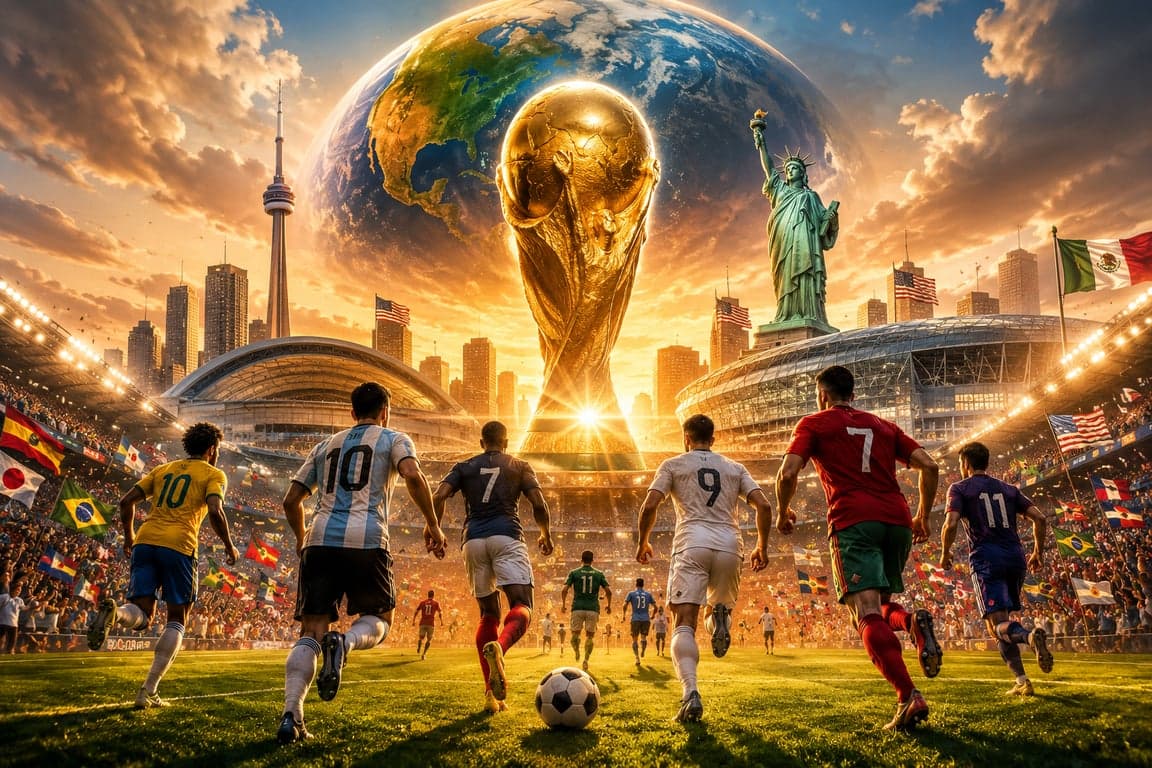

Football transcends not just mere sport; it embodies passion, fervor, culture, and serves as the heartbeat for billions globally. The FIFA World Cup, occurring every four years, stands as the largest sporting event on the planet, where individuals set aside differences in language, religion, ethnicity, and geography to unite in support of 22 players pursuing a ball. This event fosters a unique sense of community and shared experience among diverse populations.
The FIFA World Cup 2026 begins today. A festive atmosphere has already been created around this largest and most extensive World Cup in history.
This year's World Cup is being held jointly by the United States, Canada and Mexico. For the first time, 48 teams are participating in this event. As a result, the scope, competition and excitement of the World Cup have all gained new dimensions. For football lovers, this is not just a tournament; it is a time to wait for new history to be written, an opportunity to see the birth of new legends and witness some immortal moments.
The biggest World Cup in histor
The FIFA World Cup 2026 is being called the biggest World Cup in history. Previously, 32 teams participated in the World Cup, but this time that number has increased to 48. As a result, more countries have the opportunity to play in the main stage of the World Cup.
This expansion is not just a change in numbers; it is a reflection of the geographical expansion of world football. Many more teams from Africa, Asia, North America and Oceania are getting the opportunity to showcase their capabilities on the world stage. As a result, the World Cup has now become more diverse and more competitive.
Joint hosting of three countries
The 2026 World Cup will be marked as a unique chapter in football history, because this is the first time that three countries are jointly hosting a tournament on such a large scale. The matches will be held in numerous cities across the vast region of North America by these three countries. As a result, it will not only become a sports competition, but also a continent-wide festival.
Through this joint hosting, the United States, Canada and Mexico are getting the opportunity to showcase their infrastructure, hospitality and modern technological capabilities on the world stage. Each country will make the World Cup more diverse with its own culture, spectacular cities and sporting traditions.
Modern stadiums, improved transportation systems and high-quality communication technology will make this World Cup more organized and audience-friendly. At the same time, the coordinated planning and management between the three countries will set a new standard for international sports events.
All in all, this joint event will serve as a powerful symbol of North American cultural unity, where different countries will come together to celebrate football as a global festival.
The new reality of 48 team
The biggest and most groundbreaking change for the 2026 FIFA World Cup is the participation of 48 teams. This change has had a profound impact not only on the number of teams, but also on the structure of the entire tournament, the quality of the competition and the future direction of world football. Previously 32 teams participated in the main stage of the World Cup, now 16 more countries have been added, making the world stage of football wider, more diverse and more competitive.
The group stage has completely changed in the new format. Teams now not only get the opportunity to face strong opponents, but also get the opportunity to test their strategies and capabilities against teams of relatively equal strength.
This has increased the uncertainty of the matches and made each game more important. The biggest positive aspect of this change is that it has opened new doors for small and emerging football countries. Many teams from Africa, Asia and the Concacaf region, which previously did not regularly make it to the main stage, are now getting the opportunity to showcase themselves in the World Cup spotlight. These teams are gaining experience playing against the big powers and often surprising the world with unexpected results.
On the other hand, this change is also a new source of joy for the spectators. Previously the number of matches was relatively limited, now there is the opportunity to enjoy more matches, more teams and more diverse playing styles. Every day brings new stories, new drama and new excitement. Overall, this new reality of 48 teams has made the World Cup more democratic, more expansive and more uncertain. There is no longer any opportunity to look down on any match, because each team enters the field with the dream of making history.
Football is a symbol of globalization
Football is no longer a game limited to Europe or South America; It has gradually become a truly global culture and universal language. Earlier, European and South American countries were clearly dominant in the tournament, Asian, African and North American countries are now also rapidly improving their football standards and establishing themselves as strong competitors on the world stage. With improved infrastructure, training and international experience, teams from these regions are now able to compete against the favourites.
The 2026 World Cup is being considered the biggest and most tangible reflection of this globalization. With the participation of 48 teams, more countries from different continents are able to participate in this great event. As a result, different cultures, languages, costumes, music and national identities are coming together to create an extraordinary global festival atmosphere. This diversity is evident everywhere, from the stadium to the digital platform.
This World Cup will once again prove that football is not just a game, it is the strongest social bond in the world. It is a language that transcends race, religion and borders and unites the hearts of millions.
The current champions aim
The recent World Cup champions will once again take to the field in the 2026 World Cup with the aim of maintaining their superiority. As much as it is a great honor to be a world champion, retaining that title is even more difficult and challenging. Because each opposing team will enter the field more prepared, more analytical and more confident than ever before. Every match of the champion team will now be as important as a kind of “final match” for their opponents, and as a result, the pressure will be much higher.
However, the current champions are not only aiming to defend the trophy. This is a great opportunity for them to further enrich their football philosophy, strategy and tradition. They will want to maintain their dominance and prove that their success was not a one-off achievement, but the result of consistency. At the same time, one of their most important goals is to form a balanced squad by combining the team's experienced players with young talents.
Handling pressure on a huge stage like the World Cup, maintaining consistent performance, and making the right decisions at crucial moments will determine whether they can write their names more brightly in history.
A stage for the rise of new stars
Every World Cup gives birth to new heroes in football history, and this trend is expected to continue in the 2026 World Cup as well. In this grand event, many unknown or lesser-known footballers get the opportunity to become known to the world overnight through their talent, skills, and courageous performances. Good performance on a big stage like the World Cup not only brings personal glory, but also takes the players' careers to new heights.
The 2026 World Cup will be no exception. The new generation of young footballers will try their best to prove themselves in this tournament. They will not only aim to play well in the national team jersey, but also to attract the attention of the world's top clubs as the World Cup is a stage where the performance of one or two matches can change a player's life.
Some of the best football stars of the next ten years may emerge from this tournament, who will lead world football in the future. Their speed, technique, finishing and ability to understand the match can create new history. As a result, the 2026 World Cup will be considered not just a competition, but a huge factory to create future football stars.
The last World Cup of veterans
For many legendary footballers, the World Cup 2026 could be the last world stage of their careers. After long years of hard work, numerous successes and countless memorable moments, they are now standing on the threshold of their last chapter. At this stage, every player will want their farewell to be glorious, memorable and with some achievements to be immortalized in history.
These veteran footballers are not just players on the field, they are symbols of team leadership. Their years of experience, ability to handle pressure and ability to make the right decisions in difficult moments will play an important role in moving the team forward. They often become a source of inspiration and a guideline for young players.
Their presence on a big stage like the World Cup is also an emotional experience for fans. Many fans may see their favorite star play in the World Cup for the last time in the national team jersey. Therefore, this tournament will become a name not only for competition, but also for a deep sense of emotion, memory and farewell.
A new era of technology
Football is no longer just a battle of 22 players on the field; it has become a modern technology-based sports system. Over time, the use of various technologies is constantly increasing to ensure the transparency, accuracy and fairness of the game. Video Assistant Referee (VAR), goalline technology and advanced data analysis have already brought about major changes in the decision-making process in football. These technologies have reduced the number of wrong decisions by referees and made the matches more accurate and fair.
It is expected that the use of this technology may be further improved and expanded in the 2026 World Cup. There is a possibility of using advanced sensors, artificial intelligence and real-time data systems to analyze every moment of the match more precisely. This will greatly reduce offside, foul or goal disputes.
As a result, spectators, players and coaches will all experience a more transparent and accurate game. This technological advancement has not only modernized football, but also made it more credible and globally acceptable. The 2026 World Cup will therefore be considered the beginning of a new era of a unique combination of technology and sports.
The impact of the World Cup on the economy
The World Cup is not just a sports event, but also a huge global economic event, which has a profound impact on the host country and various related sectors. During this tournament, a huge amount of financial activity takes place in tourism, hotel and hospitality industries, transportation systems, advertising and television broadcasting. Billions of spectators around the world watch the matches live in stadiums and billions more on television and digital platforms, which creates huge revenue opportunities for the media and broadcasting sectors.
It is a major opportunity for economic growth for the countries hosting the World Cup as millions of tourists travel from different countries to watch the matches, resulting in huge demand for hotel bookings, restaurant business, local transportation and tourism services. This directly boosts the local economy and creates many new job opportunities.
In addition, both the World Cup host country and FIFA earn huge amounts of revenue from sponsorship, brand promotion and advertising. Overall, the World Cup is considered one of the biggest drivers of the global economy in addition to being a sporting event.
A meeting of World Cup and culture
The World Cup is not just a football competition, it is the world's largest cultural meeting. During this time, fans from different countries come together around a common passion—football. They showcase their national identity, traditions and culture on the world stage. The fans' clothes, flags, face paint, songs and dances give the stadium and its surroundings a unique festive look.
During the World Cup, the music and sports cultures of different countries blend with each other. Some sing traditional songs from their own countries, while others bring different customs of support, which makes the entire tournament more diverse. There is also a remarkable fusion in terms of food - popular dishes from different countries are available in one place, which creates a new experience for the audience.
It is not only the excitement of the game, but also a powerful means of building mutual understanding, friendship and respect between people. People from different countries prove together through joy, emotion and celebration that despite the differences in culture, football is able to bind us all together.
Spectator frenzy
The World Cup means a huge festive atmosphere all over the world. During this time, from the streets, cafes, restaurants, shopping malls to homes - discussions, analysis and excitement about football spread everywhere. People forget the busyness of their daily lives and become completely immersed in the game of their favorite team.
The passion of the spectators makes this tournament more alive. Just as a goal can make a city erupt with joy, a defeat can instantly create deep despair and silence. This emotional ups and downs is what sets the World Cup apart from other sporting events. Fans don’t just watch the game, they connect their emotions with the players on the field in every match.
Football fans pray day and night for their favorite team’s success, show their support on social media and discuss every moment of the game with friends. For many, it is not just entertainment, but a matter of deep emotion, identity and pride. This frenzy makes the World Cup a truly global festival, where everyone participates in their own way.
The World Cup of Social Media
In the current era, social media has become an integral part of the World Cup. Now every moment of a football match—a goal, a save, a controversial decision or a stunning performance—is broadcast around the world in a matter of seconds on various digital platforms. Fans directly react, analyze and express their emotions through platforms such as Twitter, Facebook, Instagram and YouTube.
Hashtag trends, live reaction videos and meme culture add to the liveliness of the event. A video clip of a goal or a controversial refereeing decision goes viral in an instant, sparking new discussions and debates beyond the game. This makes the World Cup not just confined to the confines of the stadium, but a global digital festival.
Players, clubs and federations also use social media to connect directly with fans. This allows fans to experience their favourite stars up close. All in all, social media has made the World Cup experience faster, more immersive and interactive, a new reality for modern football.
The battle of tactics and strategy
In modern football, it is not enough to have individual talent or star players; strategy and tactics now play an equally important role. The outcome of a match is often determined by the coach’s plans, formation selection, player roles and analysis of the opponent. So it can be said that the players do fight on the field, but the main basis of that fight is created by the brain of the coach sitting in the dugout.
It is expected that this tactical battle will become more intense and interesting in the 2026 World Cup. Coaches from different countries will enter the field with different plans considering their strengths and weaknesses. Some will play high-pressing football, some will emphasize defensive tactics, and some will rely on quick counterattacks.
The clash of these different tactics will make the matches uncertain and exciting. Each match will have new plans, new combinations, and the challenge of changing tactics according to the situation. As a result, it will be a kind of intellectual football battle for the audience, where there will be a lot to enjoy not only in terms of goals, but also in terms of the depth of tactics.
The possibility of underdogs
In every World Cup, there are some teams that are not considered the main contenders for the title in advance, but surprise the entire football world with their performance on the field. These teams are usually called underdogs, and they are often the biggest surprises of the tournament.
Brave battles against strong opponents, well-planned defenses and fast-paced attacks - all of these are what they dream of making history with.
On a big stage like the World Cup, underdog teams have a chance to prove themselves. A win against a big team is not just three points, but it also becomes a symbol of confidence, respect and global recognition. Sometimes such teams surprise everyone from the group stage and are able to make big surprises in the next round.
In the 2026 World Cup, everyone will be watching some teams who may not be title contenders on paper, but can become a big challenge for the strong teams through their unity, hard work and courageous mentality. This uncertainty makes the World Cup even more exciting and an extraordinary stage for unexpected success.
The battle for the Golden Boot
One of the attractions of the World Cup is the Golden Boot, which is awarded to the top scorer in the tournament. This award is not just a personal achievement, but it is a symbol of a forward's skill, consistency and ability to handle pressure on the big stage. The world's best strikers take to the field to win this honour, where every match becomes a crucial opportunity to score.
The importance of every goal increases tremendously at the World Cup. A goal not only increases the team's chances of winning, but also elevates the player's personal status. From the group stage to the knockout round, the pressure to score is on at every moment, as one goal can determine who will become the greatest goalscorer in history. The battle for the Golden Boot is often one of the most exciting aspects of the tournament.
Sometimes experienced stars, sometimes new emerging forwards advance in this race. Who will ultimately win this prestigious award depends on consistent performance and the ability to score at crucial moments, which makes the World Cup even more exciting.
The test of the goalkeepers
The role of goalkeepers is always very important at the World Cup and in many cases they are considered the unsung heroes of the team. One or more of their extraordinary saves in a match can change the course of the entire tournament. Especially in the knockout stages, where a mistake or a right decision can push a team towards victory or defeat, the responsibility of goalkeepers increases manifold.
Several world-class goalkeepers will put their skills, reflexes and mental toughness to the ultimate test at the 2026 World Cup. For them, it is not just a battle to stop shots, but also a test of making the right decisions under pressure, keeping the defense organized and maintaining the team's confidence. In situations like penalty shootouts, their role becomes even more dramatic and decisive.
Sometimes a great performance by a goalkeeper can change the fate of an entire team. Therefore, their performance in this World Cup will be very important not only in terms of the result of the match, but also in terms of personal reputation and career. For the audience, this battle of goalkeepers will also be an experience full of excitement, drama and incredible moments.
The business side of football
The World Cup is now not just a sports event, but it has become a multi-billion dollar global brand. Its economic scope is so vast that it is considered one of the largest commercial events in the world. From the sale of television broadcasting rights to international sponsorships, advertising contracts and digital content, a huge economic cycle has developed around the World Cup.
Billions of viewers around the world enjoy the matches, as a result of which the broadcasting media invest huge amounts of money and buy the rights. At the same time, large multinational companies use the World Cup as an ideal platform to promote their brands. The impact of sponsorship is clearly visible everywhere - in stadiums, jerseys, digital advertising and social media.
This huge income is not only limited to the commercial sector, but also plays an important role in the development and construction of football infrastructure. This money is used to build new stadiums, improve training facilities and promote football at the grassroots level. As a result, the World Cup serves as a source of entertainment on the one hand, and one of the main drivers of the global football economy on the other.
Inspiration for the young generation
The World Cup serves as a tremendous source of inspiration for the young generation. This great event not only gives the joy of watching the game, but also teaches the new generation to dream and inspires them to work hard to fulfill that dream. Seeing the great performance, skill and mental toughness of the world's best footballers on the field, countless young people get the courage to link their future with football.
Every match of the World Cup is a lesson for young spectators. They learn how to play under pressure, how to work as a team and how to bounce back from failure. The success of their favorite players instills in them the belief that anyone can reach the world stage with hard work and perseverance.
Extraordinary performances on the World Cup stage attract the future generation more towards football. Many children and teenagers start dreaming of choosing football as a profession after watching this tournament. As a result, the World Cup is not only a joy for the present, but also serves as a powerful source of inspiration for creating future football stars.
The possibility of setting new records and breaking old records
Every World Cup is known as a unique stage for setting new records and breaking old records in history. Here, not only team success, but also individual achievements are equally important. Numerous records such as the player who scored the most goals, the most matches played, the fastest goal, or the longest winning streak make the World Cup even more interesting.
New history is written in every World Cup, where sometimes a star breaks the goal record with his extraordinary performance, and sometimes a team sets a long winning record by showing incredible consistency. These achievements are not just statistics, but also take their place in history as memorable chapters of football.
There is a possibility of breaking many such records in the 2026 World Cup as well. The participation of 48 teams, the increased number of matches and the emergence of a new generation of players can make this tournament even more record-breaking.
As a result, fans will not only enjoy the game, but also witness the creation of new history, which will be a place in future football discussions for a long time.
Feelings and emotions of the World Cu
The biggest strength of the Football World Cup is emotion, which takes the entire tournament to a unique level. Here, a single goal can bring joy to an entire nation, while a wrong decision or a defeat can cause deep disappointment and pain in the hearts of millions of people. This emotion turns the World Cup into a vast ocean of human emotions, not just a sporting competition.
During the World Cup, fans unite with their favorite team. They experience every moment of victory or defeat in their own way. Just as there are scenes of joy and tears inside the stadium, the same emotions spread on the streets, homes and social media.
This deep feeling, unexpected drama and changing situations in an instant are what make the World Cup different from all other sporting events. Football is not just a game here, but the heartbeat of people's hearts, where each match gives rise to new hopes, dreams and emotions.
Football and human unity
When the world is moving forward through various crises, divisions and conflicts, the World Cup comes to the fore as a unique symbol of human unity. This great event is not just a sporting competition, but a global stage where people come together across all boundaries of race, religion, language and culture, centered around a single passion – football.
During the World Cup, fans from different countries stand by each other, share joy and maintain mutual respect even in the midst of competition. Respecting the victory of the opposing team, recognizing great play and friendly behavior off the field make football more humane. This game proves that coexistence, respect and harmony are possible despite competition.
Ultimately, the message of unity of the World Cup binds people around the world with a thread. People from different countries celebrate together, share the same excitement and get the opportunity to understand each other’s cultures better. As a result, football is not just a game, but has established itself as a powerful medium for building human relationships and global unity.
Over the next few weeks, billions of people around the world will laugh, cry, celebrate and witness history together. New heroes will be born, new stories will be written, old legends may say goodbye, while some will secure their own immortality.
The 2026 World Cup will be a unique epic of new history, new possibilities and new emotions that will be remembered for many years to come.
Leave A Comment