
FIFA World Cup through age of transistor: In conversation with screen legend Sohel Rana
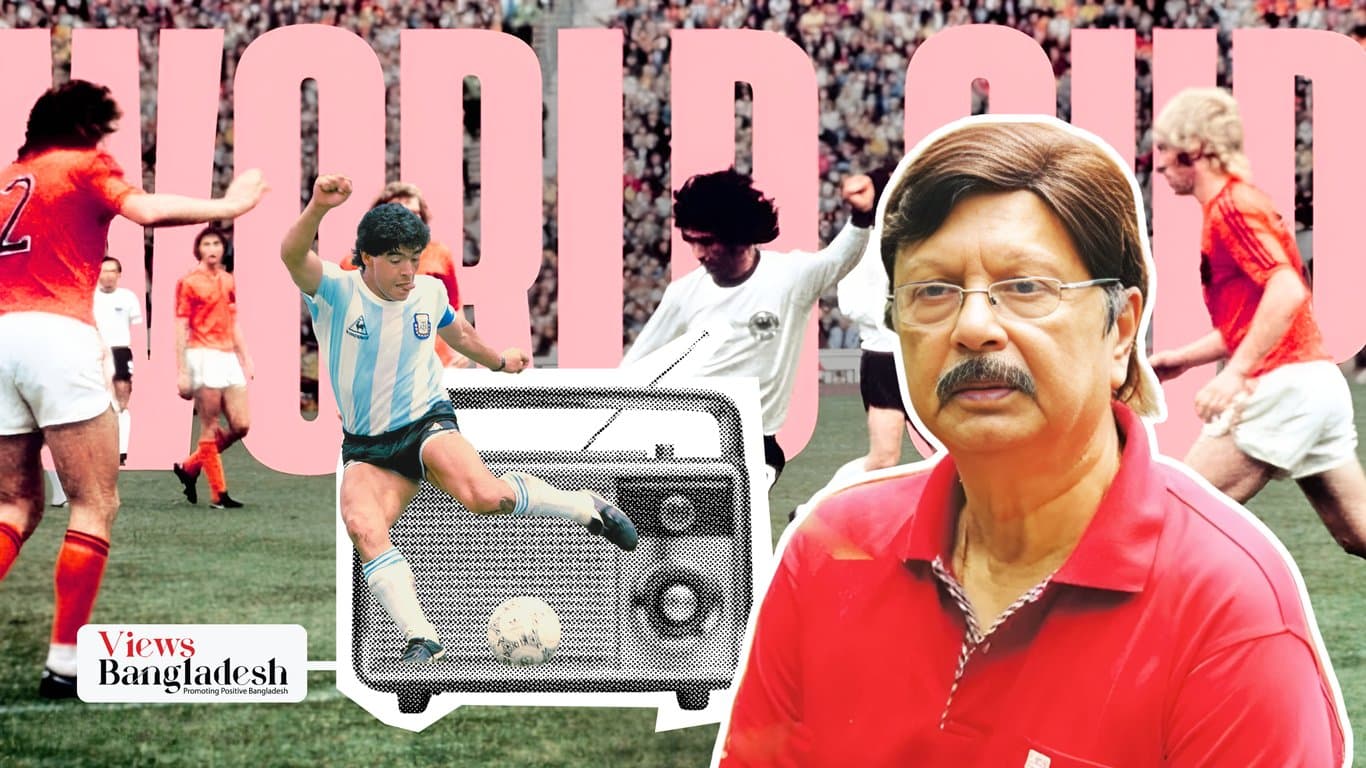

Spending time with people who have lived through history is something almost magical about. Their stories are like forgotten doorways, opening onto worlds that no longer exist except in memory. Within them lie fragments of a golden era—moments swallowed by time, now resembling fairy tales to a generation born into smartphones, livestreams and social media.
Yet when such people begin to speak, those distant days quietly return to life. That was exactly what happened one quiet afternoon as I sat across from legendary Bangladeshi actor Sohel Rana. Every sentence he uttered seemed to peel back another layer of time, transporting me to an era when the FIFA World Cup arrived in Bangladesh not through giant LED screens or viral online clips, but through the crackling voice of a transistor radio.
The conversation drifted naturally toward football. With a familiar smile, he sighed before saying softly, "These days it has become difficult to stay awake all night. But I still watched the World Cup final, you know."
He paused for a moment. "To be honest, I don't know whether I'll still be around for the next World Cup. That's why I didn't want to miss the final match of this one."
His last sentence carried a quiet melancholy that lingered in the fading afternoon light.
Wanting to steer the conversation away from such painful thoughts, I quickly asked,
"What was the World Cup like when you were young?" A knowing smile spread across his face.
It was the smile of someone opening an old wooden chest filled with treasured memories.
"It was nothing like what you experience today," he began. "There were no giant public screenings, no televisions in every household, no thousands of young people wrapped in their favourite team's jerseys, no seas of colourful flags, no fireworks, and certainly no social media frenzy. We couldn't even imagine such things because technology simply wasn't part of our lives."
He leaned back, as though the years themselves had begun unfolding before him. "Ours was a newly independent country struggling to rebuild itself. The economy was fragile. Electricity was unreliable. Most families didn't own a television. Radio was our only window to the world."
"Yet despite all those limitations, the World Cup somehow found its way into our hearts."
He smiled again. "We first became truly interested during the 1974 FIFA World Cup in West Germany. In 1974, and to a great extent even in 1978, only a handful of people managed to follow the matches through radio commentary. Bangladesh Betar was our main source. Catching international shortwave broadcasts like the BBC World Service, Voice of America, Radio Australia or Deutsche Welle was almost like fighting a battle. Very few of us were fortunate enough to tune into those frequencies."
"Instead, newspapers became their lifeline. Every morning we eagerly waited for the match reports in Dainik Ittefaq, Dainik Bangla, Sangbad or The Bangladesh Observer. Sometimes they published one or two photographs from the matches. Those tiny black-and-white pictures were enough to fill us with joy."
"Television existed, but only in theory for most Bangladeshis. Bangladesh Television (BTV) was the country's only television channel," he recalled. But unlike today, they didn't broadcast every match live. Sometimes they showed only short highlights or delayed recordings. Even then, only those fortunate enough to own a television—and perhaps a few neighbours or relatives—could watch them. Television sets were incredibly rare. He smiled at the memory. In some clubs, government quarters, university dormitories or offices in the larger cities, dozens of people would gather around a single television to watch together. But for most of us, our faithful transistor radio remained our closest companion."
"That little radio became an entire generation's connection to football's greatest stage. Whatever fragments of information we heard through the transistor," he said.
"The stories we carried to tea stalls the next morning. We argued, imagined and relived every match through those conversations. The magic of football did not require pictures. Sometimes, all it needed was a voice carried across invisible radio waves. Listening to radio commentary alone was enough for many educated young Bangladeshis to fall in love with Johan Cruyff and the Netherlands during the 1974 World Cup," he recalled.
"Then, in 1978, Mario Kempes and Argentina won over another generation of supporters. I even heard that after Argentina lifted the trophy, small victory processions were held in parts of Dhaka. For a country thousands of miles away from football's biggest stage, the World Cup had already become something far greater than a sporting event. It had become imagination.
It had become emotion. And above all, it had become hope."
Curious, I leaned forward and asked the question that had been waiting patiently in my mind, "Which team did you support back then?"
He laughed, "Actually, I only became truly obsessed with the World Cup in the 1980s."
By then, he explained, Bangladesh itself had begun to change. More homes in Dhaka could afford television sets. Watching football was no longer limited to snippets on the radio or black-and-white newspaper photographs. The country's love affair with the World Cup exploded with the 1982 FIFA World Cup in Spain, transforming football into a nationwide celebration. But it was the 1986 World Cup in Mexico that changed everything for me," he said. His eyes suddenly lighting up.
"That was when I became a fan of Diego Maradona."
For a moment, it felt as though he wasn't speaking about a footballer, but an artist.
"After that tournament, the rivalry between Argentina and Brazil spread across Bangladesh like wildfire. It reached villages, tea stalls, school playgrounds—everywhere. People argued passionately over football as if they were discussing politics."
"At the same time, stars like Zico, Paolo Rossi and Michel Platini also captured the imagination of Bangladeshi fans. From then on, staying awake through the night to watch football became a ritual. Debates over favourite teams became part of everyday life."
He paused before adding quietly, "Eventually, it all became part of our culture."
I smiled and asked another question. "So... were you an Argentina supporter?" He shook his head gently, "Not exactly. It's true that I admired Maradona. But our generation wasn't always loyal to a single team. We followed great players more than we followed national flags. Whichever country had the greatest collection of stars—that was usually the team we supported. Personally, I preferred Brazil because, in those days, Brazil simply had more extraordinary footballers."
Then, almost like a proud historian, he began naming them one by one. "Zico... Sócrates... Falcão... Júnior...That Brazilian side was probably the most technically gifted team I had ever seen. Later came Romário, Bebeto, Ronaldo Nazário, Rivaldo, Dunga, Roberto Carlos and Cafu. The Brazil of 1994 and 1998 was overflowing with talent."
I decided to bring the conversation back to the present. "So who did you support in this World Cup?" He replied, "Didn't I already tell you?"
"We never fell in love with teams. We fell in love with footballers. Today's Brazil isn't the Brazil I grew up watching. I no longer see those legendary artists wearing the yellow jersey. For me, Spain was the most complete team in this tournament. Lamine Yamal, Pedri, Fabián Ruiz, Nico Williams... every one of them played breathtaking football. Watching them reminded me of the beautiful game we used to fall in love with."
"Rodri was, in my opinion, the tournament's best player. Just look at how he controlled the final and inspired his team. That was magnificent football. Then came an opinion that many fans might debate. I don't think the Golden Glove went to the right goalkeeper," he said.
"Spain's defenders—Cucurella, Pedro Porro and Pau Cubarsí—were so outstanding that their goalkeeper was rarely placed under real pressure. For me, the best goalkeeper of the tournament was Argentina's Emiliano Martínez. Argentina's defence looked vulnerable throughout the competition. Martínez carried the burden almost single-handedly. Without him, they could easily have conceded many more goals."
I couldn't help laughing. "So is Martínez your favourite player this time?" He laughed as well.
"No... there are too many players I admire. Lionel Messi... Lamine Yamal... Rodri... Sadio Mané... Mohamed Salah... Kylian Mbappé... Erling Haaland...But if you ask me which team I enjoyed watching the most, I'd still say Spain. As a team, they were simply wonderful."
The room fell silent. For a few moments, he said nothing. Then, almost in a whisper, he returned to the thought that had shadowed the beginning of our conversation. "I don't know if I'll live long enough to see the next World Cup."
He looked away, toward the fading evening light beyond the window. "But if I'm fortunate enough to still be here... if God keeps me healthy... I'd love to watch these Spanish boys play once again."
His words drifted into silence. It was no longer merely a conversation about football. It was about time itself. For a while, silence settled between us.
Outside, evening slowly descended. Inside the room, Sohel Rana seemed to drift once more into another era—one where football in Bangladesh was not just a game, but a shared heartbeat.
He smiled faintly before reopening the pages of memory. "In our time—in the 1970s—football was the most popular sport in Bangladesh," he said.
"Every match felt like a festival. Mohammedan, Abahani later on, Wari, Brothers Union, Rahmatganj—people followed these clubs with incredible passion. Stadiums were packed, and football united people from every walk of life."
His voice carried both pride and regret.
"Back then, we truly believed Bangladesh would one day become one of Asia's strongest footballing nations."
For his generation, that dream never felt impossible. The country had talent. The supporters had passion. The stadiums had life.
What was missing, he reflected, was everything that transforms talent into lasting success.
"We lacked proper infrastructure, long-term planning, modern coaching and professional management. Without those foundations, dreams gradually faded."
He paused. "Today, that dream feels farther away than ever."
Then, almost unexpectedly, his face brightened.
He straightened himself in his chair and spoke with renewed conviction. "If you ask me which team I truly support... It's Bangladesh. Deep inside, I still believe that one day Bangladesh will step onto football's biggest stage—not merely as participants, but as a team the world admires. One day, perhaps, children across the globe will wear the jerseys of Bangladeshi footballers, just as our generation once admired Maradona, Zico, Cruyff or Ronaldo."
"Maybe it will take another fifty years. I probably won't be here to witness that day. But as long as I live, my prayers will always be with Bangladesh."
The evening had grown darker by then.
Our conversation had begun with a World Cup final and a transistor radio. It ended with a dream that has survived more than half a century.
Leave A Comment