
Flawless in play, flawed from the spot: The mechanics behind Messi’s penalty record
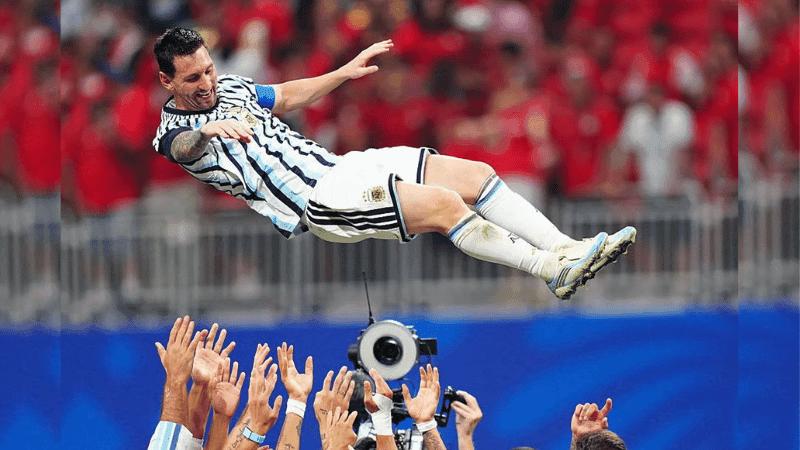

It remains the ultimate paradox of modern football. Lionel Messi can bend a 30-yard free-kick into the stanchion, thread a pass through a needles' eye, and manipulate a moving ball with unparalleled genius. Yet, when the game stops and he is handed a dead ball just 12 yards from the net with only a goalkeeper to beat, the surreal happens and the legendary playmaker becomes entirely human.
During Argentina's heart-stopping 3-2 Round of 16 victory over Egypt in Atlanta, Messi stepped up to the spot in the 20th minute. He struck the ball low and across his body, but Egypt’s towering young goalkeeper, Mostafa Shobeir, anticipated the placement perfectly, diving to parry it away.
With that single moment, Messi claimed a piece of history he would surely rather forget, becoming the first player in World Cup history to miss two penalties in open play at a single finals tournament, following an earlier miss against Austria in the group stage.
For a player widely considered the greatest of all time, Messi’s historical data from the penalty spot reveals a surprisingly modest trend. The miss against Egypt marked the 150th penalty kick of his storied career. Of those, he has converted 116 and failed to find the net 34 times, yielding a career conversion rate of 77.3 percent.
While an average conversion rate across professional leagues hovers near 80 percent, it is at the FIFA World Cup where the numbers become truly alarming. By failing to convert half of his eight non-shootout tournament spot-kicks, Messi has taken the most penalties in World Cup history while simultaneously extending his record for the most missed.
To understand why the game’s greatest technician falters from 12 yards, analysts point to a fundamental truth about penalty taking, which is that it functions primarily as a psychological skill rather than a mechanical one. When Messi is in open play, his actions are instinctive, dictated by the movement of the ball and defenders. He reads space dynamically. However, a penalty forces a prolonged pause, transforming a fluid, intuitive action into an analytical calculation.
Over his career, Messi's physical mechanics and approach routines have mutated repeatedly, indicating a lack of a comforting, standardized routine.
In recent seasons, Messi has heavily favored a slow, rhythmic run-up. The objective of this tactic is to keep his body open, monitor the goalkeeper’s feet, and slip the ball into the opposite corner the moment the keeper commits to an early dive. However, modern scouting has comprehensively decoded this routine. Goalkeepers like Shobeir are now instructed to hold their ground, standing tall until the final microsecond. When a keeper refuses to bite early, the psychological pressure flips back onto the kicker, forcing a rushed choice at the point of contact.
Furthermore, Messi's approach frequently telegraphs his intentions. Throughout his career, his comfort zone has been shooting across his body toward his natural left-hand side. When he attempts to reverse the trajectory to his right, his hip positioning and the angle of his run-up give clues to the goalkeeper. Unlike power specialists who routinely blast penalties with enough velocity to beat goalkeepers on pure speed, Messi relies heavily on placement and deception. If a goalkeeper reads his body language, the shot often lacks the sheer pace required to blow past an extended hand.
Against Egypt, the mechanical flaw was visible. Unlike his delayed run-up against Austria, Messi attempted to strike the ball with higher velocity, yet the placement remained at a comfortable, saveable height for a goalkeeper who guessed the right direction. Just minutes later, as if to mock the entire concept of dead-ball simplicity, Messi unleashed a spectacular curling free-kick from deep that struck the post.
While his left foot occasionally requires a complete system reset from 12 yards, his open-play genius remains unblemished. In typical fashion, he completely redeemed his first-half penalty failure, orchestrating the final stretch by delivering a crucial cross for Cristian Romero's goal and firing home the improbable equalizer himself.
Argentina ultimately survived the drama to win 3-2, keeping their title defense alive, but as the tournament progresses into the high-stakes quarter-finals, the psychological ghosts of the 12-yard mark will inevitably continue to follow the captain.
Leave A Comment