
'Floor price policy' for voice calls holding country back in internet services
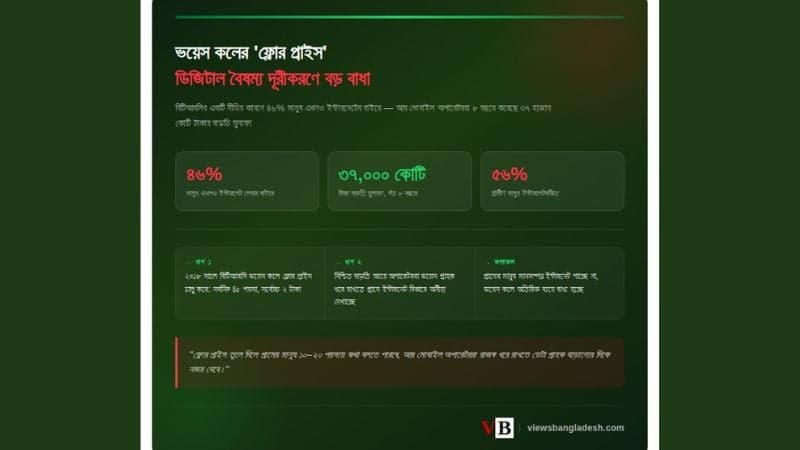

At first glance, it may appear somewhat implausible, yet it is indeed a fact! A staggering 46 percent of the population in Bangladesh remains without internet access, a situation stemming from a contentious decision made by the telecommunications regulator, BTRC.
In rural regions, the deprivation of internet service affects a total of 56 percent of the populace. This contentious decision pertains to the 'floor price' established for voice calls by mobile operators.
The BTRC formulated this 'voice call floor price' policy in response to the widespread issue of digital inequality. As this floor price guarantees a steady stream of additional income, the introduction of quality internet services in rural areas has been stalled for eight years since the launch of the Forage service, as voice call subscribers are reluctant to forfeit their current benefits.
As a result, 53 percent of the total revenue generated by mobile operators thus far comes from voice calls, as indicated by the financial statements of the operators themselves. It is clear that predominantly low-income individuals in both urban and rural areas are forced to depend significantly on voice calls. On one side, BTRC has imposed additional charges for voice calls on low-income individuals to secure extra profits for mobile operators, while on the other side, it is concurrently denying them access to affordable internet services. Through the implementation of this 'floor price' policy, BTRC established the minimum price of voice calls per minute for mobile operators at 45 paisa and the maximum price at Tk2 in August 2018.
Recently, information provided by Mahtab Uddin Ahmed, the former Managing Director of Robi Axiata Limited (who also served as the company's Chief Financial Officer at one point) during a seminar, reveals that mobile operators have accrued an additional profit of approximately Tk37,000 crore from the period when BTRC set the floor price of voice calls in August 2018 until December 2025. This represents the significant reality behind the insufficient internet penetration in rural regions of Bangladesh. Mobile operators are unwilling to forfeit this opportunity for guaranteed additional profit of 4,625 crore taka annually, which totals Tk37,000 crore over 8 years. If quality internet were to be made available, individuals in rural areas would also communicate via WhatsApp and Messenger, leading to a rapid decline in the volume of direct voice calls, thereby diminishing this lucrative opportunity for extra income.
Consequently, mobile operators will refrain from providing quality internet services in rural areas until BTRC completely abolishes this unjust 'floor price' for voice calls; this is the undeniable truth. Should the floor price be eliminated, individuals would be able to make voice calls for 10-20 paisa, similar to the rates before 2018, and mobile operators would also shift their focus towards increasing data subscribers to sustain their revenue stream, thus necessitating the assurance of service quality.
When 3G services were introduced in 2013, mobile operators claimed, 'The regulatory authority has mandated the launch of 3G at a time when 3G is nearing its end and 4G is just beginning globally.' This justification allowed mobile operators to largely refrain from extending 3G services beyond urban regions. Subsequently, 4G services were rolled out on February 19, 2018. Since that time, mobile operators have reported a significant drop in revenue from voice calls. In August, a maximum floor price of Tk2 and a minimum of 45 paisa was established for voice calls. While a maximum price limit can be determined, the criteria for setting the minimum price limit remains unclear. It is evident that the push for a minimum floor price for voice calls was primarily aimed at ensuring a pathway to increased profits with minimal investment in 4G services, without broadening the reach of this service nationwide.
During a seminar, Mahatab Uddin Ahmed advocated for the immediate removal of the floor price for voice calls, to which Shahed Alam, the current Chief Corporate Affairs Officer of Robi Axiata, responded, 'The extra revenue generated from the floor price for voice calls is utilized as a subsidy for data services.
Thus, eliminating the floor price for voice calls would negatively impact data services as well.' Although Shahed Alam's position may spark debate, he unveiled a significant reality that day.
Specifically, Robi has not allocated any new capital for data services; rather, it has merely maintained data services through subsidies derived from the additional income from voice calls.
This raises the question of the quality of such subsidized data services. Does this situation also pertain to Grameenphone and Banglalink? If that is the case, it can be concluded that the anticipated foreign direct investment in the country's telecommunications sector over the past eight years is a result of BTRC's 'floor price' policy for voice calls!
The mobile operators owned by foreign entities present a compelling argument. Specifically, they claim, 'They are unable to deliver the required service because they lack control over the transmission service.' By prioritizing this argument from the mobile operators, the Special Assistant to the Chief Advisor on Telecommunications and Information Technology during the previous interim government initiated a significant transformation in the network infrastructure policy. This policy generated various business opportunities for mobile operators.
However, the unfortunate reality is that this policy has pushed domestic entrepreneurs, who have established themselves in the telecommunications and information technology sector over the past twenty years, to the verge of total collapse. Concurrently, it has set the stage for data service prices to potentially match those of voice calls in the future.
The policy implemented during the interim government's tenure will not serve anyone's interests except for providing additional profit opportunities to the three foreign-owned mobile operators, similar to the 'Voice Call Floor Price' policy. Prior to 2009, Grameenphone held a monopoly on transmission services in the country.
At that time, they controlled the nationwide transmission network of Bangladesh Railway. They also constructed some networks in Dhaka and Chattogram. Essentially, the Bangladesh Railway's network charged Tk10,000 per Mbps bandwidth for transmission. Consequently, it was impossible to offer internet services in the country at an affordable price.
In 2008, a common transmission network was established following the adoption of the ILDTS policy. Subsequently, by 2011, the price of bandwidth per Mbps for transmission services decreased to 500 taka. This led to the establishment of small internet service providers throughout the country. Small entrepreneurs started around digital services across the country.
The recent policy implemented by the interim government regarding network infrastructure essentially aims to restore the soaring profits of mobile operators that were prevalent prior to 2009. If there had been genuine intentions behind the adoption of this policy during the interim government, the cancellation of the floor price policy for voice calls would have been addressed. However, there was no opportunity to implement such a policy that would contradict the interests of the three foreign-owned mobile operators during the interim government's tenure!
Whether one acknowledges it or not, the transmission network necessary for providing 4G services at the union level was prepared before 2018. The reluctance of mobile operators to offer 4G services in rural areas was solely due to the voice floor price policy, which resulted in the improper utilization of this transmission network. It can also be stated, 'Identify a village that lacks 4G services?'
The response is that not only in the villages, but also in the periphery or outskirts of the capital, Dhaka, proper 4G service is absent. Although your smartphone may display the 4G symbol due to technical capabilities, the lack of adequate capacity means you will not receive a signal, and attempts to browse will result in stagnation. Regarding smartphones, it is often claimed, 'Smartphone penetration in the country is inadequate, and the majority of individuals lack the financial means to purchase smartphones.
Therefore, will there be an increase in users if the 4G network is robust?' The citizens of this nation, residing in the central regions, have previously acquired mobile connections for Tk4,000 and have purchased low-quality handsets offered in mobile operators' packages for Tk6,000-7,000. Consequently, if 4G services are extended to rural areas with appropriate capacity, smartphone penetration will rise.
Handset manufacturers or donors will also seek avenues to sell more devices at reduced prices. The challenge lies in the fact that villagers, who are greatly frustrated by the lack of internet access after purchasing 4G packages from mobile operators, react negatively to the mention of 4G or smartphones.
The villagers are not yet accustomed to using the internet. As a result, local Internet Service Providers (ISPs) are struggling to expand their businesses. The villagers' simple perception is that 'the internet merely exists on the device; what more can happen to the router?'
Moreover, while mobile operators have the opportunity to profit from voice calls in the village, they are now also capturing customers who use broadband internet in urban areas, largely due to a new policy from the Bangladesh Telecommunication Regulatory Commission (BTRC). During the interim government, the BTRC allowed mobile operators to offer wireless broadband services at reduced prices.
Consequently, there has been a significant increase in 'SimFi' internet services. Unlimited internet for a month is available for just Tk1,000, without the hassle of cables, which is quite appealing! As a result, local entrepreneurs in the ISP sector are now anxiously awaiting a favorable change!
Interestingly, if one uses a SIM card in a router, they can access unlimited internet for Tk1,000 per month, whereas on a smartphone, one must purchase a limited data package of seven to ten GB for Tk500 for the same duration! This indicates that Subhankar's analysis of mobile internet packages is indeed valid!
Currently, 'digital sovereignty' is a key global policy. While you will certainly pursue foreign investment, it must be done with a focus on 'digital sovereignty.' A glance at neighboring countries such as India, Sri Lanka, and Nepal will clarify your standing.
Therefore, it is imperative for the government and regulatory bodies to formulate a new telecommunications and information technology policy that prioritizes digital sovereignty above all else in today's global context, starting with the elimination of the 'unreasonable floor price of voice calls' that perpetuates digital inequality in the nation.
Rased Mehedi, Telecommunications and Information Technology Sector Analyst, Editor, Views Bangladesh
Leave A Comment