
France moves to impose curfews to contain violence
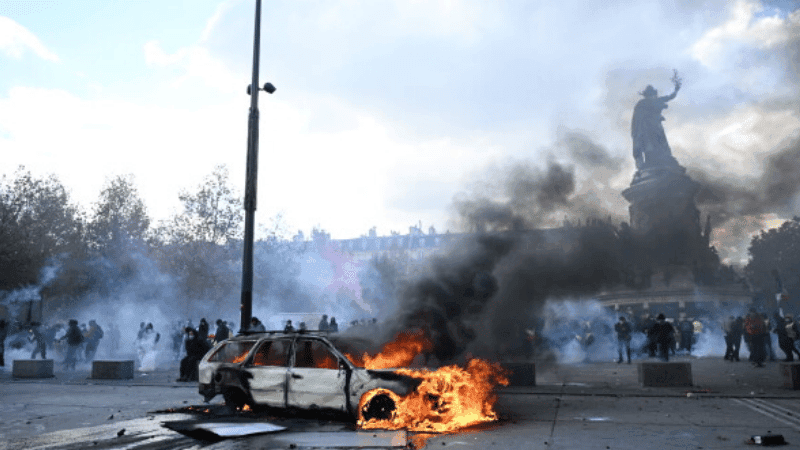

The French government is preparing to impose curfews in several areas to contain violence that erupted during protests over the rising cost of living and deteriorating conditions in educational institutions. The unrest has seen shops vandalised and looted and public buildings set ablaze in several cities. The government is also considering tougher measures if necessary.
On Monday (19 October), French Prime Minister Sébastien Lecornu said partial, localised curfews would be introduced in selected areas, depending on the situation. The aim is to ensure the safety of businesses and the public. The areas to be covered by the restrictions will be announced later.
On Sunday evening, President Emmanuel Macron granted special powers to government representatives in various regions, allowing them to ban specific gatherings if deemed necessary. In Marseille, a city hit by violence, all gatherings and demonstrations were banned from noon to 8pm on Monday.
Lecornu did not rule out declaring a state of emergency or invoking Article 16 of the French Constitution, which allows the president to exercise extraordinary powers in exceptional circumstances. For now, however, he considers curfews the more appropriate measure.
Former prime minister Gabriel Attal, a potential candidate in next year’s presidential election, has called for the armed forces to be deployed if necessary. He said temporary military deployment might be required to bring the situation under control.
Interior Minister Laurent Nuñez acknowledged that law enforcement agencies had lost control of the situation in several cities despite a massive police deployment. Some 60,000 police officers and gendarmes were mobilised to contain the violence, but the unrest could not be brought fully under control. Nuñez offered to resign on Sunday, but Macron rejected his offer. The minister said he had sought to step down while accepting full responsibility for what had happened.
More than 2,300 people were arrested after protests on Saturday escalated into violence. Nearly 1,000 police officers and gendarmes were injured, while one demonstrator died after suffering cardiac arrest.
In Paris, Lyon, Marseille and other cities, masked protesters attacked shops, looted businesses and set buildings on fire. In the central city of Limoges, a fire broke out in a 19th-century municipal building, causing its roof to collapse. At least five shops were looted in Paris, where the entrance to a department store was also damaged during attacks by looters.
Meanwhile, art students disrupted operations at the Louvre, one of the world’s largest museums, on Monday. Their blockade obstructed visitors’ access through the museum’s main entrance.
Paris prosecutor Laure Beccuau said around 130 people had been detained in the capital between Sunday night and Monday morning. Not all were arrested on suspicion of looting; some face allegations of other offences.
Meanwhile, intelligence agencies within the Interior Ministry have warned that the government fears left-wing political groups may seek to fuel unrest ahead of next year’s presidential election. However, no detailed evidence has been made public to substantiate the warning.
Separately, leaders of the Yellow Vest movement have announced plans to return to the streets next Saturday for a mobilisation dubbed “Act Two”. The announcement has raised concerns that the ongoing violence and political instability in France could spread further.
Leave A Comment