
France supports Bangladesh achieving own strategic autonomy, says French envoy
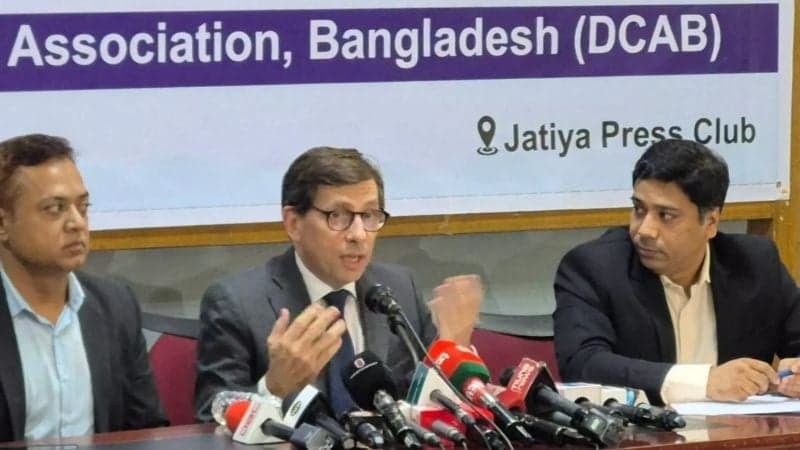

France's Ambassador to Bangladesh Jean-Marc Séré-Charlet stated on Tuesday that France is committed to assisting its South Asian partners, including Bangladesh, in establishing their own strategic independence, thereby enabling them to avoid being compelled to align with either Washington or Beijing.
"In response to the intensifying competition between the United States and China, France is establishing itself as a stabilizing force, utilizing its position as an Indian Ocean nation," he remarked.
Ambassador Séré-Charlet emphasized that France's diplomatic and strategic objectives in the Indo-Pacific region, particularly concerning its engagement with Bangladesh, are concentrated on advancing a multilateral "third way."
During remarks at the "DCAB Talk," he explained that advocating for a "third way" in opposition to dominant powers encompasses strategic independence and opposition to imperialism.
The Diplomatic Correspondents Association, Bangladesh (DCAB) organized its principal gathering at the Jatiya Press Club. DCAB President AKM Moinuddin and General Secretary Emrul Kayesh delivered remarks as well.
Regarding maritime protection and equilibrium in the Indian Ocean, the French envoy emphasized that this foundation rests upon unrestricted navigation rights.
Given that the northern Indian Ocean constitutes a critical maritime corridor for international commerce, France remains dedicated to safeguarding international maritime regulations in the region, mitigating the dangers posed by territorial disputes and expansionist activities, he stated.
The envoy further noted that this commitment encompasses monitoring and territorial authority, as France, possessing the most extensive maritime jurisdiction in the region, is reinforcing collaborative efforts to counter emerging threats, encompassing unauthorized fishing operations, maritime piracy, and illicit trade.
Ambassador Séré-Charlet noted that economic cooperation between France and Bangladesh demonstrates vigorous commercial activity, though characterized by an asymmetrical trade structure.
Reciprocal commerce surpasses 4.5 billion euros, representing substantial growth throughout the preceding decade.
According to the envoy, France maintains a structural trade deficit with Bangladesh, as Bangladeshi product imports—particularly in textiles—substantially exceed French exports to the nation. Approximately 95% of French imports originating from Bangladesh derive from the textile sector, encompassing clothing and apparel.
Remaining imports are predominantly composed of significant contracts, aerospace industry products, equipment, and technology.
The envoy noted that French commercial presence is underpinned by major industrial corporations engaged in transportation, energy, and sustainable urban development. Nevertheless, emerging opportunities for sectoral expansion exist within the pharmaceutical industry, food processing, and digital technologies, the envoy stated.
France maintains a prominent position in climate diplomacy and crisis management—having initiated the Paris Agreement in 2015, France continues to advance environmental cooperation initiatives.
"Given Bangladesh's considerable exposure to climate change impacts, France is utilizing its environmental leadership to establish robust cooperation in domains including climate adaptation, resilient infrastructure development, and natural disaster risk mitigation," he stated.
Considering Bangladesh's substantial vulnerability to climate change, both nations are intensifying their engagement regarding sustainable infrastructure projects and green adaptation strategies, Ambassador Séré-Charlet noted.
The envoy emphasized that French diplomatic efforts actively facilitate Bangladesh's significant transitions, encompassing the political reforms currently being undertaken by the government and its forthcoming transition from Least Developed Country (LDC) classification.
France has established itself as a leader in feminist foreign policy since 2019, emphasizing gender equality across diplomatic channels, development initiatives, and multilateral organizations through its comprehensive feminist foreign policy framework (2025-2030), which aims to advance gender equality and women's rights on a global scale.
This approach is consistent with comparable initiatives undertaken by other nations and addresses escalating threats to these fundamental principles. The strategy concentrates on key areas including educational access, the elimination of gender-based violence, enhanced political representation, economic advancement for women, and reproductive health rights, according to the official statement.
Emerging priorities encompass feminist approaches to climate action, digital rights protection, and economic policies designed to foster equality, the envoy explained, emphasizing that France's feminist foreign policy represents a deliberate response to entrenched systemic inequalities and mounting threats to women's rights, with emphasis placed on collaborative multilateral efforts and coordinated domestic measures.
"For these compelling reasons, we stand prepared to deepen our partnership with Bangladesh, a nation that occasionally adopts a reserved position in international affairs. We believe that countries sharing identical values and objectives regarding peaceful international relations must demonstrate greater assertiveness and proactive engagement, enhance their collaborative efforts, and exemplify through their conduct the viability of this approach," stated Ambassador Séré-Charlet.
He noted that unprecedented cooperation is emerging with Canada, alongside partnerships with additional nations. "This engagement extends beyond geopolitical considerations to encompass economic and commercial dimensions. I am confident that Franco-Bangladeshi relations possess considerable development potential."
The envoy characterized the contemporary global environment as increasingly chaotic, hazardous, and unpredictable compared to previous periods.
"Interstate confrontation has become a prevalent mode of engagement, while cooperation, even when present, continues to diminish in frequency."
Ambassador Séré-Charlet observed that the world is experiencing a transformative period marked by proliferating conflicts and expanding zones of instability where access has become progressively restricted.
"Furthermore, the application of military force has emerged as a viable option that numerous nations now contemplate."
Regarding the Middle East, he emphasized that today marks the first anniversary of the French government's official recognition of the State of Palestine, which was formally declared by President Emmanuel Macron on September 22, 2025, during his address to the United Nations General Assembly in New York.
France extended recognition to the State of Palestine during the 80th session of the General Assembly, in conjunction with a collaborative conference addressing the two-state solution, which was jointly facilitated with Saudi Arabia.
France became part of a broader international movement alongside other Western nations (including the United Kingdom, Canada, Australia, and Belgium) that have either announced or enacted comparable measures during the same timeframe.
"Through this declaration, a substantial majority of UN member states have formally acknowledged the State of Palestine. This action is designed to reinvigorate the peace process throughout the Middle East, recognizing the legitimate aspirations of the Palestinian people while reaffirming France's dedication to Israel's security," stated Ambassador Séré-Charlet.
He further noted that the establishment of a French embassy in the State of Palestine remains dependent upon the achievement of a ceasefire agreement and the liberation of hostages currently detained in Gaza.
Leave A Comment