

Free the Book Fair from policing and party influence
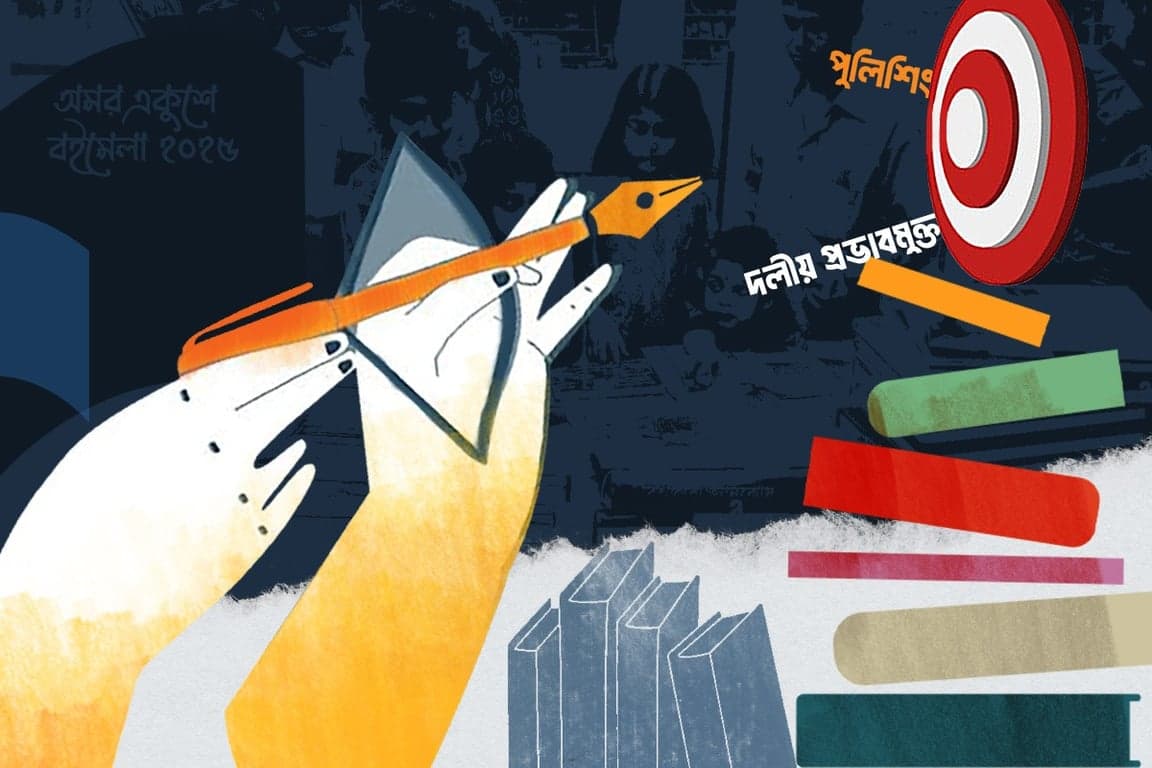

When we think of the two most cherished events in the Bengali community, one is the Amar Ekushe Book Fair—held every February at the Bangla Academy and the adjacent Suhrawardy Udyan—and the other is Pohela Boishakh.
In fact, the book fair, organized by the Bangla Academy, forms the backbone of the country’s publishing industry. Apart from textbooks, creative and intellectual books do not sell much throughout the year. Some books do sell through government procurement lists, but these are a small fraction of total sales. Hence, publishers eagerly wait for February each year.
The Book Fair plays a significant role in creating readers. It also contributes to the creation of writers. Altogether, the fair fosters a strong connection between writers, readers, and publishers, significantly impacting the intellectual and creative spheres of the country. Every year, thousands of new books are launched at the fair, with millions of dollars in sales. As a result, the fair has its own economic significance as well.
A recurring issue at the fair is the difficulty many face in finding their desired stall or pavilion. Even though there are several information centers at the fair, navigating the vast space and finding the right stall, despite having the stall number, can be quite challenging. Often, the numbering system for stalls can feel confusing. To address this, many believe that the fair needs to embrace digital technology. For instance, an app could be developed for the Book Fair, where visitors can easily find a list of books, author profiles, stall numbers, and book prices. This may not be feasible this year, but with effort, it could certainly be implemented by next year.
The demand for e-books and audiobooks is increasing day by day. As a result, many believe that the fair should designate a separate section specifically for e-book and audiobook publishers.
Since the book fair attracts a large crowd, it is essential to have good toilet facilities. Every year, there are reports of dissatisfaction, especially from women, children, and elderly visitors, regarding the toilet arrangements.
Dust is a major issue at the book fair. Every year, visitors are left struggling with dust. While water is sprayed to control it, this often results in muddy areas. A more modern solution is needed. However, completely covering the entire Bangla Academy and Suhrawardy Udyan area with concrete is not a viable option. Here, a bit more innovation is required.
The environment advisor has stated that this year’s fair will be free of polythene. This means no product will be handed out in polythene bags. Polythene usage is already minimal at the book fair since books are typically given in paper bags. Still, reducing the use of polythene even further would be a positive step.
For the past couple of years, tea has not been available inside the book fair. There are a few "ready coffee" shops, but this has caused a great deal of dissatisfaction among visitors, as the satisfaction of drinking tea cannot be found in "ready coffee." Vendors do not serve tea because the profit margin on a cup of tea is much less compared to a cup of coffee. In other words, their primary focus is on profit, not customer satisfaction. The Bangla Academy could issue clear guidelines, stating that no harmful chemicals under the name of "ready coffee" should be sold. Instead, they should reinstate the traditional tea service as it was before.
Due to the rise in the cost of paper and other printing materials, the price of books has also increased. However, the higher prices sometimes lead readers to leave without buying their preferred books. Since books are not ordinary commodities but play a key role in shaping the intellect and mindset of a nation, the government should incentivize publishers by lowering the cost of paper and printing materials, providing subsidies, and keeping book prices affordable. It should be kept in mind that the largest group of book readers is students, many of whom buy books with money given to them by their parents.
Will there be political party stalls?
In previous years, during the tenure of political parties in power, various wings and affiliates of the ruling party, as well as organizations established under their patronage, set up stalls in large areas of the Bangla Academy premises. These stalls mainly showcased literature aligned with the party's ideology. At these stalls, branding the organization often took precedence over book sales. Since this year a non-partisan government is in power, it is expected that there will be no stalls or pavilions representing any political party. However, it is not unusual for a political party or organization closely associated with the interim government to have a stall. If such stalls are absent this time, or if they are significantly fewer, the Bangla Academy area could be left with more open space, benefiting the movement of visitors.
Will there be 'Policing' at the fair?
In the past, various publishers and authors have faced awkward situations at the book fair, with certain books being removed from stalls, sales being banned on specific titles, and publishing houses being placed under pressure or even threats. Will this pattern continue this year?
Over the last 15 years of the Awami League’s rule, numerous books about Sheikh Mujibur Rahman have been published at the book fair. Will publishers be allowed to display those books at the fair this year? Or will the fair authorities impose an unofficial ban on such publications, or will publishers themselves practice a form of self-censorship and avoid displaying these books? Even if a book has the image of Sheikh Mujibur Rahman on its cover and holds academic or historical value, will publishers be able to freely showcase such books this year?
The concern arises because, recently, the head of a prominent publishing house in the country mentioned an incident where their company had organized a book exhibition. Since they mainly publish books related to Bangladesh's history, heritage, and politics, some of their books featured images of Sheikh Mujibur Rahman on the covers. However, during the exhibition, some students from a private university visited and insisted that books with the image of the Father of the Nation should not be displayed. Despite a discussion with the students, the publisher had to remove those books. Given this, it is difficult to guarantee that such incidents will not occur at the book fair as well.
This concern is compounded by another reason. During the stall allotment process for this year’s fair, several publishers, who were allegedly close to the previous government and had benefited during that time, reportedly demanded that certain publishers be denied stalls or pavilions. As a result, a well-known publisher possibly has been denied a stall or pavilion. Many others have been allocated smaller spaces compared to previous years. This has led to disputes between the publishers and the Bangla Academy, with some publishers expressing their dissatisfaction.
The question is, why must a book publisher, who is involved in the creative business and plays a crucial role in the intellectual development and formation of the nation’s mindset, be aligned with either the Awami League or the opposition? Is not the identity of being a publisher enough?
The reality is that over the years, our society has become so politically divided that now, in order for a publisher to increase book sales, they had to align themselves with the Awami League. Conversely, there are now those who are attempting to prove themselves as "anti-Awami League" to gain additional advantages or state patronage. The fact that even the business of those working in the intellectual domain of the nation has been influenced by party politics raises a pertinent question: Over the years, with the Amar Ekushe Book Fair taking place for an entire month in the expansive grounds of the Bangla Academy and Suhrawardy Udyan, with thousands of books being published and millions of books sold, what change has this brought about in the nation’s intellect, thought, and consciousness?
Amin Al Rasheed: Journalist and writer
Leave A Comment
You need login first to leave a comment