
Argentina-England historic rivalry
From 'Animals' to 'Hand of God': Fiercest battle of football history heads to Atlanta
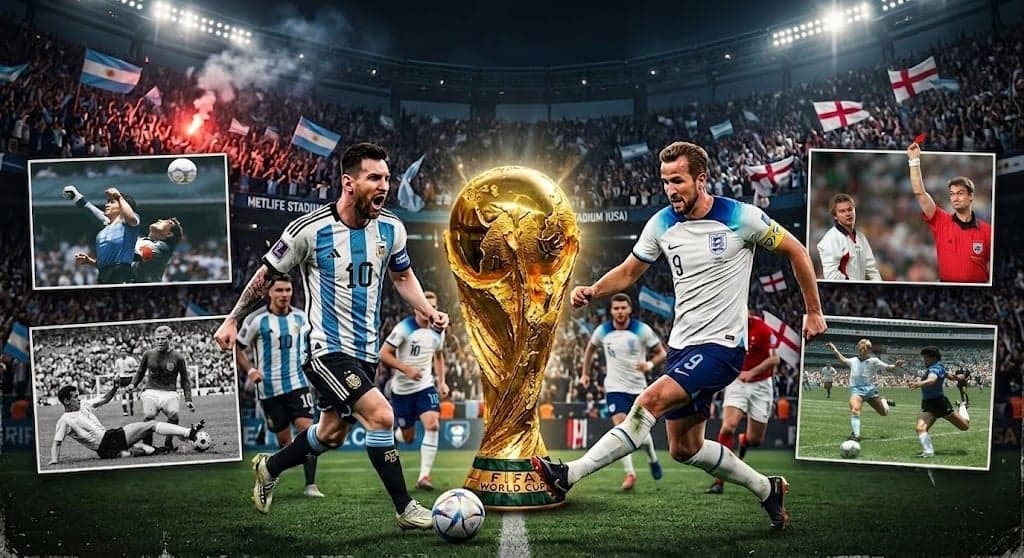

As night falls over Atlanta, the heat will build on the pitch. A heat that will not be contained within the stadium, it never has been throughout history! The latest chapter of one of football's greatest rivalries is set to unfold in the 2026 FIFA World Cup semi-final between Argentina and England.
In this edition, one side of the semi-final will feature defending champions Argentina, while the other will see England desperate to end a 60-year drought. This is not just a semi-final; it is a fierce battle of emotion, history and politics between two nations. Whenever Argentina and England meet on the football pitch, the game transcends the two teams and becomes a clash of national pride. This rivalry has prompted a red alert in Atlanta, as the heat, controversy and history surrounding this match are larger than the game itself.
The high-voltage match at Atlanta's historic Mercedes-Benz Stadium has the entire football world on edge. Beyond the on-field contest, the historical political and footballing enmity between the two nations has led the local police department to issue a 'red alert' across Atlanta. A match generating such intense security may sound surprising, but a look at history reveals the depth of this rivalry.
These two teams first met at the 1962 World Cup. Little did anyone know then that this would mark the beginning of one of football's most toxic and emotional rivalries. Since then, they have faced each other five times in the World Cup, with England winning three times and Argentina twice. However, the win-loss record is secondary; the real story lies in the margins of each match — in the referee's whistle, the wave of flags, the rage of players leaving the pitch, or the thirst for revenge. Every meeting between these two sides seems like a chapter where football and politics, glory and humiliation, blend to create the most dramatic episodes in World Cup history.
1962: First battle in Rancagua
The first meeting between England and Argentina took place on June 2, 1962, at the Estadio El Teniente in the small Chilean city of Rancagua. It was a group stage match that England won 3-1. Ron Flowers scored from a penalty, Bobby Charlton doubled the lead just before the break, and Jimmy Greaves added a third in the second half. Jose Sanfilippo scored the only goal for Argentina, but it was not enough to change the outcome.
This victory was crucial for England's survival in the tournament. The two teams finished level on points, but England advanced to the quarter-finals on goal average, while Argentina were eliminated. This was the first time in World Cup history that a team was eliminated on goal difference, a decision that Argentine fans naturally could not accept. That seemingly simple match became the first page of this long, dramatic saga.
1966: The 'Animals' controversy and Rattin's red card
The sky over London was grey, but tension was building at Wembley Stadium for the 1966 World Cup quarter-final between hosts England and Argentina. Argentine fans sought revenge for the previous tournament's elimination.
Just 35 minutes into the match, the game's character changed. After a tackle by Argentine captain Antonio Rattin, German referee Rudolf Kreitlein stopped the game. Rattin tried to protest, but the language barrier proved his biggest obstacle — the referee could not understand Spanish, but interpreted Rattin's gestures and intense reaction as misconduct and showed him the red card.
What followed is one of football's most bizarre scenes. Rattin refused to leave the pitch. He stood near the centre circle for nearly ten minutes, arguing and raging. Many claim Rattin gestured towards the English flag in frustration. Finally, with police intervention, he was forcibly escorted off the field. The image was broadcast around the world, and this moment left a lasting mark on football — it ultimately led to the introduction of yellow and red cards as visible symbols of punishment.
With ten men, Argentina lost 1-0 to a Geoff Hurst header. But the controversy did not end on the pitch. After the match, England manager Alf Ramsey made an explosive comment, calling the Argentine players "animals." He even instructed his players not to exchange shirts with their opponents. The Argentine camp was furious — to this day, older football fans in Buenos Aires claim that Hurst's decisive goal was offside. That single afternoon gave birth to a bitter rivalry between two nations across two continents, one that would later merge with the shadows of politics and war.
1986: The 'Hand of God' and 'Goal of the Century'
Four years earlier, Britain and Argentina had fought a war over the South Atlantic Falkland Islands. Argentina had lost that war, thousands of its soldiers had died, and the nation's pride bore deep wounds. When the two teams met again in the 1986 World Cup quarter-final in Mexico City's iconic Azteca Stadium, the match was an unwritten battle for Argentina to restore honour. Leading that battle was a dramatic, brilliant, almost supernatural footballer — Diego Armando Maradona.
In the 51st minute, a ball floated into the English box. Maradona and English goalkeeper Peter Shilton both leapt for it. Shilton was much taller, but the ball ended up in the net. Slow-motion replays later showed that Maradona had punched the ball with his left hand, not his head. The referee could not see it clearly and awarded the goal. After the match, Maradona confessed to journalists what had happened, but in a poetic twist, he said the goal was scored "a little with my head and a little with the hand of God." And so the phrase 'Hand of God' became eternal in football history.
But Maradona did not stop there. Just four minutes later, in the 55th minute, he produced a goal that FIFA later called the 'Goal of the Century'. He picked up the ball in his own half and started running, dribbling past one English player after another — Peter Reid, Terry Butcher, Terry Fenwick — five defenders tried in vain to stop him. Finally, he rounded goalkeeper Shilton and slotted the ball into the net. The entire stadium seemed frozen for a few moments, then exploded in cries of amazement. The emotion in the commentators' voices that day is still etched in the memory of football fans.
Argentina won the match 2-1. For Argentines, this victory was a symbol of restoring the honour lost in the Falklands conflict, a spiritual revenge for political humiliation. Argentina went on to win the World Cup, and Maradona became a national hero, almost a god-like figure.
1998: Beckham's red card and English penalty heartbreak
In the Round of 16 at the 1998 World Cup in France, England and Argentina met again at the Stade Geoffroy-Guichard in Saint-Étienne. The tension was sky-high from the start. Argentina took the lead from a penalty in the second minute, and England equalised from a penalty in the sixth minute through Alan Shearer. Then, in the 16th minute, came the famous moment — 18-year-old Michael Owen raced through the Argentine defence and scored a goal that overnight made him a new English star. But Argentina were not to be outdone — they equalised with a brilliant free-kick routine just before the break, making it 2-2.
Then came the most controversial moment of the match. In the 47th minute, a collision occurred between Argentina's Diego Simeone and England's young midfielder David Beckham. After Simeone fouled Beckham, the Argentine playmaker fell theatrically to the ground, and Beckham appeared to kick out — a slight, almost involuntary touch. Simeone's dramatic reaction convinced the referee, who showed Beckham a straight red card.
For years, Beckham was vilified by the English media and fans. Simeone himself admitted years later that he had exaggerated his reaction to influence the referee. Despite being down to ten men, England showed incredible resolve, holding on through extra time. The match went to a penalty shootout. David Batty and Paul Ince missed their penalties, and Argentina won 4-3. Beckham later described this night as the darkest, most painful chapter of his footballing life. But history was waiting for him to write another chapter.
2002: Penalty of revenge and Beckham's redemption
Four years later, the two rivals met again in the group stage of the 2002 World Cup in Sapporo, Japan. This time, David Beckham was the England captain, and the memory of that red card in 1998 still festered. All of England knew this match was not just about three points; it was a chance for Beckham's redemption.
In the first half, that opportunity arrived. Argentine defender Mauricio Pochettino — now the head coach of the United States national team — fouled Michael Owen in the box. The referee pointed to the penalty spot. Beckham stepped up to take it. The entire stadium and the millions watching on TV held their breath. With a cool head and no hesitation, he slotted the ball into the corner of the net. Goalkeeper Pablo Cavallero dived the wrong way.
That single goal won the match for England, 1-0. The burden of humiliation and criticism Beckham had carried for four years seemed to lift in an instant. He broke down in tears on the pitch, embraced by his teammates. It was a moment of redemption. For Argentina, this defeat was a heavy blow — they were eliminated at the group stage, despite being considered among the favourites to win the tournament.
From red cards to the Hand of God, from tears in shootouts to penalties of revenge, each meeting between England and Argentina has gifted football history some of its most memorable and emotional moments. The politics off the pitch, national pride and personal vendettas have combined to make this one of the greatest rivalries in world football.
New chapter in Atlanta
In this semi-final, both teams have the chance to write new history. Argentina seek to rediscover the magic of 1986, while England want to repeat the revenge of 2002. The stars of the present will collide — Lionel Messi vs Harry Kane, Alexis Mac Allister vs Jude Bellingham, John Stones vs Cristian Romero. Time will tell which player will claim this new chapter of the rivalry. Interestingly, Messi — arguably the greatest footballer since Maradona and even in world football history — has never played against England. And for Harry Kane, this will be the biggest match of his career.
When the referee blows the whistle at the Atlanta Stadium, it will not just be the start of 90 minutes of football. It will be the beginning of a new chapter in World Cup history. A chapter that will surely be written once again with drama, controversy and tears.
Leave A Comment