
Global conflict of AI era: Which alliance should Bangladesh join?
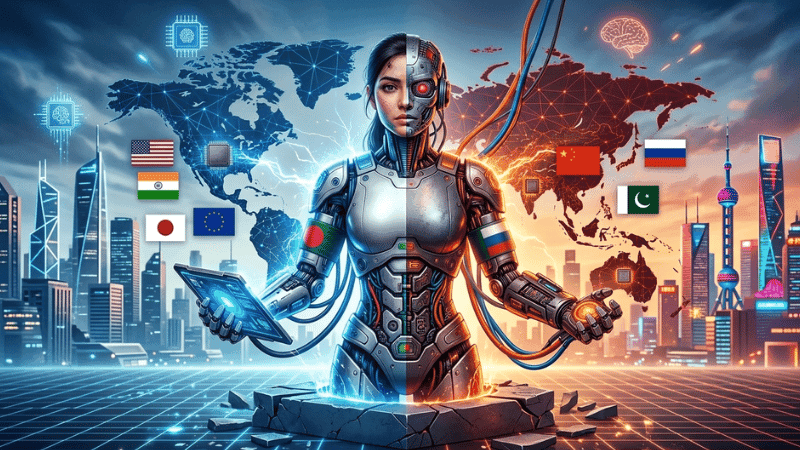

A new international conflict has emerged over the dominance of the artificial intelligence technology sector. Similar to past global rivalries, one faction is spearheaded by the United States, while the opposing faction is led by China and Russia. As anticipated, it was the United States that instigated this latest competition. On December 12, 2025, during the concluding day of the International Tech Summit in Washington, D.C., the Pax Silica Alliance was formed through an agreement signed by 25 nations.
The primary aim of this alliance was to maintain control over the artificial intelligence and semiconductor industries for the United States and its allies, while simultaneously diminishing China's influence in the global technology arena. Essentially, the alliance united the foremost semiconductor and technology powers under U.S. leadership, with India representing South Asia. China did not remain idle following the establishment of Pax Silica. True to form, Beijing adopted a stance of silence while meticulously observing the alliance's activities and evaluating its trajectory. However, in June of this year, after the European Union, supported by its 27 member states, officially joined Pax Silica, China was compelled to swiftly create a counter-alliance.
Just one month later, on July 16, China declared the formation of the World AI Cooperation Organization (WAICO). This new alliance comprises 29 member nations, with Pakistan serving as the representative for South Asia. A notable highlight of WAICO's inauguration was the attendance of United Nations Secretary-General António Guterres at the treaty-signing event.
As per the statement from Bangladesh's Ministry of Foreign Affairs, the nation opted on August 1 to become an observer in WAICO.
The ministry's statement elaborated: "WAICO's objective is to enhance global collaboration in AI innovation and foster inclusive development by bridging technological gaps. It also aims to establish an open, equitable, and non-discriminatory framework for the progress of AI technologies. The organization advocates for regulations that guarantee AI remains safe and advantageous for humanity." In essence, the statement clearly conveys that the Government of Bangladesh endorses WAICO's aims and objectives.
Nevertheless, the timing of Bangladesh's announcement is significant. At that precise moment, U.S. Special Envoy for South Asia, Sergio Gor, was visiting Dhaka. The day following the Foreign Ministry's announcement, on August 2, the U.S. envoy met with Prime Minister Tarique Rahman. During this meeting, Sergio Gor officially invited Bangladesh to become a member of the Pax Silica Alliance.
The pressing question now is: Which path will Bangladesh opt for? While Bangladesh has effectively shown support for WAICO, it has not yet attained full membership; it has only joined as an observer. Thus, the option of joining Pax Silica remains open.
Another critical question emerges. Why did Bangladesh declare its decision to become a WAICO observer precisely when the U.S. envoy was present in Dhaka? Was there considerable pressure from China to ensure that Bangladesh refrains from joining Pax Silica?
Let us begin by examining the countries that are part of each alliance.
The Pax Silica Alliance comprises 25 members, including the United States (the leading nation), the United Kingdom, Germany, the Netherlands, Greece, Finland, Sweden, Norway, India, Japan, South Korea, Australia, Singapore, the Philippines, Israel, Qatar, the United Arab Emirates, Canada, Argentina, Chile, Costa Rica, El Salvador, Panama, and Kazakhstan. Furthermore, the European Union has officially joined as a partner of this alliance.
Conversely, the members of WAICO include China (the leading nation), Russia, Indonesia, Malaysia, Cambodia, Laos, Myanmar, Oman, Pakistan, Kazakhstan, Kyrgyzstan, Belarus, Serbia, Tajikistan, Uzbekistan, Algeria, Cameroon, the Republic of the Congo, Ethiopia, Kenya, Lesotho, Mozambique, Senegal, South Africa, Zambia, Brazil, Cuba, Nicaragua, and Venezuela.
A noteworthy point is that Kazakhstan is a member of both alliances. Kazakhstan adheres to what it terms a "multi-vector" foreign policy. This approach enables the nation to cultivate and sustain balanced relationships with competing global powers at the same time. Both Pax Silica and WAICO allow for participation in both alliances, and Kazakhstan has capitalized on this opportunity. However, can Bangladesh pursue a similar path?
For Bangladesh, while such a strategy is not out of reach, it presents significantly greater challenges.
Historically and geopolitically, Kazakhstan possesses advantages that are not available to Bangladesh.
While Bangladesh advocates for a balanced foreign policy, it has frequently encountered challenges in adhering to this principle for three main reasons. The first reason is that the national and foreign policies of Bangladesh tend to fluctuate with the change of government. There has been a lack of policy continuity. Successive political parties have seldom shown a strong commitment to prioritizing national interests over partisan agendas or to formulating long-term strategies for domestic growth and international relations.
Consequently, powerful foreign nations consistently seek to influence Bangladesh's political parties, leading to divisions among these parties based on external alliances. This represents a significant weakness in Bangladesh's foreign policy. The second reason is the persistent animosity between India and Pakistan, which exerts additional pressure on all countries in South Asia, particularly Bangladesh.
Bangladesh gained independence in 1971 after enduring a liberation war against the genocide perpetrated by Pakistan, resulting in the loss of three million lives. India played a crucial role in supporting Bangladesh during this conflict. Therefore, whenever Bangladesh is faced with major strategic decisions, it must consider the adversarial dynamics between India and Pakistan.
Take the current scenario as an example: India has aligned itself with Pax Silica, while Pakistan has joined WAICO. The two nations have intentionally opted for opposing alliances instead of collaborating within the same framework. This rivalry between India and Pakistan continues to hinder not only their own progress but also the overall development, advancement, and prosperity of the entire South Asian region.
The third reason is that Bangladesh has now emerged as a direct battleground for strategic rivalry between the United States and China, primarily due to the significance of the Bay of Bengal.
Consequently, Bangladesh finds itself unable to openly align with either side, nor can it effortlessly maintain an ideal equilibrium between the two competing powers.
This same dilemma extends to the choice between Pax Silica and WAICO.
In this scenario, the most prudent course of action for Bangladesh would be to meticulously monitor the activities of both alliances and ensure that it derives benefits from each. After all, the global information technology ecosystem is predominantly influenced by the United States. Even nations like China and Russia have struggled to operate completely outside of this technological domain.
Simultaneously, China is gearing up to contest for technological supremacy in the future.
Thus, Bangladesh must thoroughly evaluate the broader geopolitical landscape and anticipate the trajectory of the global technology environment before committing to any long-term decisions. External pressures will inevitably arise from both factions, but formulating an effective strategy to navigate that pressure is significantly more crucial than merely responding to it.
In reality, maintaining neutrality in this new era of technology-driven geopolitics is more complex than it has ever been. The challenge extends beyond mere diplomatic positioning. Instead, Bangladesh must ascertain the sources of critical technologies: Who will provide the semiconductor chips? Whose technology will drive future data centers? Which vendors will construct 5G and eventually 6G networks? Which bloc will offer AI training platforms and cloud infrastructure? Decisions regarding alliance membership must be made with all of these strategic factors in consideration.
Currently, a substantial part of Bangladesh's telecommunications infrastructure has been established using equipment from Chinese suppliers. Conversely, Bangladesh's primary export markets, key sources of remittances, and the most promising areas for technology investment are located in the Western world. Additionally, the country's burgeoning freelancing and IT services sector is more likely to thrive through enhanced collaboration with Western economies.
Consequently, Bangladesh faces a critical decision: whether to evolve into a genuine partner in the global high-tech industry or to continue as a mere provider of low-cost labor to the global technology market. This pivotal question should guide the nation's negotiations with both alliances.
The challenge lies in the fact that Bangladesh has not yet fully executed a comprehensive national AI strategy. The discussions surrounding data protection legislation remain unresolved, and semiconductor policies have not advanced from theoretical frameworks to actual production. In this context, Bangladesh finds itself in a relatively weaker position during international negotiations.
Simultaneously, Bangladesh must acknowledge the sources of its own negotiating power. For Pax Silica, Bangladesh's advantages include its youthful workforce, rapidly growing digital market, and strategic geopolitical position. For WAICO, Bangladesh is viewed as a significant member of the Global South, boasting a large population.
The nation's diplomatic achievements will hinge on how effectively it utilizes these strengths to obtain technology transfer, workforce training, investment, and enhanced access to international markets.
Ultimately, Bangladesh must recognize that alliances are not an end in themselves; they serve merely as a means to fulfill national objectives.
At this juncture, it would be prudent for Bangladesh to maintain openness to both avenues—Pax Silica and WAICO. However, regardless of the path it opts to pursue, it must do so on its own terms and in alignment with its national interests.
The overarching challenge is that the AI race has evolved beyond a mere contest of software or algorithms. It now represents a battle for dominance over the future global economy, technological standards, digital infrastructure, and geopolitical power. Nations that make well-informed, strategic choices today will influence the technological landscape of tomorrow, while those that do not may find themselves reliant on others.
Consequently, Bangladesh should not perceive this matter through a limited perspective of choosing between Washington and Beijing. Instead, it ought to engage with both blocs from a standpoint of strategic pragmatism, aiming to derive maximum advantage from each while steering clear of undue dependence on either.
This necessitates a well-defined national vision. Bangladesh must expedite the execution of its AI strategy, enhance data protection and cybersecurity measures, cultivate a domestic semiconductor industry, invest in AI research and advanced digital competencies, and formulate policies that foster innovation and technology transfer. Only by doing so will Bangladesh be able to negotiate with major technology powers from a position of strength rather than one of vulnerability.
The nation is endowed with significant assets: a vibrant young population, a swiftly expanding digital economy, a growing ICT workforce, and a strategically advantageous position at the intersection of South and Southeast Asia. These advantages ought to be leveraged diplomatically to attract increased investment, foster technology partnerships, promote research collaboration, and gain access to international markets.
Ultimately, the effectiveness of Bangladesh's foreign policy in the age of AI will not be gauged by the alliances it forms, but rather by its ability to protect its sovereignty while promoting its national interests.
We are entering a period where technology will play a crucial role in determining economic strength, political clout, and national security. Bangladesh must strive to be more than a passive observer in this evolution; it should be an engaged participant capable of influencing its own destiny.
Rased Mehedi
Telecommunications and Information Technology Sector Analyst, Editor, Views Bangladesh
Leave A Comment