

Inaugural issue 3 : Look back at 2023
Global Peace and Harmony– A Rarity
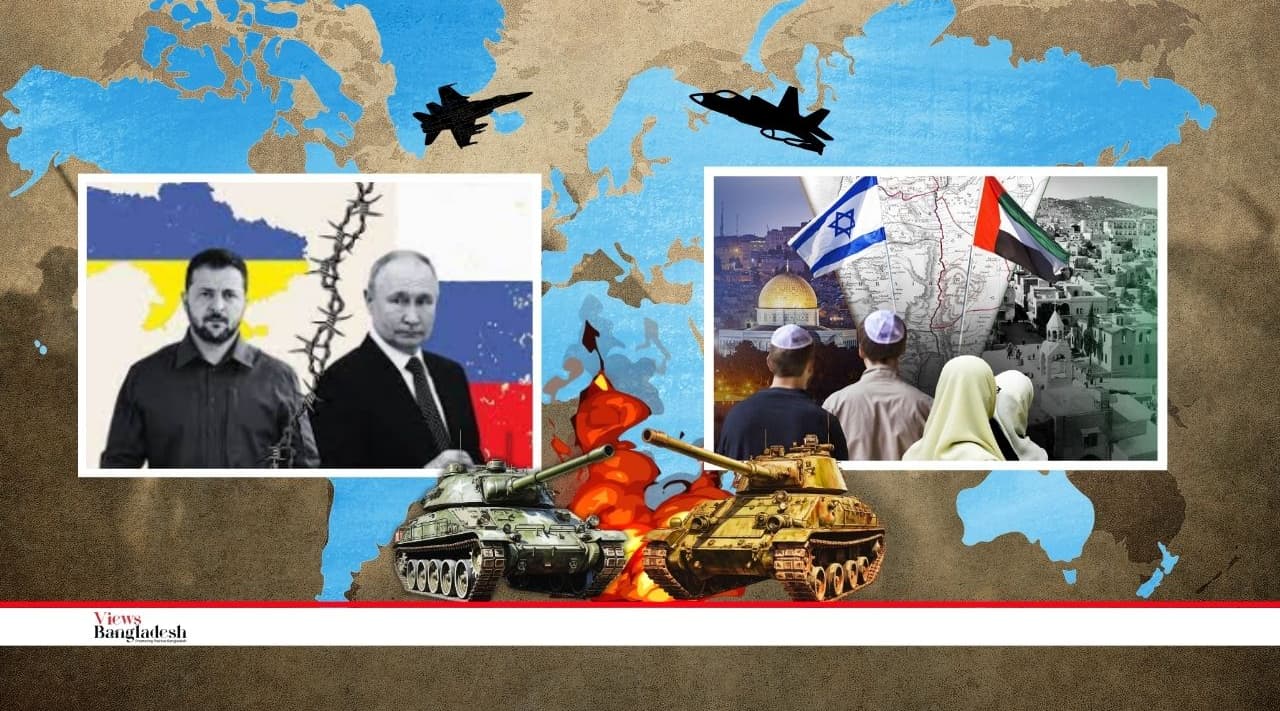

According to UN Office for the Coordination of Humanitarian Affairs, in 2024, nearly 300 million people around the world will need humanitarian assistance and protection, due to conflicts, climate emergencies and other drivers. In East and Southern Africa, about 74 million people will need humanitarian assistance; in West and Central Africa, approximately 65 million people are in need; in the Middle East and North Africa, about 54 million people require assistance; and in Asia and the Pacific, about 51 million people need humanitarian assistance. The aforementioned is an UN estimate of the number of people that will need humanitarian assistance in 2024. The reasons for so many people requiring these assistances are categorically – conflict, climate induced crisis, and economic factors that are also intricately linked and created because of the former two.
The outgoing year was significant for those primed and eager for engaging in conflict, battle, and rampant killing and destruction – the Israeli Defense Force comes to mind first; but there are many others.
Attack on Gaza – Genocide, Live!
Almost all media outlet term it as war in Gaza, but a war needs two sides at equal footing of confrontation. The Gazans are being killed indiscriminately since the 7 October attack on Israel in which around 1,400 people were killed. The attack worked like a breather for Prime Minister Benjamin Netanyahu, who was struggling for his political existence. He has used the Israel’s ultimate objective of overtaking the whole of Palestine to his political agenda, and initiated what seems like the ultimate assault on Palestine that all of Israel and its western patrons were eagerly waiting for. It is unlikely that they will stop before the worst is done to Palestinians. They are all intent on ensuring that the world sees a genocide – Live. They will turn Gaza into a graveyar and maybe later do the same to the West Bank. They will not stop until the last brutal act of colonization and imperialism is realized. Alas! Worst is yet to come.
Ukraine-Russia conflict – Prime news, of the yesteryear!
The biggest and most concerning conflict of the year 2022 but now seems more of an irritant, to Ukraine’s western backers, not so much to the Ukrainians. Ukraine is now faced with a dilemma as the ‘inflated US-backed ego’ is deflated with lack of or stalled funding. Concerns of an ‘all-out’ nuclear war has now gone into a dim phase where both countries secured minor victories and defeats every day. A live genocide seems more attractive to the western imperialists than a regional conflict in east Europe that seems to have lost interest in Ukraine as Gaza occupies their thought process. Ukraine is nothing more than a fatigue factor for the US and the Europeans, who are more focused on enjoying the show in Middle East!
Nagorno-Karabakh – A region dissipating!
Nagorno-Karabakh region dispute is a long, complex, and historic one between Armenia and Azerbaijan. When the 2020 ceasefire agreement violated in 2022, a skirmish began that led to the death of more 100 people. Azerbaijan had a clear upper hand in the conflict and controlled most of the territory. In April 2023, Azerbaijan decided to open a checkpoint on the highway to deter military shipments from Armenia to Nagorno-Karabakh, resulting in intense round of diplomatic meetings including the US, EU, and Russia. US urged Azerbaijan to officially recognize the internationally acknowledged territorial boundaries of Armenia and ensure the rights and safeguards of ethnic Armenians residing in Nagorno-Karabakh. Something that the US hypocritically does not want to acknowledge for the Palestinians. Not to digress, the security environment remains precarious in the region, with periodic instances of gunfire erupting along the Armenian-Azerbaijani border during the peace negotiations. This underscores the fragile state of the talks and the potential for the two military forces to revert to hostilities. Azerbaijan is backed by Russia and Turkey and maintains a hold over the region. The situation led to a humanitarian crisis in Nagorno-Karabakh as around 80% of the region’s population decided to move to Armenia. The Nagorno-Karabakh administrator has signed a decree to dissolve all state institutions by 1 January 2024.
Venezuela-Guyana: Essequibo dispute revived!
The US back yard did not enjoy any respite from the spate of conflicts that marred the year 2023. South American security dynamics were under crisis as Venezuelan President Maduro signaled considering invasion of neighboring Guyana over the disputed Essequibo region. Apart from the historical claims of both nations, the Essequibo region holds significant oil reserves which ushered a wave of development in the poor Guyana nation. Venezuelans are emotional about the Essequibo region, as they consider it being unfairly taken from them. Maduro is up for elections in 2024 and wishes to capitalize on this emotion. A referendum on the issue was held in December raising concerns that it could provide Maduro with the justification to invade Guyana.
The aforementioned are the key conflicts between nations that have rattled the outgoing year. the International Institute for Strategic Studies in London published the latest edition of its annual Armed Conflict Survey, and its predictions don’t bring peace to the mind not forecast so for the world. The survey was compiled before the murderous events in Israel two months ago and what has followed, but it records rising tensions of the armed settler movement in the West Bank prompting speculation of a new intifada. The Gaza situation may prolong and expand conflict and skirmished across the Middle East as seen by the recent skirmishes created by the Houthi attacks on ships, as surmised by the survey findings. The survey findings indicate conflict has risen year on year, with fatalities increasing by 14% and violent events by 28% in the latest survey. The authors describe a world “dominated by increasingly intractable conflicts and armed violence amid a proliferation of actors, complex and overlapping motives, global influences and accelerating climate change.” It paints a grim picture of rising violence in in many regions. And this is not incorporating the effects of the Gaza situation in the survey findings.
The survey— which addresses regional conflicts rather than the superpower confrontation between China, Russia, the US, and its allies — documents 183 conflicts for 2023, the highest number in three decades. The report underscores that Ukraine remains, the most violent place on the planet, but Syria, Brazil, Myanmar, Mexico, and Iraq are also fragmented. In Nigeria, more than 10,000 people died by violence, mostly at the hands of jihadists, and over 9,000 in Somalia. The numbers of refugees displaced by war are stunning: more than six million in Syria, five million in Afghanistan, a million in Myanmar. Bloomberg reports that the International Committee of the Red Cross catalogues 459 armed groups whose activities provoke humanitarian concerns, with 195 million people living under their full or partial control. Four-fifths of these groups possess sufficient local or regional dominance to levy taxes and provide some measure of public services. The survey further informs that tensions continue between Russia and Georgia, and situation remains the same between Algeria and Morocco. In Pakistan, domestic political tensions are escalating, and tensions in relations with India’s anti-Muslim government are running high. Apart from these are situations across Asia and Africa that raising humanitarian challenges.
According to rescue.com, Intense fighting broke out in eastern Democratic Republic of the Congo (DRC) in 2023, following the collapse of a truce between the government and the armed group M23. This exacerbated a protracted crisis that had already exposed millions of Congolese to conflict, political tensions, economic pressures, climate shocks and persistent disease outbreaks. The country enters 2024 with 25.4 million people in need of humanitarian assistance—more than any other country on earth.
Humanitarian organizations report that across Ethiopia, livelihoods have been decimated by three consecutive years of drought alongside multiple conflicts and now, there is a risk of El Niño-induced flooding. Persistent inflation is further deepening the crisis. The November 2022 ceasefire between the Government of Ethiopia and the Tigray People’s Liberation Front (TPLF) continues to hold in northern Ethiopia. However, the conflict in central Oromia region and in Amhara in the northwest continue fueling humanitarian needs and raising the risk of a return to large-scale fighting.
Somalia is now experiencing widespread flooding after five consecutive failed rainy seasons, devastating agricultural lands, damaging critical infrastructure, and driving up humanitarian needs. The country enters 2024 with people faced with food insecurity at critical levels, with limited ability to restore food production. The continued government offensive against the armed group al-Shabaab risks driving civilian harm and displacement, further worsening conditions for 6.9 million in need of humanitarian aid.
Mali is faced with security and economic crises leaving 6.2 million people in need of humanitarian support. The recent withdrawal of the U.N. peacekeeping force has raised safety concerns. There are fears of renewed fighting between the government and Tuareg armed groups in northern Mali. Already, armed groups are besieging towns and cutting off humanitarian access while half of the country is living in poverty. Food insecurity is set to increase as more cities are besieged or blockaded, with 200,000 children already at risk of death if humanitarian support does not reach them.
The ongoing war between the Sudanese Armed Forces and Rapid Support Forces has propelled Sudan to the top of the 2024 Emergency Watchlist—and pushed the country to the brink of collapse. Less than a year of fighting has already more than doubled the number of people in need of humanitarian support. In Darfur, human rights groups have reported mass killings and forced displacement along ethnic lines. The crisis is expected to dramatically deteriorate through 2024, leaving millions with insufficient food and unable to access critical health and other services. The situation is nothing different in South Sudan, which is faced with insecurity since its independence from Khartoum in 2011. Going into 2024, the war across the border in Sudan threatens to undermine South Sudan’s fragile economy and worsen political tensions. Meanwhile, an economic crisis and increased flooding have impacted families’ ability to put food on the table. Currently, 9 million or 72% of the people in South Sudan are in need of humanitarian assistance.
Burkina Faso is facing rapidly growing and spreading violence as the Burkinabe military struggles to contain armed groups. Roughly half of the country is now outside government control, with armed groups including Islamic State in the Greater Sahara (ISGS) and Jama'at Nusrat al-Islam wal-Muslimin (JNIM) blockading cities and towns and preventing residents from accessing basic goods and services. Harvests in 2024 are likely to be weak following poor rains in 2023, compounding the impacts of conflict and further deepening food insecurity.
July 2023 coup in Niger triggered political tensions with neighboring countries, resulting in the withdrawal of international security assistance, facilitating grounds for armed groups to consolidate more power. New sanctions and border closures have also severely limited the amount of nutritional aid and medical supplies entering the country. 7.3 million people are at risk of falling into acute food insecurity, resulting from adverse impacts of climate change, conflict and the economic effects of border closures.
The conflict in Myanmar (Burma) has spread significantly since the military retook political power in 2021. In October 2023, three major armed groups resumed clashes with the government, putting state military forces under significant pressure and causing increased civilian harm. 18.6 million people in Myanmar are now in need of humanitarian assistance—nearly 19 times more than before the military takeover. Over 335,000 people have had to flee their homes since the latest escalation began, leaving more than 2 million people displaced across the country. Security has rapidly deteriorated, with severe impacts on civilians and their access to basic services and humanitarian aid.
UN sources confirm that more people are displaced now than at any other time since the beginning of the century. Worldwide, more than 1 in 73 people are forcibly displaced, a ratio which has almost doubled in the past ten years. Conflict and climate disasters remain the main factors driving displacement. Acute food insecurity is a reality for 258 million people in 58 countries, driven by armed conflict, economic shocks, climate extremes, poverty, and inequality. Wasting threatens the lives of 45 million children under 5 (accounting for 7% of all children). Cholera outbreaks are reported in 29 countries, and these have grown deadlier in the past two years due to overstretched health systems, shortages of the oral cholera vaccine, lack of access to clean water and sanitation, and the presence of multiple, parallel disease outbreaks. El Niño and other climate phenomena, including the Indian Ocean Dipole, are expected to worsen the effects of climate change and consequent health challenges worldwide. Climate change, worsening armed conflicts, growing debt-loads and shrinking international support will accelerate humanitarian crises worldwide in 2024, the International Rescue Committee (IRC) said in a report.
The outgoing year of 2023 has been devastating for the world and humanity and relishing for the butchers and sadists of the world that thrive on imperialism. The new year is unlikely to bring any positives as the global policymakers are not of the political will to take actions for restoring peace and order globally. May the Almighty save us all in the coming year! On that note, happy new year to all!
Author: Political and International Affairs Analyst
Leave A Comment
You need login first to leave a comment