
Google heads for space-based data centres, AI chip satellite set for October 1 launch
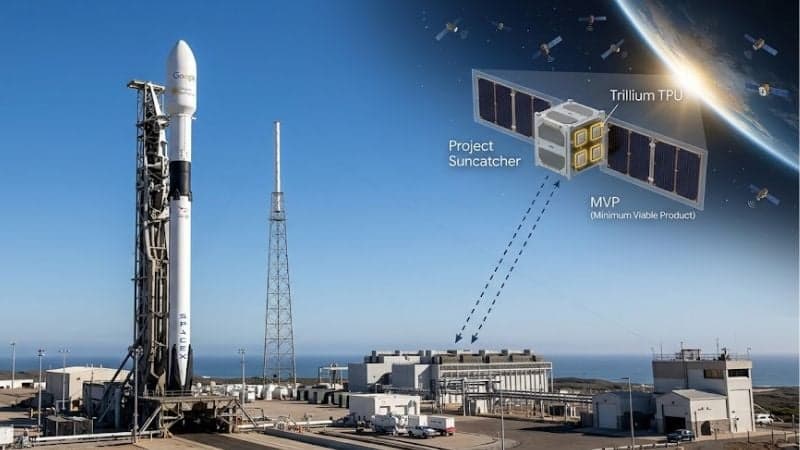

Seeking a solution to the soaring electricity demand created by artificial intelligence (AI) on Earth, technology giant Google is now turning to space. The first prototype satellite under the company's "Project Suncatcher" is scheduled to be launched into orbit on October 1 from Vandenberg Space Force Base in California aboard SpaceX's Transporter-18 mission.
Google CEO Sundar Pichai announced the plan on September 24. He has framed the entire project around one central question: Can Google's AI chips survive and operate in space?
Four AI chips in a refrigerator-sized satellite
Developed jointly with US satellite manufacturer Planet, the prototype is roughly the size of a refrigerator. It carries four Trillium-generation Tensor Processing Units (TPUs) designed by Google. The satellite has been internally designated "MVP," or Minimum Viable Product.
Its combined computing capacity is equivalent to that of a data-centre server on Earth. It will receive around 1 kilowatt of power from solar panels. The satellite is designed to operate for approximately one year, although it could remain in orbit for up to six years before re-entering the atmosphere.
Google has made it clear that this is not a full-fledged orbital data centre, but rather an initial test of the technology's capabilities.
Why Space?
The electricity demand of AI data centres is putting pressure on power grids in various regions, from Virginia in the United States to Ireland. Major technology companies are competing throughout 2026 to secure electricity supplies on a gigawatt scale.
Google argues that satellites in orbit can receive sunlight almost continuously and generate up to eight times more solar energy than is possible on Earth. That is why the satellite is being sent into a dawn-dusk sun-synchronous low Earth orbit, where it will remain in sunlight for most of the time.
Three major challenges
The first challenge for the project is surviving the shock of launch. It takes about 10 minutes to reach low Earth orbit. During that period, acceleration can reach up to 10 times the force of gravity, while individual components such as chips can experience forces of up to 50 to 100 times greater. Google said the satellite has successfully withstood vibration tests along all three axes.
The second challenge is radiation. Solar storms and cosmic rays can alter computer data and cause computational errors. To test this, Google ran AI workloads on the chips under proton beams at the Crocker Nuclear Laboratory at the University of California, Davis. The tests showed that the Trillium chips withstood radiation levels greater than those expected during a five-year space mission.
The third challenge is thermal management. Because there is no air in space, conventional methods of dissipating heat from computer chips do not work there.
Long-term plan
Google first announced Project Suncatcher on November 4, 2025. The initial plan was to send two prototype satellites into orbit in early 2027. The first test is now taking place ahead of that schedule.
The project's long-term goal is to establish an integrated network of around 81 satellites linked to one another through high-speed, laser-based communications. A mission involving two satellites is also planned for 2027 to test the laser communication system.
However, no timeline has yet been set for when orbital AI computing could be used for practical applications. The Transporter-18 mission is intended to answer several fundamental questions: whether the chips can withstand the shock of launch, whether they can operate reliably for months amid radiation, and whether they can be kept sufficiently cool.
Technology analysts say that even a successful launch would not prove that AI computing in space can compete with Earth-based data centres in terms of cost.
Leave A Comment