

Special issue : Monajatuddin
Guiding Light of Journalism Monajatuddin
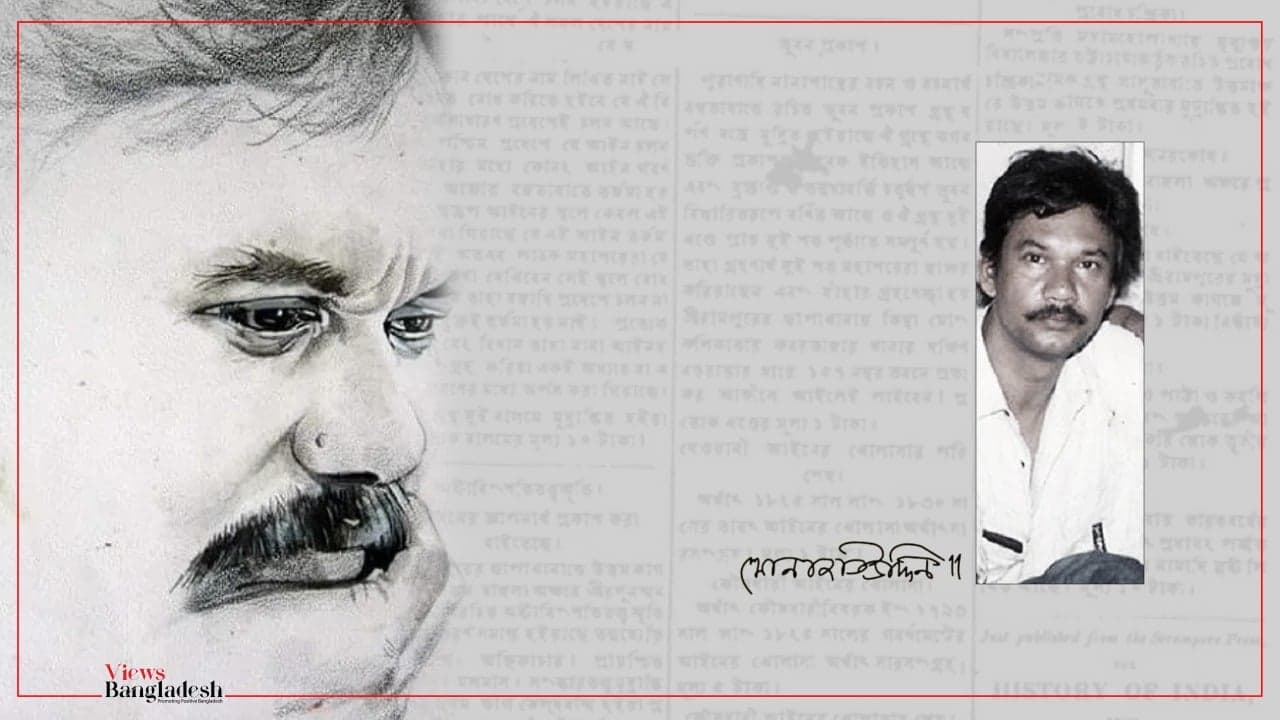
The path of journalism is always challenging. Following this challenging path, veteran journalist Monajatuddin (1945-1995) created a revolutionary chapter in the history of journalism. He experienced the laughter and tears, joy and sorrow of the people in the village very profoundly. As a result, in the shadow of his skilled hands, the life stories of those people came alive in the pages of the newspapers.
He took upon himself the responsibility of ensuring that news is not only centered around the city but also reflects the transformation of the people in the villages. The newspapers mainly focus on the elite class and actively engage in promoting politics or financial interests through advertisements. Monajatuddin, however, stepped outside this trend and played a proactive role in shaping a new direction in journalism. When he emerged, he ushered in a new chapter in journalism.
Monajatuddin's profession and occupation both revolved around traversing the paths and byways of villages to gather news. The major portion of his news coverage focused on the tales of sorrow from the lives of marginalized people. He consistently prioritized the news of the underprivileged and destitute, aiming to shed light on their struggles.
He skillfully brought forth the news behind the news, with his reporting tool being the narratives of the struggling lives of the oppressed. His journalistic instrument was the stories of the life battles of the underprivileged. With a sense of responsibility, he wrote about the compassionate images of the downtrodden, and he endeavored to attract attention to their plight through the lens of empathy.
Moreover, he extended a helping hand to others when needed. He had a sense of responsibility towards society and accepted accountability for his actions. His self-acknowledgment was evident, and this was the reason he traversed the paths, collecting news along the way.
Stepping outside the prevailing trend of journalism, Monajatuddin highlighted the possibility of bringing the villages and their people to the forefront of the news.
He didn't confine himself to the established norms of news reporting; rather, he wrote about various issues affecting the people in the villages, going beyond the conventional narrative. Monajatuddin practiced advocacy journalism. He aimed to bring about a certain kind of change in people's lives. He didn't merely present the news of ordinary people in newspapers; rather, he consistently followed up on the subjects, not confining himself to the routine reporting. Besides the news that was published, he regularly kept track of whether there was any feedback and diligently pursued investigative journalism.
While the concept of rural journalism is prevalent, mass journalism expands its meaning further. Mass journalism gives guidance on how to solve the problems of people's lives regardless of religion, caste, caste, caste. Journalism provides that direction. Monajatuddin did not only focus on the problems of rural people; his work extended to broader areas. He also worked for the welfare of the people at large. To bring an incident to the pages of the newspaper, he had the ability to delve deep into the heart of the news. Simultaneously, he embraced various journalistic skills, and each skill was inherent in him.
Monajatuddin conducted investigative reporting. He uncovered the news behind the news. It can be observed that due to commercial interests influencing the sale of news, rural journalism or investigative reporting might have been sidelined. Many times, due to the involvement of the owner's interests in corruption, many news stories are not published. Newspapers of this nature mainly prioritize political news or sensational news. Therefore, news about rural people is often relegated to the inner pages. However, sometimes it is not published at all. That is, news about why farmers are not getting fertilizers, why their crops are not doing well, or why the same area faces drought year after year does not receive much importance on the pages of newspapers. However, news about a political leader's public rally or the love affairs of a popular actor gets more attention.
Monajatuddin has expanded his focus beyond traditional journalism and delved into rural economy. He has traveled extensively in search of news, exploring on foot and occasionally covering vast regions using different modes of transportation. By extensively traveling through different regions, he has highlighted the socio-economic conditions, and his writings are so touching that the news is not merely a straightforward report; it becomes a reflection of the places he visits.
He has captured the transformation of a farmer into a landless individual in his writings. From his pen, it is evident that both child marriage and polygamy have occurred due to poverty. The news behind this is the strong economic tension. He wants to give a permanent form of news to stop child marriage.
Monajatuddin has identified the main problems of the people in the periphery in our country through his documentary. Successfully navigating through journalism, he has not stopped after identifying the issues. He has discovered the extent and types of problems, indicating solutions during reporting. His effort was to portray an accurate picture of the people affected by the issues and propose appropriate solutions.
Without the development of women, comprehensive development of any nation is impossible. In Bangladesh, women are lagging behind in this regard. The image of women being subjected to oppression is prevalent here. Monajatuddin has transcended the prevailing trend of presenting women in the media with skillfulness. Due to his adept news presentation skills, issues of women in rural areas have surfaced with an appropriate depiction. He has contemplated on the status of women and has envisioned the need for organized efforts to end oppression against women. Monajatuddin has emphasized the necessity of women's education and awareness, considering it vital. He has also thought about providing them with workplaces.
He was not just a journalist who confined his work to reporting news; he went beyond that. Recognizing the necessity of women's development for the overall progress of the country and with the goal of ending violence against women, he ventured into remote regions. His aim was not limited to presenting news about issues; he aimed for broader objectives related to women's development and the cessation of oppression.
Monajatuddin believed that there should be no distinction between urban and rural news; all news should carry equal importance based on its news value. Even though the relevant authorities understood these issues, they often expressed dissatisfaction due to financial interests.
Clearly, it can be said that due to the nature of Monajatuddin's journalism, decisions regarding policy changes in media houses became somewhat easier. His writings encompassed the voices of people from various professions.
Such as freedom fighters, collaborators (Razakars), thieves, police, religious leaders, business owners dealing with illegal activities, smmuglers, usurers, corrupt wealthy individuals, government employees, school teachers, military personnel, journalists, itinerant doctors, ascetics, traditional healers, tailors, blacksmiths, potters, sailors, cattle farmers, petty thieves, marijuana traders, beggars, brokers, small business owners, farmers.
In other words, Monajatuddin's journalism revolves around the diverse occupations of rural people. His writings do not primarily focus on those who sit around dining tables in the city. Instead, his pen breathes life into the struggles and stories of those who, in clay bowls either eat or go without food.
It can be said that Monajatuddin has succeeded in constructing a form of journalism through which a kind of participatory journalism has emerged.
Whether consciously or unconsciously, Monajatuddin managed to grasp the fundamental essence of journalism. In his style of journalism, the principles of participatory journalism are applied correctly.
Author: Journalist and children's writer
Leave A Comment
You need login first to leave a comment