
HIAF: China's new heavy-ion accelerator starts trials
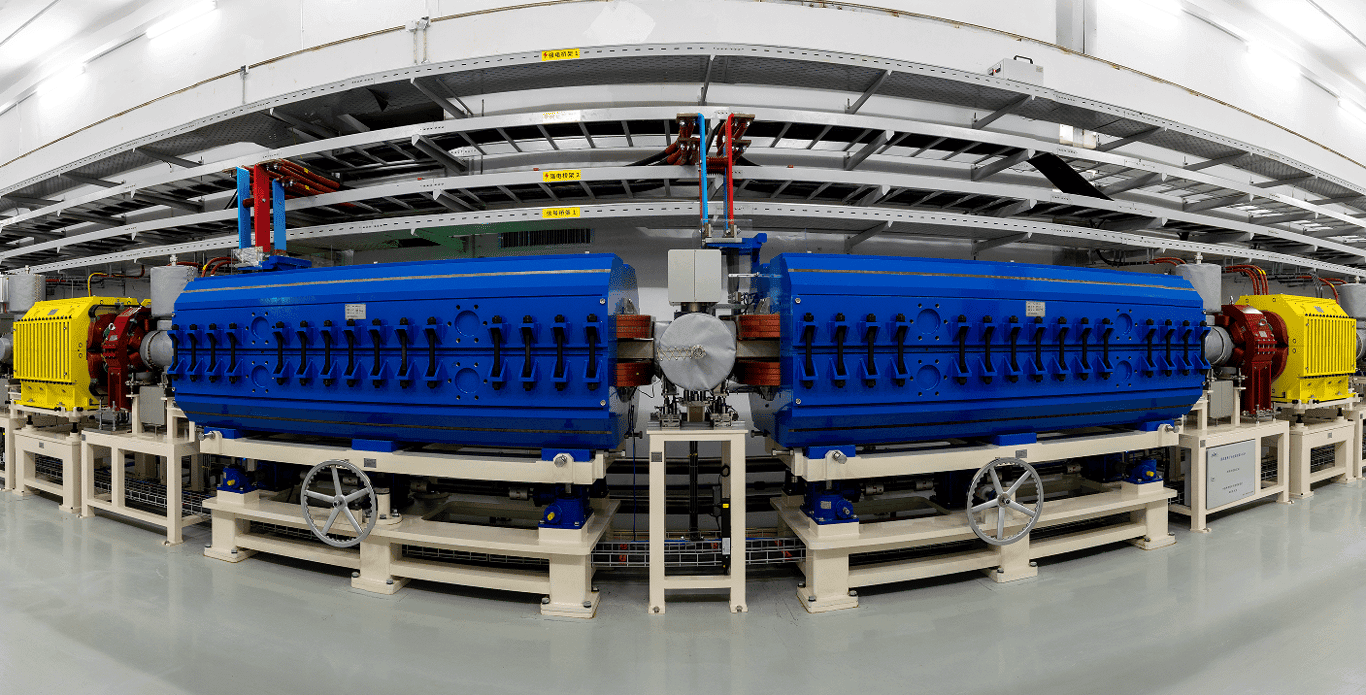

China has officially launched scientific operations at the High Intensity Heavy-ion Accelerator Facility (HIAF) in Huizhou, Guangdong province.
It is a massive $384 million (roughly 2.6 billion yuan) science complex designed to fire the most intense atomic particle beams ever generated.
The South China Morning Post (SCMP) reported that the mega-facility took 16 years of joint effort by the Institute of Modern Physics in Lanzhou and collaborating institutions. Construction wrapped up this week, making a major advance for international particle physics.
Interestingly, it can produce “the most intense beams of charged atoms.” Reportedly, the facility delivers eight times as many atoms per pulse as the previous record holder in Darmstadt, Germany.
More particles per pulse means far more high-speed collisions every second. It slashes the time needed to gather data on short-lived, exotic atoms from months or years down to hours or days.
“These fast-moving ions act like microscopic bullets. By smashing them into target atomic nuclei, or into each other, scientists can recreate extreme conditions found only inside stars or during supernova explosions,” said Yang Jiancheng, HIAF’s chief engineer.
Compared with standard accelerators built in isolated segments, China’s HIAF merges three systems into a single complex. The combined system includes a 100-meter (328 feet) linear accelerator, a 570-meter (1870 feet) main ring, and integrated storage rings.
This all-in-one design boosts ions from their initial ignition to ultra-high energies and holds them in circulation for repeated testing.
A May 2026 study stated that HIAF is “the world’s first heavy ion research device that integrates superconducting linear, synchronous acceleration, and storage rings.”
The unique combination would keep fragile, short-lived atomic nuclei trapped long enough to measure them with extreme precision. Getting here wasn’t easy. Engineers had to design ultra-fast acceleration protocols and construct one of the world’s largest ultra-high-vacuum systems just to keep stray gas molecules from knocking the particle beams off course.
At its core, nuclear physics strives to understand strongly interacting matter, which makes up nearly all visible mass in the universe. By exploring its origin, structure, evolution, and distinct phases, the idea is to decode the fundamental building blocks and physical laws that shape the vast cosmos.
Apart from probing cosmic mysteries and the limits of the periodic table, HIAF offers other practical benefits as well. Its intense heavy-ion beams enable pinpoint accuracy in destroying cancer cells without damaging healthy tissue. Also, the facility will produce rare radioactive isotopes for advanced medical imaging.
In addition, HIAF is expected to test spacecraft alloys and satellite components against cosmic radiation, helping build more durable materials for deep-space exploration.
First proposed in 2010 and designated a major national research project in 2011, HIAF broke ground in December 2018. Since generating its initial particle beam in October 2025, the facility has already delivered early scientific wins, including high-precision nuclear mass measurements, material radiation tests, rare isotope production, and advanced studies on highly charged ions.
“HIAF will be one of the world’s leading heavy-ion accelerators in the near future that enables scientists with concerted efforts to explore the hitherto unknown territories in the nuclear chart, to approach the experimental limits, to open new domains of physics research in experiments, and to develop new ideas and heavy-ion applications beneficial to the society,” the IMP website noted.
According to Chinese state media, the state-of-the-art facility will not remain behind closed doors, and it will be opened to scientific collaborators from across the globe.
Leave A Comment