

High expectations from new government
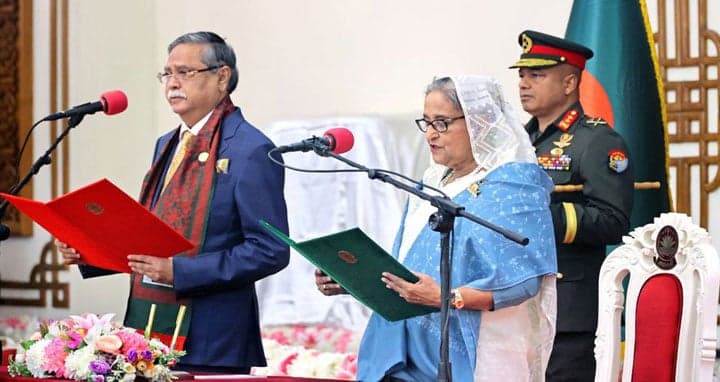

The new government has assumed office, marking not just a fresh administration but a continuation of the policy trends observed in the preceding three governments. Despite winning the election and taking a new oath, this government reflects the continuity seen in the previous three administrations. Under the leadership of Prime Minister Sheikh Hasina, this government has come to power for the fourth consecutive term. And Bangabandhu's daughter Sheikh Hasina took oath as the prime minister for the fifth time.
Therefore, this government will be governed by the continuity of the previous government's policies – that is only natural. The new government will focus on completing the tasks that were left unfinished in the previous terms. In this regard, Obaidul Quader, general secretary of ruling Awami League and the newly appointed Minister of Road Transport and Bridges, emphasized, "Control of commodity prices will be the first task of the new government."
Undoubtedly, during the previous term of the Awami League government, the gradual increase in the prices of essential commodities was a significant problem. Exchange rate fluctuations, foreign currency appreciation, and the fluctuation of prices of essential commodities beyond the reach of the common people became recurring headlines in the media. Consequently, the issue of controlling commodity prices has become a top priority for the new government. Like a thunderbolt from a clear sky, the prices of essential commodities in the market often skyrocket without any apparent economic reasons. Sometimes it's sugar, sometimes cooking oil, onions, green chilies, potatoes, or even the price of eggs that unexpectedly and suddenly shoot up.
According to multiple investigative reports in the media, a sudden price hike is allegedly orchestrated by an unscrupulous syndicate. This syndicate, driven by the pursuit of quick profits in a short period, exploits both the government and the general public by manipulating prices abruptly. The identities of the members of this syndicate remain largely undisclosed, shrouded in secrecy.
If this syndicate is brought under control, it will be possible to curb the arbitrary and unjustifiable increases in commodity prices. However, regulating commodity prices will become challenging if this syndicate operates from beyond the reach of legal scrutiny, much like it did in the past.
Before the government's previous term, road congestion has been a major issue in Bangladesh since gaining independence. Perhaps, in the past 52 years, it is challenging to find a day when the country did not witness casualties due to accidents on the roads! After realizing the dream of Digital Bangladesh, the journey towards Smart Bangladesh has now commenced. Bangladesh, despite being a small developing country, has made significant progress on the path of continuous economic and social advancement. In various sectors, there has been development and progress. However, the extreme congestion in the road management of the capital city Dhaka and the inefficiency in public bus services remain unchanged. As a result, the progress achieved by the government in many significant areas is overshadowed by the grim face of traffic congestion and poorly managed roads.
Undoubtedly, the unconsciousness of road users is a major cause of road accidents; however, it must be remembered that not only pedestrians but also drivers contribute to road usage. Multiple investigative reports in the media have highlighted that, in several instances, inexperienced drivers without proper contractual agreements are identified as the primary cause of road accidents. A syndicate operating within the transportation sector is encircling the field of transport. This syndicate, through malpractices, compels the operation of vehicles driven by poorly trained drivers without formal employment contracts.
Because appropriately trained drivers require monthly salaries and other benefits along with formal employment contracts, which go against the vested interests of the syndicate. In Dhaka, taxis are not visible on the streets; instead, what is prevalent are CNJ-operated auto-rickshaws, which are highly unregulated and risky. Beyond that, an extremely hazardous form of transportation, known as "Easybike," without licenses, has emerged on the roads and highways of the country. In recent times, accidents involving easybikes have become the most frequent on the roads.
In the priority list of the new government, it is imperative to take appropriate steps towards establishing discipline in road transportation. Simultaneously, dismantling the special syndicates surrounding the roads and implementing smart public transportation systems through the use of modern technology, such as buses, trucks, and taxis, should be undertaken immediately. Alongside controlling commodity prices and ensuring road discipline, the government's priority should include upholding human rights, promoting good governance, and maintaining cleanliness in the economic sector.
Leave A Comment
You need login first to leave a comment