

Hindustan Times analysis: The rise and fall of Mamata Banerjee, a street fighter
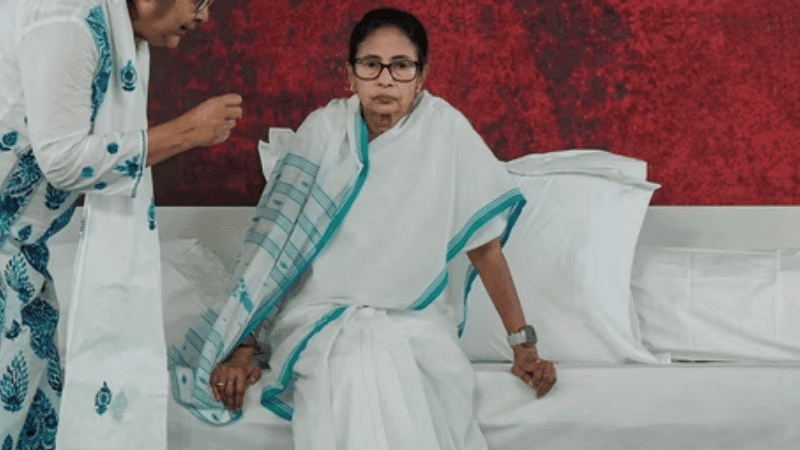

Politics in West Bengal has always been about street politics—massive rallies, violent protests, and empty roads on bandh days. This politics has shaped the state's destiny since independence. From Congress to the Left Front, and then from the Left Front to the Trinamool Congress, the street has been the main stage for every transition. And it was in this street politics that Mamata Banerjee established herself as a true fighter, leading from the front and defeating one rival after another.
But this time, West Bengal chose the BJP. For the first time in decades, the same party is set to come to power in both Delhi and Kolkata simultaneously. The primary reasons behind this rejection of Mamata's 15-year government are intense anti-incumbency, widespread allegations of corruption, and the consolidation of Hindu votes.
Mamata's final battle
'I am the candidate for all seats' – this declaration was a hallmark of Mamata's electoral politics. 2026 was no exception. At 71, she held 90 rallies and 22 roadshows in just two months – a record. Neither the heavyweight BJP leaders nor the young Trinamool leaders could come close to this number.
Yet, by Monday evening, 'Didi' was virtually defeated. According to Election Commission data, by 6:00 pm, the BJP had won 44 seats and was leading in 160 out of 294 seats; Trinamool had won 21 seats and was leading in 62. Bengal had turned saffron.
When Mamata's nephew and the party's second-in-command, Abhishek Banerjee, entered the Sakhawat Memorial Girls School during the counting of votes from Bhabanipur, BJP supporters shouted 'Chor, chor' (thief, thief).
The challenges ahead for Trinamool
For Mamata, who rose from a lower-middle-class family and defeated Left heavyweight Somnath Chatterjee in her first Lok Sabha election in 1984 as a Youth Congress leader, the 2026 election was an unprecedented challenge.
The biggest challenge was the Special Intensive Revision (SIR) of the voter list. When the process began in October, West Bengal had approximately 7.66 crore voters. The revision removed around 91 lakh names – including about 63 lakh deceased and relocated voters, and another 27 lakh with documentation discrepancies. Mamata alleged that the BJP had used the Election Commission to delete the names of their supporters.
The story of Mamata's rise and fall
Mamata's first major anti-Left Front movement began in 2000 – two years after she left Congress and formed the Trinamool. She launched an agitation in Keshpur and Garbeta in West Midnipur, accusing CPI(M) workers of torture. She demanded that the Atal Bihari Vajpayee government impose Article 356, with the slogan— 'Keshpur hobe CPIM-er sheshpur' (Keshpur will be CPIM's last outpost).
That didn't happen then. But after a series of agitations and strikes, the anti-land acquisition movements in Nandigram and Singur intensified the resentment against the Left Front government. Chief Minister Buddhadeb Bhattacharjee's attempt to cultivate a pro-industry image couldn't stop the tide that ended 34 years of Left Front rule. On Monday, West Bengal saw a repeat of 2011 – but with the roles reversed.
Political science professor Udayan Bandyopadhyay said, "Just as the Left fell to anti-incumbency in 2011, this time widespread unemployment and lack of industry created dissatisfaction that worked against Mamata."
Many Trinamool leaders, speaking anonymously, admitted that Mamata's attempt to create a state without opposition in her first term ultimately led to her downfall.
Within a year of coming to power in alliance with Congress in 2011, the relationship soured. Congress alleged that Trinamool was poaching its MLAs. The alliance broke. As Congress and the Left grew closer, the BJP began expanding in Bengal from scratch. This marked the beginning of the politics of polarisation.
The burden of corruption
In 2012, the state government's decision to pay Imams of all mosques Tk 2,500 per month and Muezzins Tk 1,500 was branded by the BJP as minority appeasement. The Kolkata High Court later ruled it unconstitutional, but the state government continued the payments through the Wakf Board.
Despite launching various social schemes for women, students, the elderly, and farmers, the BJP made 'infiltration from Bangladesh' and corruption of Trinamool leaders its main issues in every election. While the Saradha and Narada scandals remained in public discourse, they did not significantly affect voters in the 2016 election, which Trinamool won by a huge margin.
The 2018 announcement of Tk 10,000 grants for Durga Puja committees also faced legal challenges. However, the High Court accepted the state's argument that the funds were for social security and festival management. In 2021, Mamata returned to power, winning 213 seats. That same year, UNESCO recognised Kolkata's Durga Puja as an intangible cultural heritage.
By 2025, the grant for each Puja committee had increased to Tk 1,10,000, with total expenditure reaching approximately Tk 4,950 crore.
Mamata's Hindu temple strategy to stop polarisation
Although Mamata opposed the National Register of Citizens (NRC), the Citizenship Amendment Act (CAA), and the Uniform Civil Code (UCC) implemented in Uttarakhand, she realised that religious polarisation was intensifying before the 2026 election.
To counter it, she took countermeasures. In response to BJP's allegations of Muslim appeasement, she built a Jagannath temple at Digha in East Midnipur at a cost of Tk 250 crore, inaugurating it in June 2025. Three months before the election, in January, she laid the foundation for the world's tallest Shiva statue and temple complex at a cost of Tk 344 crore near Siliguri.
The BJP questioned whether taxpayer money should be spent on temple construction in a secular state.
Ultimately, these efforts proved unsuccessful. Professor Bandyopadhyay said, "The election results suggest that a significant portion of Muslim voters also supported the BJP. Mamata failed to create employment – lakhs of Muslims were forced to leave the state out of economic necessity. The BJP made arrangements to bring back approximately 22 lakh migrant workers to vote."
Women voters also turned away
Women, who had long been Mamata's strongest support base, also appear to have turned away this time. The voting pattern suggests that the BJP's promise of Tk 3,000 per month for women proved more attractive than Trinamool's 'Lakshmir Bhandar' scheme (Tk 1,500 for general category and Tk 1,700 for SC/ST).
Even in the lanes of Kalighat, where Mamata grew up, loudspeakers were playing BJP's campaign song: 'Paltano dorkar, chai-BJP sorkar' (Change is needed, we want a BJP government).
Leave A Comment
You need login first to leave a comment