
Travelling Chongqing
Hongyan, Chongqing: A nation’s story of resilience written on hillside
Chongqing is a mountainous city in south-western China, where the Yangtze and Jialing rivers meet. At first glance, its mist-shrouded skyline, towering buildings, elevated roads carved through hills and metro trains running through the middle of buildings make it seem as though the entire city is looking towards the future. Yet, on the banks of the Jialing River, a small village in Yuzhong district called Hongyan reminds visitors that the foundations of this dazzling present were laid upon a past marked by fire, blood and extraordinary patience.
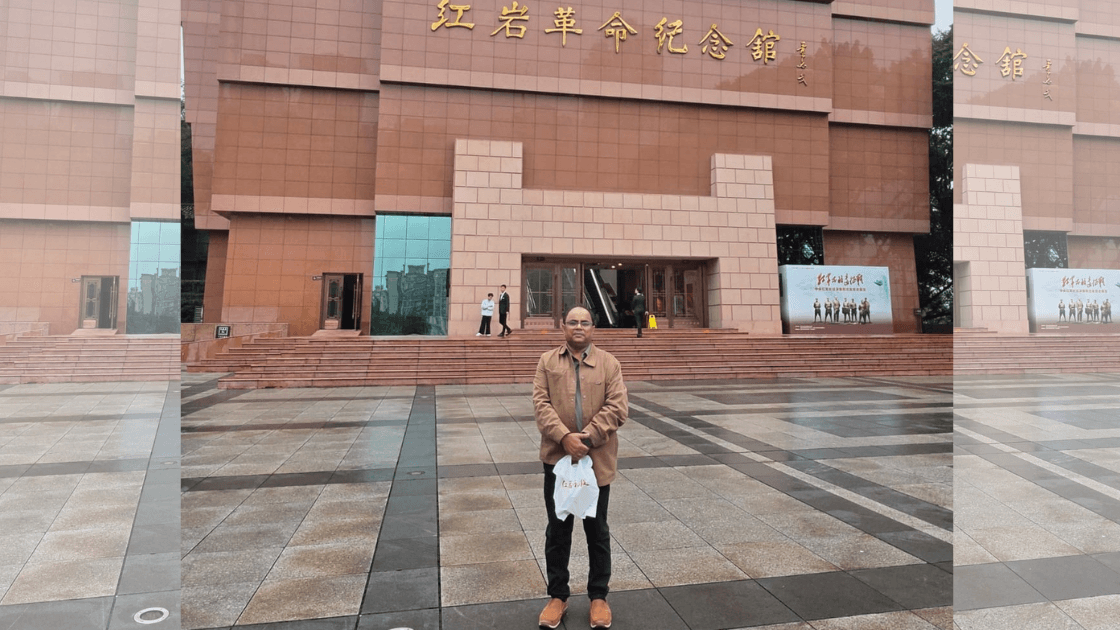
Photo: In front of the Chongqing Hongyan Revolutionary Memorial Museum
Hongyan means ‘red rock’. It is home to the Chongqing Hongyan Revolutionary Memorial Museum, a silent witness to some of the most difficult days in the lives of Zhou Enlai and Mao Zedong.
From a woman entrepreneur’s farm to a revolutionary stronghold
The story of Hongyan’s origins is quite remarkable. It was once a farm owned by Rao Guomo, a woman entrepreneur from Chongqing. During the dark years of Japanese aggression, the Chinese Communist Party needed an office in the city. Rao handed over her farm to Zhou Enlai. That single decision by a woman entrepreneur transformed a quiet farm on the outskirts of Chongqing into one of the most significant sites in modern Chinese history.
After Nanjing fell to Japanese forces, Chongqing became China’s wartime capital. The city was under the control of Chiang Kai-shek’s Kuomintang government. Setting aside the bitterness of their prolonged civil conflict, the Communists and the Kuomintang formed a united front against Japan. As part of that alliance, the Communist Party’s Central Committee established its Southern Bureau in Hongyan in 1939. Zhou Enlai served as its secretary. The Chongqing office of the Eighth Route Army was also based there. Other leaders, including Dong Biwu, Ye Jianying and Deng Yingchao, came to Hongyan over time.
In simple terms, Zhou Enlai conducted diplomatic, publicity and organisational activities from here, operating from inside the capital of his political rivals while facing constant surveillance and the threat of Japanese air raids. Through sustained contact with foreign journalists, diplomats, writers and businesspeople, he presented the Chinese people’s position in the resistance against Japan to the outside world. Much of his patient, measured yet resolute diplomatic style took shape in this village of red rocks.
Zhou Gongguan: The hidden staircase of House No. 50
One of the museum’s main attractions is House No. 50 in Chengjiayuan, locally known as Zhou Gongguan, or ‘Mr Zhou’s Residence’. It served as Zhou Enlai’s home and workplace in the city. The architecture is striking. The staircases leading to the upper floors are concealed inside individual rooms, making them difficult to locate from outside. The ingenuity required to survive amid surveillance and the risk of infiltration continues to fascinate visitors.
The modest furnishings, old tables and chairs, and dimly lit rooms convey a simple truth: great chapters of history are often written in very small spaces.
Hongyan also preserves the former offices of the Xinhua Daily, the Communist Party’s newspaper. Seeing the old printing press, where the newspaper was produced under the guidance of veteran Chinese journalists, prompts a question for someone like me, a journalist: how did a newspaper come out every day amid censorship, paper shortages and aerial bombardment? During wartime, newspapers are more than carriers of information; they become instruments of resistance. The printing press at Hongyan bears witness to that truth.
The 43-day Chongqing negotiations and Guiyuan
Japan surrendered in August 1945. At Chiang Kai-shek’s invitation, Mao Zedong flew from Yan’an to Chongqing in a special aircraft on 28 August, accompanied by Zhou Enlai. It was the first meeting between Mao and Chiang in nearly 20 years. The historic Chongqing negotiations began.
Mao stayed in Hongyan for more than 40 days. During breaks in the talks, he met more than a hundred people from different walks of life, including government officials, industrialists, intellectuals and students.
Guiyuan, meaning ‘Osmanthus Garden’, was the place Mao used for official work and entertaining guests in the city. Two old osmanthus trees stand in its courtyard. When they bloom in autumn, their fragrance fills the entire compound, giving the place its name. On 10 October 1945, the ‘Double Tenth Agreement’ was signed here. Under the agreement, the Kuomintang and the Communist Party pledged to pursue peaceful national reconstruction.
The cruel irony of history is that the agreement did not last. Within months, China was once again engulfed in full-scale civil war. Yet the political significance of the Chongqing negotiations cannot be dismissed. They played an important role in shaping public opinion around the question of which side was genuinely committed to peace. The talks also helped lay part of the political groundwork for the founding of the People’s Republic of China in 1949, four years later.
The manuscript of ‘Snow’
One of the museum’s most moving exhibits is the manuscript of Mao Zedong’s celebrated poem Qinyuanchun: Snow. During the Chongqing negotiations, Mao presented the poem to his friend, the poet Liu Yazi.
When a statesman writes poetry amid the intense pressures of war and political negotiations, it becomes clear that politics and literature need not be adversaries. Both can coexist within people driven by great ambitions and dreams. Even ordinary objects used by Mao, such as his water container and copper spoon, have been carefully preserved here.
Ho Chi Minh’s room: An Asian connection
Few people know that Hongyan also has deep connections with Vietnam. Around 1939–40, Ho Chi Minh stayed in a room here under the pseudonym ‘Ho Quang’ while carrying out revolutionary activities. That room, too, has been preserved. In November 2024, Vietnamese Prime Minister Pham Minh Chinh visited the site.
Hongyan, therefore, is not merely a landmark in Chinese history; it is also a shared memorial to Asian struggles against colonialism and aggression.
From a museum to the ‘Hongyan Spirit’
The Hongyan Revolutionary Memorial Museum first opened on 1 May 1958. Its name plaque was written by Dong Biwu in 1959. A new museum building was inaugurated in 2000. On 19 January 2007, the Chongqing Hongyan Revolutionary History Museum was established.
It comprises three institutions: the Hongyan Memorial Museum, the Gele Mountain Revolutionary Memorial Museum and the Exhibition Centre on the History of China’s Democratic Parties. The Baigongguan and Zhazidong prisons on Gele Mountain recall the political prisoners who lost their lives on the eve of liberation.
The phrase ‘Hongyan Spirit’ is now widely recognised in China. Its central values are devotion and perseverance, honest hard work, and remaining steadfast in one’s ideals despite adversity. In China’s official narrative, this spirit is presented as one of the moral foundations of the country’s subsequent development.
Stepping out of the museum and looking towards Chongqing’s skyline, the connection becomes apparent. A city repeatedly devastated by Japanese bombing has grown into one of China’s major industrial and technological centres.
Lessons for Bangladesh
Hongyan’s story also offers much food for thought for Bangladesh. It provides a living lesson in how a nation can temporarily set aside internal divisions and forge unity in the face of foreign aggression; how patient diplomacy under difficult circumstances can help win international public opinion; and how a country can preserve the memory of its struggles and pass it on to future generations.
Many memorials to Bangladesh’s Liberation War are still being lost through neglect. This village of red rocks in Chongqing reminds us that preserving history is not a luxury. It is an essential part of a nation’s understanding of its own identity.
Evening falls over the Jialing River. The breeze stirs the leaves of the osmanthus trees in Hongyan’s courtyard. Nearly eight decades ago, the future of a nation was the subject of intense negotiations in this very place.
Here, history is not merely an exhibit kept behind glass. In every staircase, every table and every yellowing manuscript, it continues to breathe.
Rased Mehedi
Editor, Views Bangladesh
Leave A Comment