
From refugee camps to World Cup stardom
How immigrant stories are shaping Australia’s modern Socceroos
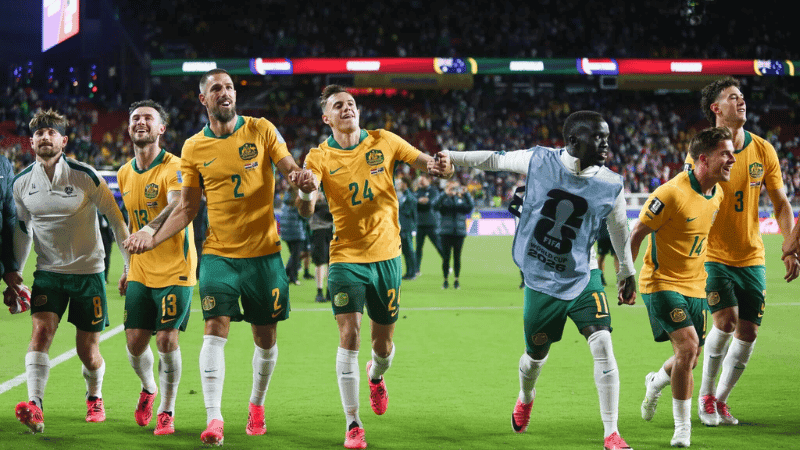

“The Socceroos aren’t just a team. We are a reflection of modern Australia.” Those words, spoken by midfielder Jackson Irvine on the eve of the 2026 FIFA World Cup, have come to define Australia’s inspiring campaign in North America. As the team prepares for a historic Round of 32 clash against Egypt on Friday, their journey is being fueled by a generation of players whose roots trace back to global conflict zones, turning the national squad into a beacon of multiculturalism.
Nowhere was this more evident than in Australia’s 2-0 group-stage victory over Turkey. The opening goal was converted by 20-year-old phenom Nestory Irankunda, who celebrated by mimicking the iconic corner-flag-punching routine of his childhood hero, Tim Cahill. He was quickly joined by fellow striker Mohamed Toure, marking a poignant milestone for two close friends who shared remarkably parallel journeys to international football.
Escaping civil war
Both Irankunda and Toure were born in African refugee camps to parents fleeing devastating regional civil wars. Irankunda was born in a Tanzanian refugee camp in 2006 after his parents fled conflict in neighboring Burundi, arriving in Australia as a three-month-old infant. With his goal against Turkey, the former Adelaide United prodigy—now signed with German giants Bayern Munich and on loan at Watford—became the youngest World Cup goalscorer in Australian history.
Toure’s path was remarkably similar. Born in Conakry, Guinea, after his parents escaped the Liberian civil war, Toure’s family emigrated to Australia in 2004 when he was a baby. Now a rising star for Norwich City, the 22-year-old views the national jersey as a symbol of profound gratitude, noting that the Socceroos jersey represents the freedom and opportunity given to his family by their new homeland.
A squad forged in adversity
The Socceroos' 26-man roster features several other players who overcame displacement and hardship before arriving on the world stage. Winger Awer Mabil, now 30, spent his first ten years in a Kenyan refugee camp after his parents fled South Sudan. Currently playing for Spain's Castellon, Mabil has assumed a mentorship role for the younger players while co-operating Barefoot To Boots, a charity that provides footwear, education, and healthcare to current refugee installations.
Defensive stalwart Milos Degenek has an equally harrowing background, having been born in Knin, Croatia, in 1994. His family fled to Belgrade on a tractor when he was just 18 months old during the Croatian War of Independence, losing everything they owned. After surviving another conflict and subsequent bombings in Serbia during his early childhood, Degenek's family eventually resettled in Sydney when he was six years old.
The face of modern Australia
The diversity within the squad extends far beyond its refugee contingent, showcasing the vast diaspora that characterizes contemporary Australian society. The veteran full-back Aziz Behich was born in Melbourne to Turkish-Cypriot parents who fled political unrest in Cyprus, while fellow Melbourne native Nishan Velupillay was born to a Malaysian father of Sri Lankan Tamil heritage and an Anglo-Indian mother.
The lineup further includes forward Tete Yengi, whose father was awarded the Medal of the Order of Australia for his extensive humanitarian work with refugee resettlement, and Canberra-born defender Jason Geria, who was raised by Ugandan immigrants. Together, these unique backgrounds form a collective identity that resonates deeply with football fans back home.
History beckons in Texas
The Socceroos advanced to the knockout stages as runners-up in Group D, securing four points from three matches—highlighted by the 2-0 win over Turkey, a narrow 2-0 defeat to co-hosts the United States, and a gritty 0-0 draw against Paraguay.
As attention pivots to AT&T Stadium in Arlington, Texas, for Friday's elimination match against Egypt, Graham Arnold's side has a chance to win a World Cup knockout game for the first time in the nation's history. Yet, regardless of the final scoreline, this iteration of the Socceroos has already left an indelible mark on the tournament, proving that the modern Australian identity is defined not by where you come from, but where you are going.
Leave A Comment