
How much are banks exempted for NPL expansion?
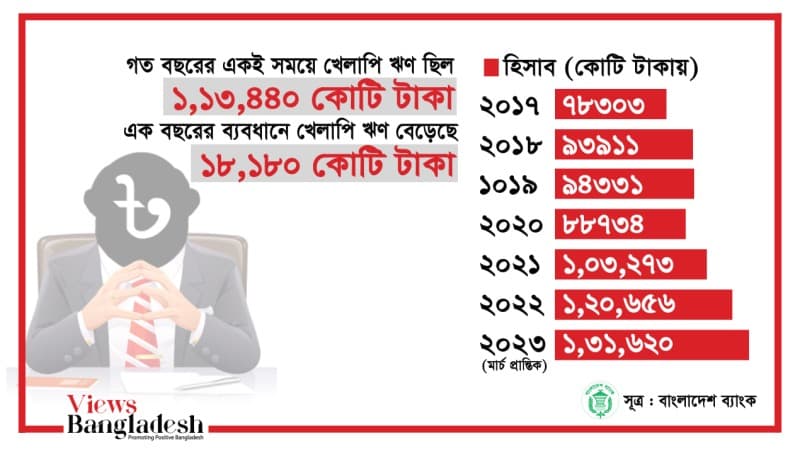

The banking sector in the country is plagued with various problems, and one of the primary concerns is the lack of internal governance and the presence of rampant non-performing loans(NPLs). The lack of governance and the prevalence of defaulters are closely intertwined issues, with one contributing to the other. According to statistics of Bangladesh Bank, the total amount of non-performing loans in the country's banking sector has surged to Tk 1 lakh 25 thousand crore. At the same time, the total amount of discounted loans of the banks was Tk 13 lakh 98 crore. At one point, a few days ago, the total amount of defaulted loans increased to Tk 1 lakh 34 thousand crore. That was the highest default loan record in the history of Bangladesh.
However, most international organizations and local economists do not have faith in the statistics provided by Bangladesh Bank regarding non-performing loans. In any country's banking sector, the presence of non-performing loans can be assessed directly. However, in the case of Bangladesh, the amount of non-performing loans is far from being manageable. When the World Bank initiated banking sector reform programs in the late 20th century, discussions about non-performing loans first came to the forefront, much like it did for the first time.
At the end of the Jatiya Party regime, the amount of defaulted loans in the country's banking sector was Tk 6 thousand crore. Subsequently, democratically elected governments, while in office, have only seen an increase in the amount of non-performing loans. At various times, finance ministers have made various commitments to recover these loans, but all efforts have fallen short. Finance ministers have publicly disclosed the list of loan defaulters through national daily newspapers on several occasions.
However, nothing substantial has been achieved in practice. Loan defaulters have come to realize that the government will not take any meaningful action against them, and as a result, they have little incentive to repay their loans. Consequently, they show little interest in repaying the installments of their loans. The International Monetary Fund (IMF) approved a loan of 470 million US dollars to Bangladesh a few months ago. Among the various conditions imposed for this loan, one crucial requirement is to ensure internal governance in the banking sector and reduce the amount of non-performing loans to a manageable level through legal reforms and other measures.
It's worth noting that the statistics on non-performing loans provided by the Bangladesh Bank are not acceptable to the IMF either. Many within the organization have argued that the Bangladesh Bank is artificially reducing the amount of non-performing loans. Hence, their statistics are neither reliable nor information-based. The actual amount of non-performing loans in the banking sector will be at least three times more than what is being reported.
This is because the Bangladesh Bank is not accounting for large loans as non-performing, categorizing restructured loans as near-default loans, and not disclosing loans under litigation as non-performing loans in their presentation of loan defaulter statistics. Local economists believe that when various methods of granting relief to loan defaulters are taken into account, the total amount of non-performing loans could exceed Tk 3 to 3.5 lakh crore.
We will discuss the reasons behind the creation of non-performing loans in the country's banking accounts without delving into debates about the specific amount. This discussion will shed light on why banks are partly responsible for creating non-performing loans in their accounts and why they are unable to recover installments from loan defaulters. During my long tenure of 34 years at a nationalized bank, I have personally witnessed the considerable influence and tactics employed by loan defaulters in our country's banking accounts.
When it comes to loan defaults, we often find ourselves in a difficult position, as loan defaulters frequently manipulate and exploit bank employees to serve their own interests. We end up shouldering the responsibility for loan defaults when the issue arises. It's as if it's because of their actions that banking accounts have deteriorated into non-performing loans. Bank employees sometimes find themselves in a situation where they appear to be accommodating loan defaulters, but it's essential to remember that not all situations result in a win-win scenario.
Non-performing loans are not solely the result of the behavior of loan recipients; a certain category of unscrupulous bank employees also directly contributes to the creation of non-performing loans for their own gains. Loan defaulters typically fall into two categories. One category consists of those who, despite having the desire, cannot repay their loan installments due to various reasons. They are considered genuine defaulters. If they are provided with various forms of financial incentives and support, they may become willing to repay their loan installments.
One category of loan defaulters consists of those who have the capability to repay their loan installments but intentionally withhold payments. They are considered willful defaulters. Willful defaulters are often influential individuals who maintain close ties with powerless government authorities or directly involve themselves in the politics of powerless parties to safeguard their interests. Stringent legal measures against such individuals are essential. However, the reality is that banking laws are often formulated in a manner that appears to protect the interests of loan defaulters, allowing them to evade responsibility for their actions. Recently, changes have been made in banking company laws that allow loan defaulters to artificially reduce the reported amount of non-performing loans even if they do not repay their installments.
A renowned economist has described this situation as an attempt to "clean the house while keeping the dirt under the carpet." Previously, in order to restructure a loan account, borrowers had to make a down payment of 10% of the total outstanding amount to the bank. For the second restructuring of the loan account, they had to pay 12%, and for the third restructuring, they were required to pay 30% as a down payment. Now, a loan account can be classified as "classified" and eligible for restructuring if it remains overdue for three years. There is no requirement to file a case for loan accounts involving less than 5 lakh taka in arrears.
The condition for preserving one hundred percent provisions has also been abolished. Additionally, the time limit for loan account classification has been extended. As a result, it is no longer easy to classify a loan account as non-performing. If someone pollutes the water at the source, the polluted water will flow downstream. So, if we want clean water downstream, we first need to remove the person who is polluting the water at the source. Only then can we obtain clean water downstream.
To bring the amount of non-performing loans in banking accounts to a manageable level, we must first identify and address the underlying causes of these bad loans. Efforts should be made internally within the banking sector to correctly pinpoint the reasons behind non-performing loans. However, I refrain from commenting on the most capable or responsible bank employees when it comes to loan disbursement. In some cases, it may seem that bank employees lack the necessary expertise in assessing loan applications effectively. However, without receiving assistance from some unscrupulous bank employees, it is not easy for a loan account to become delinquent. I am not discussing here the honest and good bank employees who still love the bank. There are still many bank employees who treat the bank as their own life. However, they are quite helpless in the face of unscrupulous employees' connivance. When an entrepreneur or an individual seeking a loan approaches a bank, they first need to have a discussion with the branch manager.
If the branch manager is honest and dedicated to the bank's interests, they can quickly assess the character of the applicant and their intentions regarding the loan they have applied for. The likelihood of loan recovery depends on several factors. Unscrupulous borrowers often try various tactics to influence the manager's decision and obtain the loan. Before loan approval, the concerned individual or organization is required to provide collateral or assets as security for the loan, which can be seized in case of default.
The collateral ratio for this security is 100:125 or 100:150. In other words, when an individual or organization is granted a loan of 100 crore (1 billion) taka, the bank will keep collateral worth 125 crore or 150 crore taka as a security bond from the borrower. This marks the beginning of the first game of non-performing loans. If the manager is corrupt and unscrupulous, they can assist the loan applicant in undervaluing the bonded property.
For example, if the proposed collateral property is originally valued at 1 crore taka, the manager may help the borrower show it as worth 5 crore taka. The manager can involve an engineer and financial analyst to assess the collateral property. The loan applicant is informed in advance that they will need to assess the property on a specific date. The borrower gathers their own local residents to assess the value of their property. When questioned by the manager, they often overstate the property's value. If the loan amount is substantial, the bank may also provide a valuation form for property assessment.
However, even the valuation form's officials may not provide an accurate assessment outside the manager's desires. This is because doing so could lead to difficulties in getting bills paid by the form. They may also face issues with any future dealings with the same bank. An example of how collateral valuation is often increased can be illustrated as follows. I am currently serving as the head of a regional office for a state bank, specifically in the KarwanBazaar area.
We approved a loan of Tk 20 lakh from our Ashuganj branch. In return for this loan, collateral worth Tk 36 lakh is held. Three years later, another inspection team from the bank's head office goes to evaluate the relevant asset. They determine the land's value to be Tk 3 lakh. If the property valued at Tk 3 lakh is shown as worth Tk 63 lakh, then why will the borrower pay back the loan installments?
When I interview for the position of General Manager, I am assigned the task of conducting an evaluation in a remote area. The borrower presents a proposal, and another inspection team from the bank assesses the property value at Tk60 lakh. However, when there were doubts from the head office's loan application selection committee, I was assigned the responsibility of reevaluation by the inspection team. I can find out that the committee had purchased the land two years ago for Tk 30 lakh, with half of the land being utilized for road construction.
And during that time, the land value didn't see much increase over the two years. I personally evaluated the land's value at Tk 30 lakh per percentage, deducting the portion used for the road. The loan was not approved. A retired general manager of our bank was trying from behind to approve this loan proposal. However, the loan proposal was canceled due to the property valuation. The loan applicant had lodged a complaint against me with the management, but he couldn't manage to get the loan approved in any way.
Eventually, a loan proposal was sent to the regional office from the Ashuganj branch. During that time, our bank's management had invited the loan applicant's wife to their residence, receiving various types of gifts. The branch manager was confident that the management would approve the loan proposal. I resubmitted the loan proposal as it was missing some documents. The manager commented on the scarcity of documents, stating that the loan applicant was highly influential and financially well-off.
At one point, they had been a magistrate from Ashuganj to Comilla. Therefore, the loan could potentially be approved. I wrote in reply to the note, "The financial and influential status of a loan applicant is indeed important, but what matters more than anything else is their current financial situation. It's also crucial to consider their past loan history with any banks, their repayment status, as well as their social and family circumstances. We will certainly take these factors into account when making the loan decision."
However, it is not advisable to grant loans to individuals who could potentially become defaulters and burden the bank. This loan proposal was canceled for that reason. The branch manager, though, behaved unethically towards me. However, I did not compromise my position in favor of the bank's interests. If an employee works ethically with integrity for the organization's best interests, it is quite possible to prevent fraudulent loan tendencies on their part. However, the problem lies in the fact that many employees cannot resist the temptation of financial gain. Some employees refrain from unethical behavior themselves but help the boss to indulge in corruption.In a state-owned organization, there are four categories of employees. Among them, one category consists of highly talented individuals who, unfortunately, engage in corrupt practices.
Their policy seems to be to work for a salary and indulge in corruption. On the other hand, there is another category of employees who do not engage in corruption and, in fact, avoid working altogether. They spend their time by sleeping in the mosque. The third category of employees consists of those who do not engage in corruption themselves but turn a blind eye to others indulging in corrupt activities or even provide assistance.
The final category of employees neither engages in corruption them nor allows others to do so. They are the ones most at risk and are often labeled as government adversaries, facing various forms of harassment and persecution. In government-owned institutions, especially in the banking sector, some honest and sincere employees often become targets of violence by corrupt individuals.
In such establishments, there is a group of employees, particularly in the banking sector, who are involved in partisan politics. They were once responsible for embezzling the bank's revenue under the guise of a "Zia Parishad." Now they are carrying out the wrongdoings in the name of “Bangabandhu Parishad”.
These party-oriented employees will never become well-wishers of any government.Because when they are out of power, they are always critical. They are opportunists. They see it as an opportunity when their party comes into power. They are the ones who destabilize a politically weak government. Those who will work as employees in nationalized institutions should never be allowed to engage in political discussions. This is their complete prohibition in terms of employment regulations.
An applicant has received loan approval from a nationalized bank, and there is no evidence of corruption or malpractice at any level. If we take this perspective, there is no reason to be suspicious. However, there are certain employees within the bank who, when they acquire illicit wealth, can hide it day and night. But most of them manage to evade detection. They face no music for their actions.
There's a saying that goes “Within state-owned organizations, employees often face the unfortunate reality that without engaging in corruption or malpractice, they may not retain their jobs.” Corrupt employees work within the organization, receive salaries and benefits, and actively engage in partisan activities. A former manager of the now-defunct Shilpo Bank once told employees during a discussion that if they ever read a staff member's notes, they would feel like they don't work for the bank, but rather, they work in the loan recipient's projects.
The state-owned banks' financial distress is primarily due to extensive corruption by one group of employees. I can assert that if the valuation of mortgaged assets is conducted correctly, the prevalence of corrupt loans will decrease by at least 50 percent. Furthermore, if employees work for the bank's interests rather than being beholden to corruption, then the prevalence of bad loans will inevitably decrease to a tolerable level. No matter how hard we try, unless corrupt employees are held accountable, banking sector will never improve.
The author is retired general manager of Bangladesh Development Bank Limited, and economist
Leave A Comment
You need login first to leave a comment