

Indian Ocean- The next frontier for geostrategy, geopolitics and global economy

Bangladesh hosted the Indian Ocean Conference (IOC) in Dhaka on May 12-13. The sixth edition of the conference was organized by India Foundation in association with Bangladesh's foreign ministry. With the theme of “Peace, Prosperity and Partnership for a Resilient Future”, the conference brought together a luminary gathering of key stakeholders to chart the roadmap for strengthening the Indian Ocean Region. The conference endeavored to bring critical states and principal maritime partners of the region together on a common platform to deliberate upon the prospects of regional cooperation. In the last few decades, the geo-economics, rather than geostrategic significance of the region has become evident to all.
The 21st century is marked with swiftly changing dynamics of global politics and to cope with looming challenges, states are adopting timely measures to secure their respective national interests. The Indian Ocean has become a region which provides opportunity to build global businesses, promote international trade and investment and achieve sustainable and market-led economic growth that would contribute to job creation in the region. There are opportunities to establish effective trade linkages.
Due its geostrategic and geopolitical significance, the third largest of world oceans, the Indian Ocean (IO) has gained special global attention. Bangladesh is one of key littoral countries for the cohesion of the Indian Ocean states and affairs. With the Bay of Bengal, a key region for the IO strategic cohesion, and with three (Chittagong, Payra, Mongla) ports out od the 12 ports in the Bay of Bengal, Bangladesh is can play a pivotal role in the strategic success and economic cohesion of IO region. It should be noted that the number of ports in the Bay will soon be 13, and the new one also - Matarbari, a deep sea port - will be on Bangladesh territory.
Geographic
significance
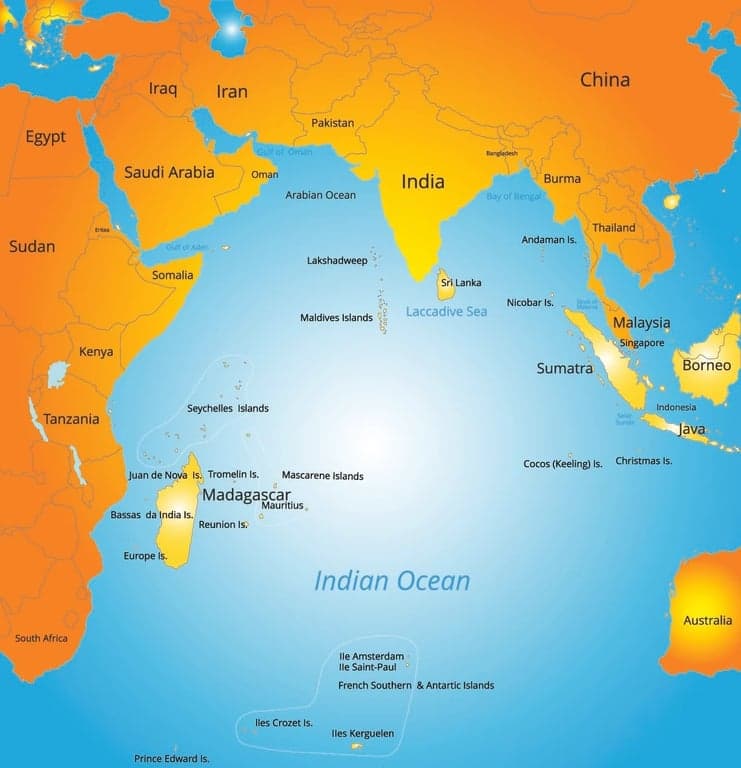
It is the third largest Ocean of the world being neighbored to Asia in its north, Africa to its west, Indo China to its east while Antarctica lies in its south. It ranges from north to south from the Bay of Bengal to Antarctica with estimated area of 9600 kilo meters, while it extends from west to east from Southern Africa to Western Australia with the range of 7800 kilo meters. Indian Ocean covers almost 20% of the world’s water. Its total area is almost 5.5 times larger than the United States. The ocean includes vital global shipping routes and choke points, namely Strait of Hormuz, Strait of Malacca, Bab-el-Mandeb, The Sunda and Lombok straits, Mozambique Channel, Ten Degree, and Six Degree Channels. IO’s unique geographic design, and the strategic value of the minerals that the ocean bed and its coasts are laden with, further underscore the economic and geopolitical importance of the IO.
Mineral Deposits
IO’s littoral states possess more than two thirds of the world’s oil reserve, and roughly 35% of the world’s gas reserves, 60% of uranium, 40% of gold and 80% of all diamond deposits. Japan imports almost 90% of its oil from the IO region, Italy 85%, Britain and Germany 60% and France almost 50%. Indian Ocean is also important because of the industrial raw materials it possesses. These include lithium, beryllium, zirconium, thorium, coal, iron, copper, manganese, tin, bauxite, chromites, nickel, cobalt, vanadium and phosphates. Recent surveys reveal that the shelves on the south of Sumatra, the Persian Gulf, and the Red Sea are rich in oil, tin, gold, and seafood. The offshore presence of calcareous deposits suitable for chemical and cement industries have been reported from the Andaman and Lakshadweep zones.
Economic Significance
Indian Ocean is also important as area for navigation and trade. The Indian Ocean is linked to other main water bodies on the earth which creates interconnected shipping lanes. It is home to world’s busiest waterways and chokepoints such as the Suez Canal, Bab al Mandeb, Strait of Hormuz and the Strait of Malacca. All these chokepoints and waterways are highly important for the rising nations of the world. Some 40% of the world’s offshore oil production takes place in the Indian Ocean basin. Fishing in the Indian Ocean accounts for almost 15% of the world’s total. The region constitutes between a quarter and a third of the world’s population, which makes it a massive market and huge potential labor force. The sea lanes on the Indian Ocean account for 70% of the world’s traffic of petroleum products. The Indian Ocean is one of the world’s most strategic locations, with more than 75% of the world’s maritime trade and 50% of daily global oil transfers passing through the region. IO countries are responsible for about 10% of the global GDP.
Regional, Extra-regional Geopolitical and Geo-strategic competition
To pursue and secure its economic interests, China has been extending its military might in the Indian Ocean region with the help of smaller South Asian littoral states. The smaller South Asian states are either directly or indirectly dependent on China in terms of trade and economic relations which gives China an upper hand in this region.
Due to the significance of Indian Ocean for modern trade and shipping both China and India are funding deep sea ports in the very Indian Ocean. Gwadar deep sea port is constructed in Pakistan by China, while strategically important Chabahar port in Iran was developed and constructed with Indian support. It is India’s policy to provide a passage to landlocked Central Asian states and Afghanistan through Iran by lessening their dependence on Pakistan.
The growing competition between China and India in Indian Ocean and US intervention on this and other fronts in the IO region add a new dimension to the region’s geopolitical complexity. Though, the flow of energy and trade is China’s first concern, but its activities are watched over by India through strategic calculations. China is involved in enhancing a political and economic influence over Africa, by investing billions of dollars in industries such as oil, mining, transport, electricity generation, telecommunications and infrastructure. This would ensure a successful access to energy resources and raw materials, which are crucial to its development and growth. This is simply a geopolitical orientation of Chinese policy towards energy resources which would have far reaching impact on development, competition and conflict of interests between China, US, and India. This has become the characteristic feature of Indian Ocean’s geopolitical significance.
Potential of Economic Integration
The non-East Asian IO countries (that is, the IO states from South Asia, Africa, and the Middle East) would benefit greatly through promoting economic integration in the region. The same applies to both the East Asian and non-East Asian states of IO, but the focus is on the latter because it is they who lag on policy actions and implementation, including trade and industrial liberalization. Many East Asian countries have reached the “middle income” level and are relatively free of policy distortions. The non-East Asian IO states have comparative advantage in mainly primary goods (including minerals and oil) and labor-intensive goods and ICT services, while East Asian IO states have comparative advantage in a much wider range of products. These include primary goods such as crude oil, rubber, and fish; labor-intensive manufactures such as textiles and foot-wear; and capital-intensive and knowledge-intensive goods such as office machines and telecommunications equipment. While East Asian IO states are dense with production networks, the non-East Asian IO states lag. For example, while production network participation rates are 72.7% and 65.5% in Singapore and Malaysia respectively, they are 43.4% and 34.5% in Bangladesh. Such networks have transformed the East Asian trade landscape, contributed to deepening regional economic integration, and brought unprecedented prosperity to the region.
Bangladesh in the IO region
Indian Ocean Rim Association (IORA) is an important partner in the lndian Ocean region capable of engaging and convening regional stakeholders for the development of lead programs of UNESCO/IOC, cooperation under the Second International lndian Ocean Expedition, and implementation of the United Nations Decade of Ocean Science for Sustainable Development (2021-2030), for which UNESCO/IOC acts as coordinator. Bangladesh is the chair of IORA and Dhaka’s tenure will end this year.
Bangladesh asserted a leadership role in promoting the sustainable use of marine resources, protecting the health of the ocean, and ensuring peace and stability in the maritime space. Bangladesh underscored the potential of Blue Economy as the priority area of IORA. In fact, blue economy has the potential to change the fate of the people of the Bay of Bengal and the Indian Ocean region.
Bangladesh during its tenure as chair of IORA has promoted for the adoption of various policies to enhance the integration among the member states of IORA. Bangladesh through its leadership has underscored that it is important for the non-East Asian IO members to provide favorable business environments to attract investors. They could do this through regulatory, labor market, and legal reforms. The non-East Asian IO members should improve their ICT systems to coordinate supply chains efficiently. Various indicators published by the International Telecommunication Union suggest that the non-East Asian IORA states are behind many East Asian countries on this indicator. The non-East Asian IORA members should strive to reduce trade facilitation and logistics costs. With product fragmentation, efficient trade facilitation and logistic service is a key determinant of a country’s competitiveness. The logistics performance index calculated by World Bank suggests that, on average, non-East Asian IO members lag behind all other developing regions except Africa. In addition, IO members should support ongoing efforts to enhance physical connectivity within the region as this would help in reducing trading costs and enhancing competitiveness. The non-East Asian IO members should be more active in signing Free Trade Agreements (FTAs) with East Asian countries. Finally, IORA members should prioritize the future membership of the landlocked countries in South Asia (Afghanistan, Nepal, and Bhutan), which are important stakeholders of trade in the Indian Ocean should be invited to join IORA.
Concluding remarks
Indian Ocean has gained tremendous importance over the years and has now become the most concerted area where global economic activity conjoined political interests. There are opportunities to establish effective trade linkages between member states on existing sectors, e.g., food sector, Small and Medium Enterprises (SMEs), financial services, mining, tourism, the ocean economy and renewable energy, etc.
This is why world’s major economic as well as political concentration has shifted towards the Asian and African continents which border Indian Ocean at large. This aims to unveil the emerging Economic and Geopolitical significance of Indian Ocean by highlighting the evolving roles of India, China, and the USA in Indian Ocean, and by delineating the geographical features of this mighty ocean.
At the same time, the emergence of Indo-Pacific Strategies of US, Canada, EU, Japan, and Australia has created a new set of challenges for the IO states.
However, the IPS that are led by specific countries are already polarizing the worldview. The IPS touting countries are trying to focus on a global system that is crafted as per their respective viewpoint. They are underscoring inclusivity but seemingly dictated by their respective self-interests. Bangladesh, in line with its foreign policy, should continue to promote highlight the importance of the Indian Ocean for the security, connectivity, peace and prosperity of the region. Undeniably, Bangladesh possesses the potential in playing a proactive role in the Indian Ocean region for ensuring stability and prosperity in the region. Bangladesh needs to ramp up its policy, planning, and implementing mechanisms for leveraging its ports and its maritime boundary for reaping the potential benefits from the Indian Ocean and the renewed global interest in the region.
Writer: Political and international affairs analyst
Leave A Comment
You need login first to leave a comment